


There has never been a better time to understand the funding opportunities available to Canadian entrepreneurs.
Canadian governments continue to invest in entrepreneurship through grants, loans, tax credits, wage subsidies and other funding initiatives designed to encourage business growth, innovation and job creation.
If you’re thinking about starting your own small business, already started, or looking to grow your existing business, it’s important to be informed about the available opportunities - especially the grants!
Based on Canada’s current funding landscape, thousands of funding opportunities exist across federal, provincial, territorial, municipal and private organizations, each designed to support different industries, business stages and project types.
Unlike conventional financing, most grants do not require repayment provided recipients comply with the funding agreement and spend the funds on eligible project costs. As the grants and funding come from local, provincial, or federal government of Canada, government-backed agencies, as well as private organizations looking to provide funding towards entrepreneurship, your job is to ensure you meet the criteria.
The amount of funding you can obtain via a small business grant often depends on the agency providing the funds, but typically you can see grants from as little as a few hundred dollars to as much as $100,000. However, it’s important to note that many grants can be stackable, so you can, in fact, apply to multiple grants from differnt agencies to increase that cap. While some may impose limits on the amount of government assistance, you can access multiple options for the most part.
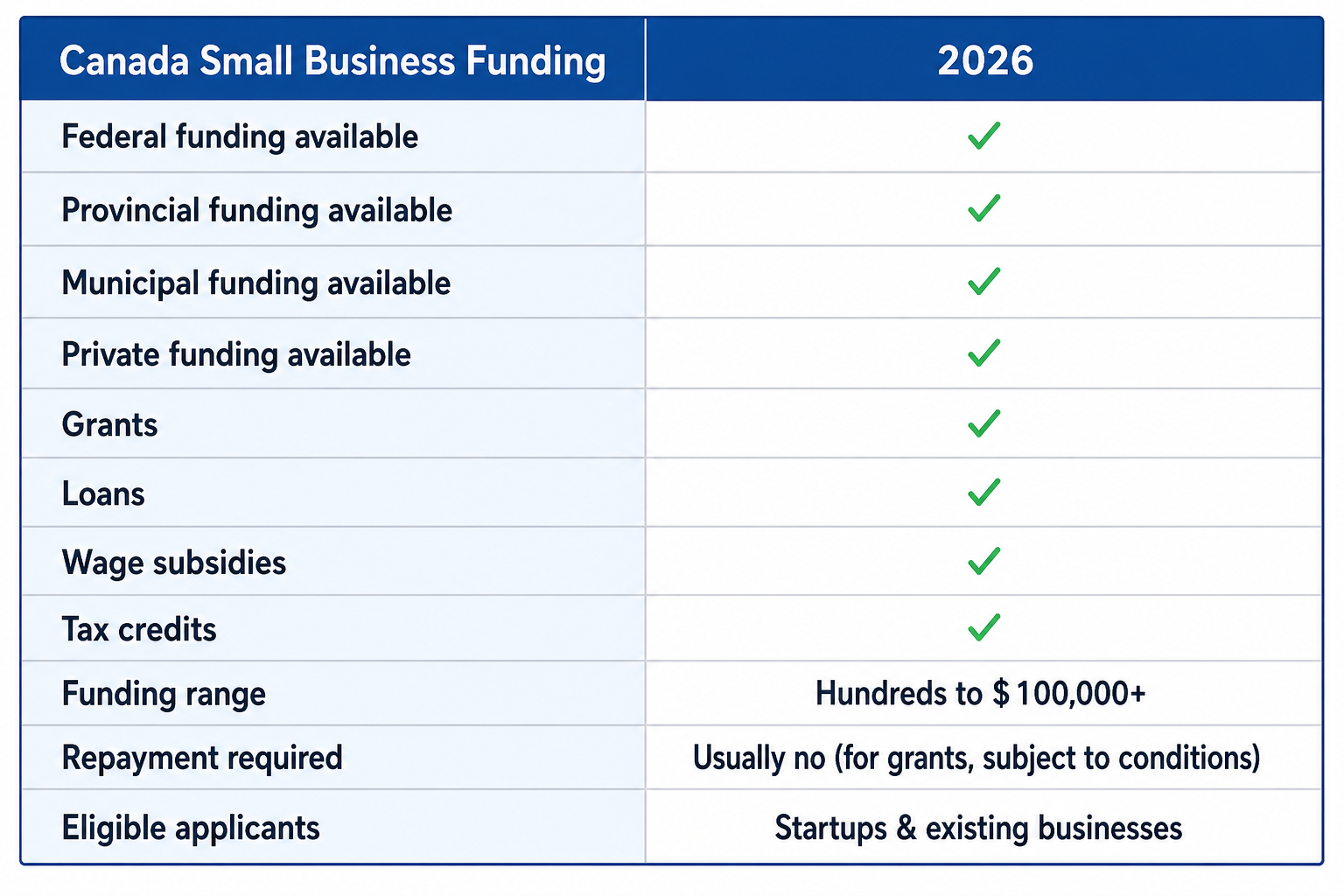
In 2026, over 1,000 different grants and funding options are available for small business owners to take on, with potential of $100,000+ in non-repayable grants.
By the end of this guide, you’ll understand how Canadian business grants work, who qualifies, what expenses can be funded, how to identify the right programs for your business, and the practical steps you can take to improve your chances of securing funding.
What Are Business Grants?
Small business grants are one of the most popular types of funding available to Canadian entrepreneurs, mainly because, unlike traditional loans from banks, grants often don’t require repayment if conditions are met.
These busienss grants are created with growth and potential in mind, allowing your small business to launch, grow, hire staff, purchase tools and equipment, access new technologies, and succeed by enabling you extra coverage of expenses.
Before you apply for business grants, it is important to understand how grants work, who provides the funding, the obligations with receiving the funds..etc
What are small business grants?
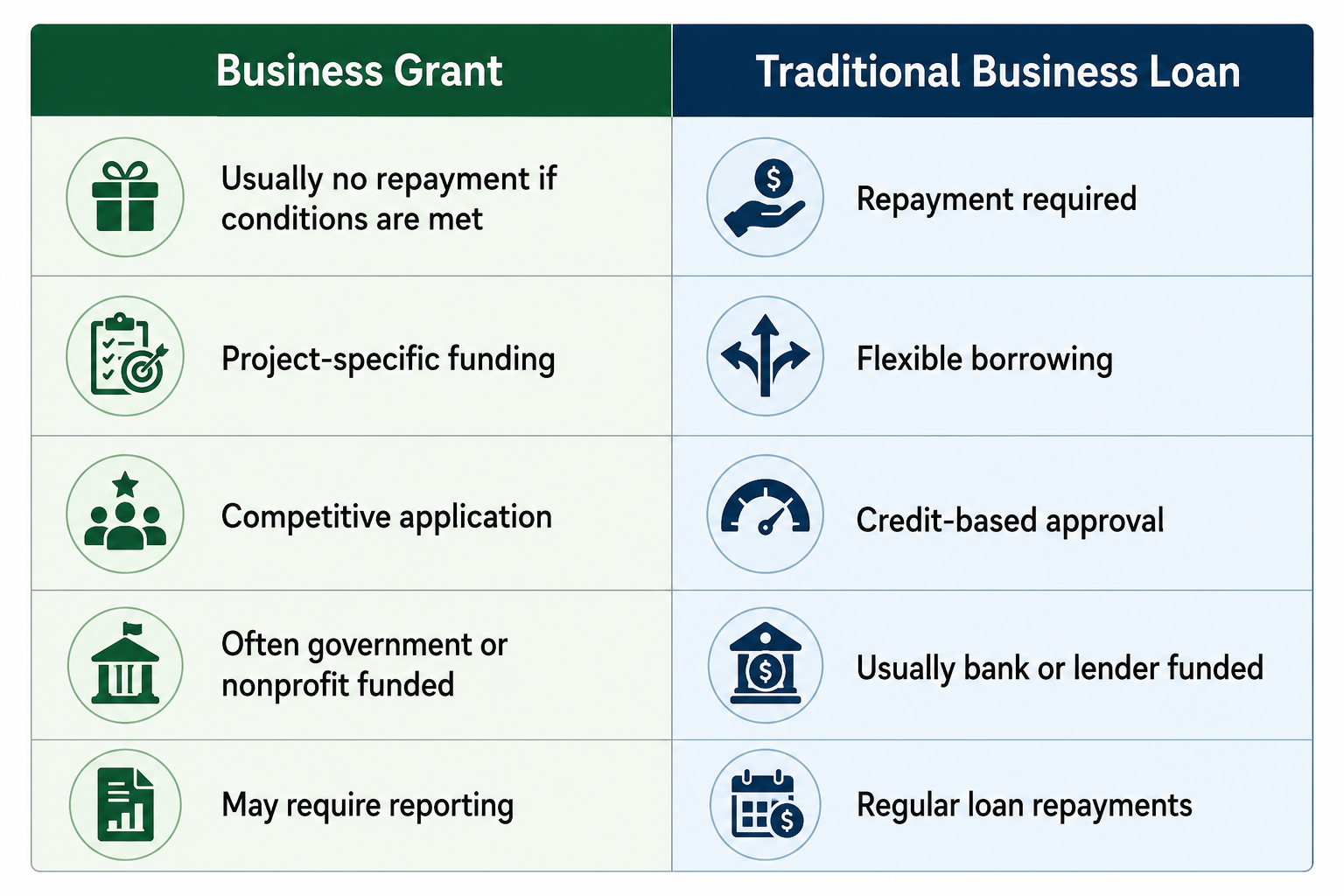
For many entrepreneurs, business grants are among the most attractive forms of funding because, unlike traditional loans, they generally do not require repayment when program conditions are met.
Small business grants are a form of financial assistance provided to entrepreneurs, often not requiring repayment, assuming the recipient meets the program’s terms and conditions. Unlike a traditional loan, a business grant is designed to help businesses start, grow, innovate, hire employees, expand into new markets, or complete specific projects without creating debt.
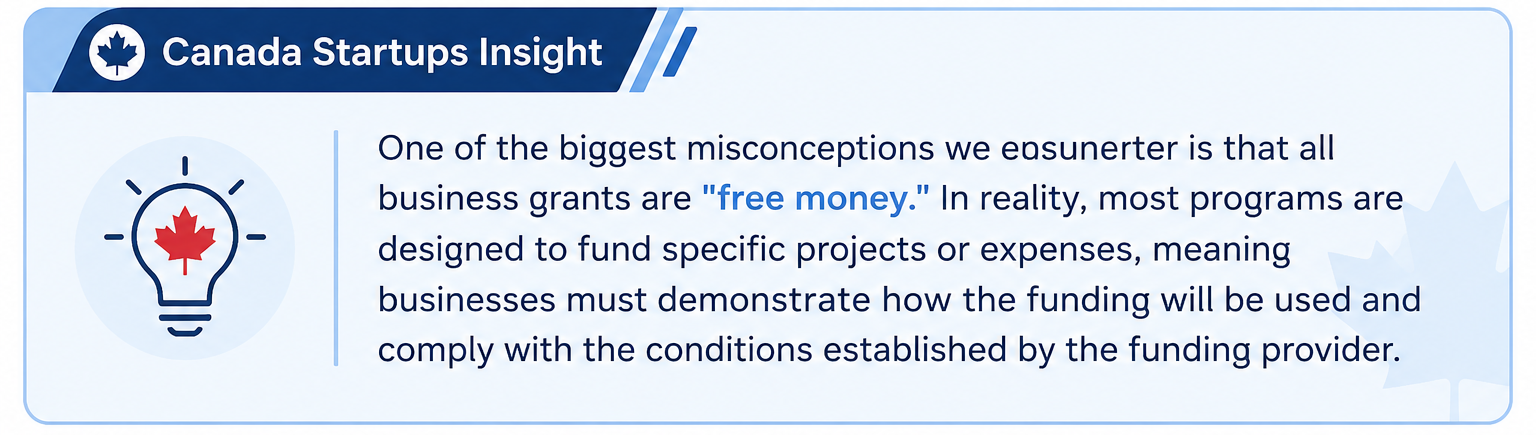
Canada Startups Funding Insight
Business grants are offered by a wide range of organizations, including federal, provincial, and local governments, economic development agencies, industry associations, non-profit organizations, and private corporations. Each funding provider establishes its own eligibility requirements, funding priorities, application process, and evaluation criteria. It’s important to be familiar with the purpose and criteria of each funding agency before you apply.
Grant funding can be used towards covering many business expenses; however, eligibility for what can be covered will depend on the specific grant program.
Common eligible costs include:
- equipment purchases
- technology upgrades
- product development
- research and innovation
- employee hiring and training
- marketing
- export activities
- sustainability initiatives
- and business expansion.
Most grants are intended to support activities that contribute to economic growth, job creation, innovation, or community development. By supporting these activities, funding agencies aim to stimulate economic growth, create employment opportunities, encourage innovation, and strengthen Canada’s long-term competitiveness.
Although grants can provide valuable non-repayable funding, they are highly competitive. Most programs receive far more applications than they can fund, meaning only businesses that closely match the program’s objectives, meet all eligibility requirements, and submit a strong application are likely to receive funding. Preparing thoroughly and applying to programs that align with your business significantly improves your chances of success.
Canada Startups Funding Insight
Based on Canada Startups’ ongoing review of Canadian funding programs, the majority of grant opportunities are designed around specific business objectives rather than providing unrestricted operating cash.
The most common funding categories include:
- Hiring and wage support
- Equipment purchases
- Technology adoption
- Research and innovation
- Business expansion
- Skills and training
Businesses whose projects align with one or more of these objectives typically have access to a broader range of funding opportunities than businesses seeking unrestricted operating capital.
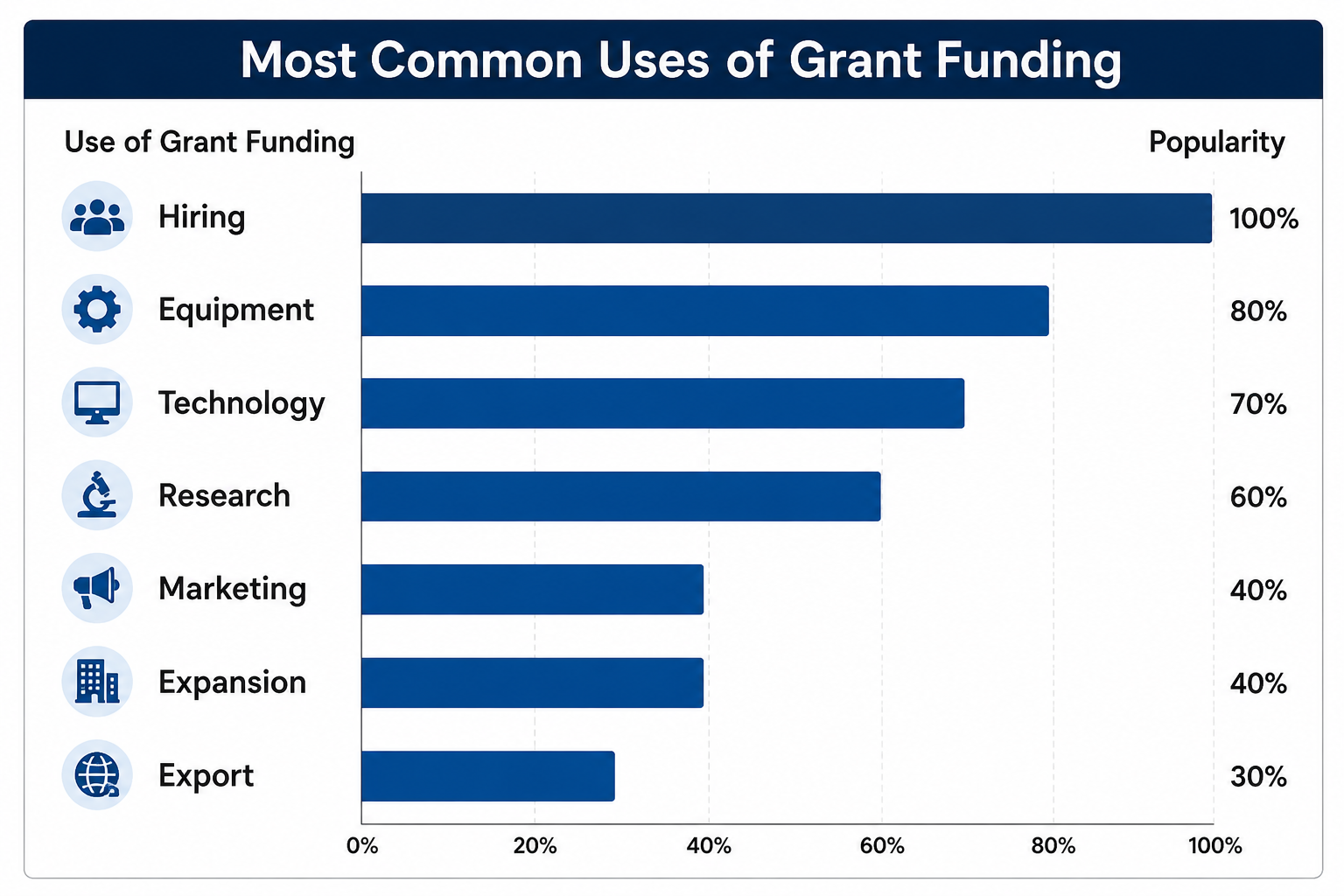
Hiring and equipment funding often tops the charts for what grants are often used for.
How do business grants work?
Although every funding agency has its own application process and evaluation criteria, most Canadian business grant programs follow a similar six-step process. Understanding each stage before you apply can help you prepare stronger applications, avoid common mistakes, and improve your chances of success.
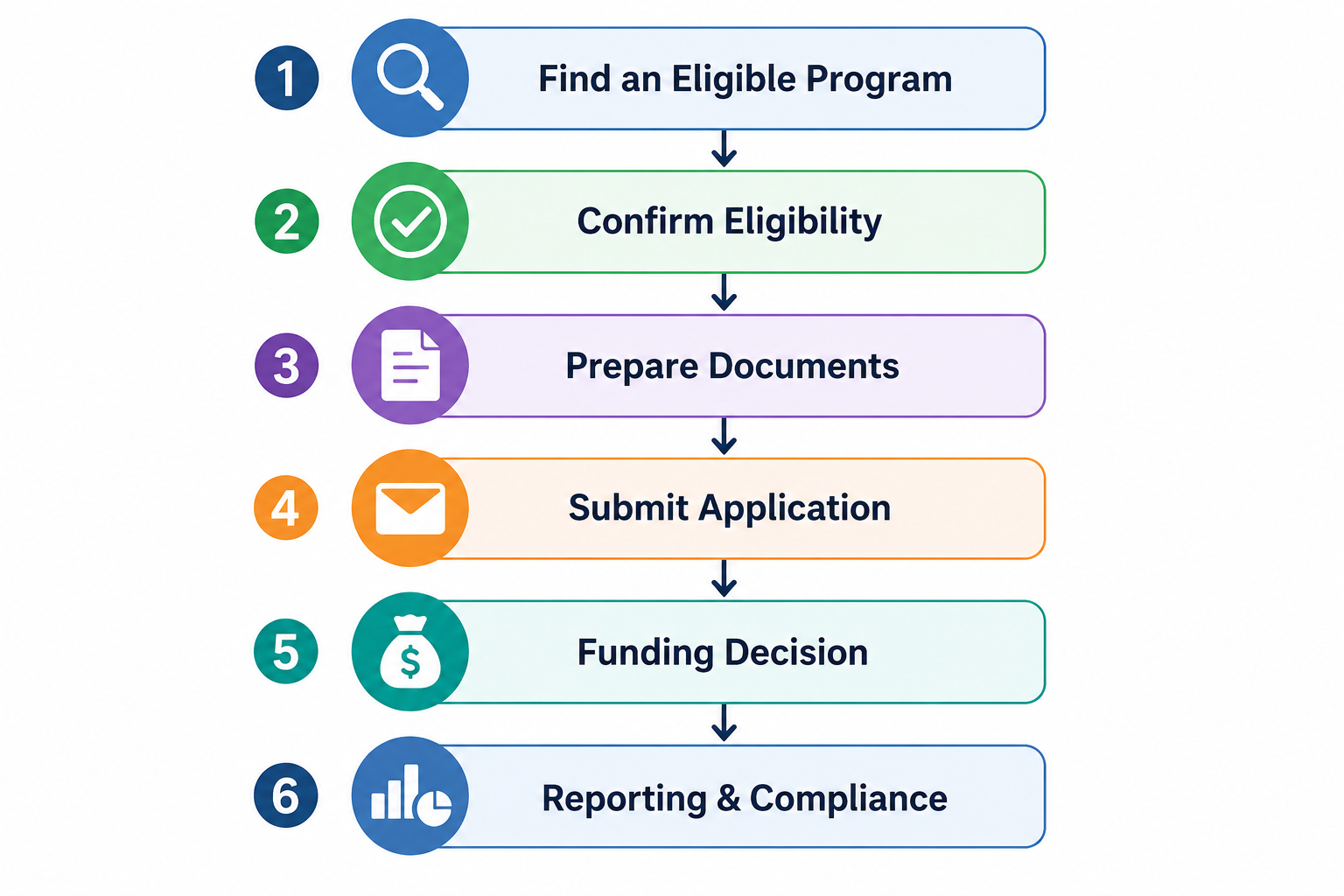
A structured process when applying to business grants.
Canada Startups Resource
Looking for Matching Funding Programs?
Finding funding is often the most time-consuming part of the process. Rather than searching individual government websites one at a time, many businesses use funding databases and expert funding searches to identify opportunities that match their industry, province, business stage and project.
Resources
Step 1: Find an Eligible Program
The first step is identifying a grant that matches your business, industry, location, and project. As there are thousands of grants and funding programs, finding one that matches your top criteria is important. Remember, every funding program has specific objectives, so it’s important to focus on grants that align with your business’s needs rather than applying for every opportunity available.
Applying to a smaller number of highly relevant funding programs is often more effective than submitting applications to dozens of programs that do not closely match your business.
Step 2: Confirm Eligibility
Before investing time in an application, carefully review the eligibility criteria. Our internal Canada Startups Insight shows that nearly 50% of applications are often denied for this reason. Funding providers may require businesses to meet conditions such as operating within a specific province, industry, business size, years in operation, revenue level, or project type. While there may be many more requirements, the key ones are often most crucial.
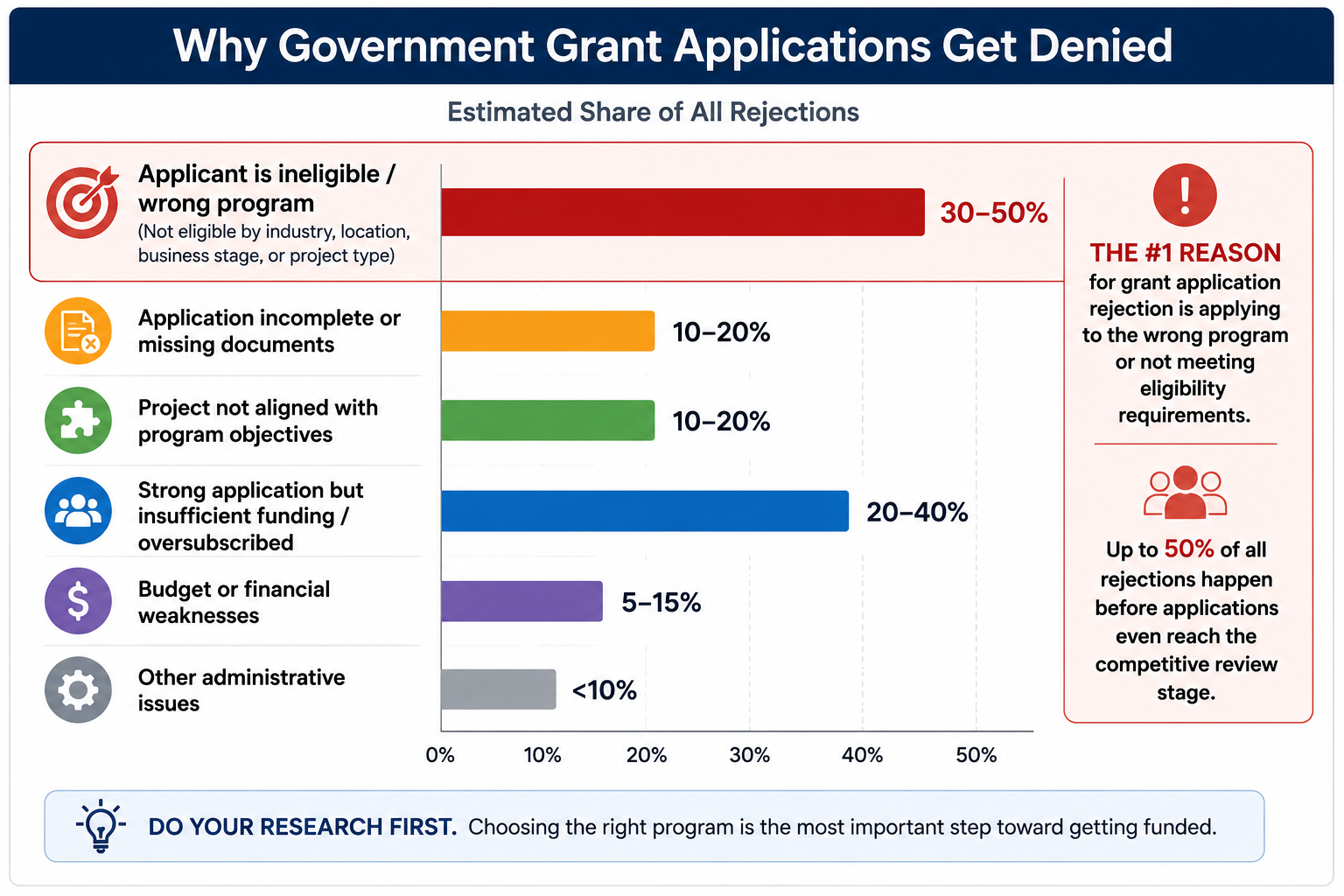
Applying to the wrong program is often seen the #1 reason for a grant application being denied.
Step 3: Prepare Your Documents
Most grant applications require supporting documentation. This may include:
- your business plan
- financial statements
- pitchdeck presentation
- and some may dig deeper and ask to see your projected budget, funding proposal, incorporation documents, quotes for planned purchases, or other information demonstrating how the funding will be used.
Canada Startups Resource
Prepare Your Funding Documents
Many funding applications require supporting documentation before they can be evaluated. If you haven’t yet prepared your business plan, financial projections or pitch deck, having these documents ready before applying can make the funding process significantly more efficient.
Helpful resources:
Step 4: Submit the Application
Complete the application accurately and submit it before the deadline. Many funding agencies evaluate applications based on how well the proposed project aligns with the program’s objectives, the quality of the information provided, and the potential impact of the project.
Before submitting, review the application carefully to ensure all required documents have been included and every question has been answered completely.
Step 5: Funding Decision
After the review process, applicants are notified whether their application has been approved, declined, or placed on a waiting list. If approved, the funding provider typically issues a funding agreement outlining the amount awarded, eligible expenses, payment schedule, and any conditions that must be met. It is important to note that not every application will be a success, and many agencies receive far more applications than funds are available, so denials may be frequent as well.
It can take an average of 6-8 weeks to hear back from an agency once a submission has occurred, based on Canada Startups’ tracking of submitted applications.
Step 6: Reporting Requirements
Receiving a grant is usually not the final step.
Most funding programs require recipients to provide progress updates, financial records, invoices, receipts, or final reports showing how the funding was used. Meeting these obligations helps ensure compliance with the funding agreement and maintains eligibility for future funding opportunities.
Businesses that comply with reporting requirements are generally in a stronger position when applying for future funding opportunities offered by the same organization.
Common Mistakes Businesses Make When Applying for Grants
Even well-qualified businesses can be unsuccessful when applying for funding if they overlook key requirements or apply to programs that are not a good fit. Understanding the most common mistakes can help you prepare stronger applications, avoid unnecessary rejections, and improve your chances of securing funding.
❌ Applying Before Checking Eligibility
One of the most common reasons grant applications are unsuccessful is that the applicant does not meet the program’s eligibility requirements. Before investing time in an application, confirm that your business meets the funding provider’s criteria, including industry, location, business stage, years in operation, revenue requirements and eligible project activities.
❌ Submitting Incomplete Applications
Funding providers often require supporting documentation such as business plans, financial projections, project budgets, incorporation documents or supplier quotes. Missing documents can delay the review process or result in the application being declined before it is fully evaluated.
❌ Missing the Application Deadline
Most funding providers have strict application deadlines and do not accept late submissions. Waiting until the final day to prepare your application increases the risk of technical issues, missing documents or incomplete information. Whenever possible, prepare your application well before the closing date.
❌ Applying to the Wrong Funding Programs
Not every grant is suitable for every business. Applying for programs that do not closely match your industry, business stage or proposed project significantly reduces your chances of approval. A smaller number of well-targeted applications is generally more effective than submitting applications to every funding opportunity available.
❌ Not Reading the Program Guidelines
Every funding program has its own objectives, eligible expenses, funding limits and reporting requirements. Failing to read the program guidelines carefully can result in businesses requesting funding for ineligible expenses or overlooking important application requirements.
❌ Forgetting Required Quotes or Supporting Evidence
Many funding programs require supplier quotes, cost estimates or other documentation to justify the requested funding. Submitting an application without the required supporting evidence may delay the review process or make the application incomplete.
❌ Waiting Until the Last Minute
Many entrepreneurs begin preparing their application only days before the deadline. This often leads to rushed applications, overlooked requirements and avoidable mistakes. Starting early provides time to prepare supporting documents, review the application thoroughly and make corrections before submission.
Frequently Asked Questions About Grant Applications
Applying for business grants often raises many questions, particularly for first-time applicants. Below are answers to some of the most frequently asked questions about the grant application process to help you better understand what to expect and how to prepare.
How long does a grant application take?
The time required to complete a business grant application depends on the complexity of the funding program and how prepared your business is before you begin. A simple online application may take as little as 5–10 minutes, while more detailed applications requiring supporting documents can take several hours or even several days to complete.
Businesses that already have key documents prepared, such as a business plan, financial projections, incorporation documents and project budget, can usually complete applications much more quickly. If these documents still need to be created, preparing them may take anywhere from a few days to several weeks, depending on the level of detail required.
After the application has been submitted, the review process varies by funding provider. Some organizations communicate funding decisions within a few weeks, while others may take several months depending on the complexity of the program and the volume of applications received.
Can I apply for more than one grant?
Yes. In many cases, businesses can apply for more than one grant at the same time because funding programs are often administered independently by different government departments, agencies, nonprofit organizations or private funders. Applying to multiple programs can increase your overall funding opportunities, provided your business meets the eligibility requirements for each program.
However, it is important to review the terms and conditions of every funding program before applying. Some grants include stacking limits, which restrict the total amount of government funding a business can receive for the same project or expense. Others may prohibit combining their funding with certain programs or require applicants to disclose any other funding they have received or applied for.
Before submitting multiple applications, always review the program guidelines to confirm whether funding can be combined and whether any restrictions apply.
What documents do I need?
The documents required for a business grant application will vary depending on the funding provider and the type of funding being requested. While some programs require only a short online application, others may request detailed business and financial information to evaluate your project.
Commonly requested documents include:
- A business plan
- Financial statements or financial projections
- A project budget
- A funding proposal or project summary
- Business registration or incorporation documents
- Quotes or estimates for planned purchases
- Tax information (where applicable)
- Proof of business ownership
- Resumes or biographies of key team members
- Supporting documents relevant to the project, such as permits, contracts or partnership agreements
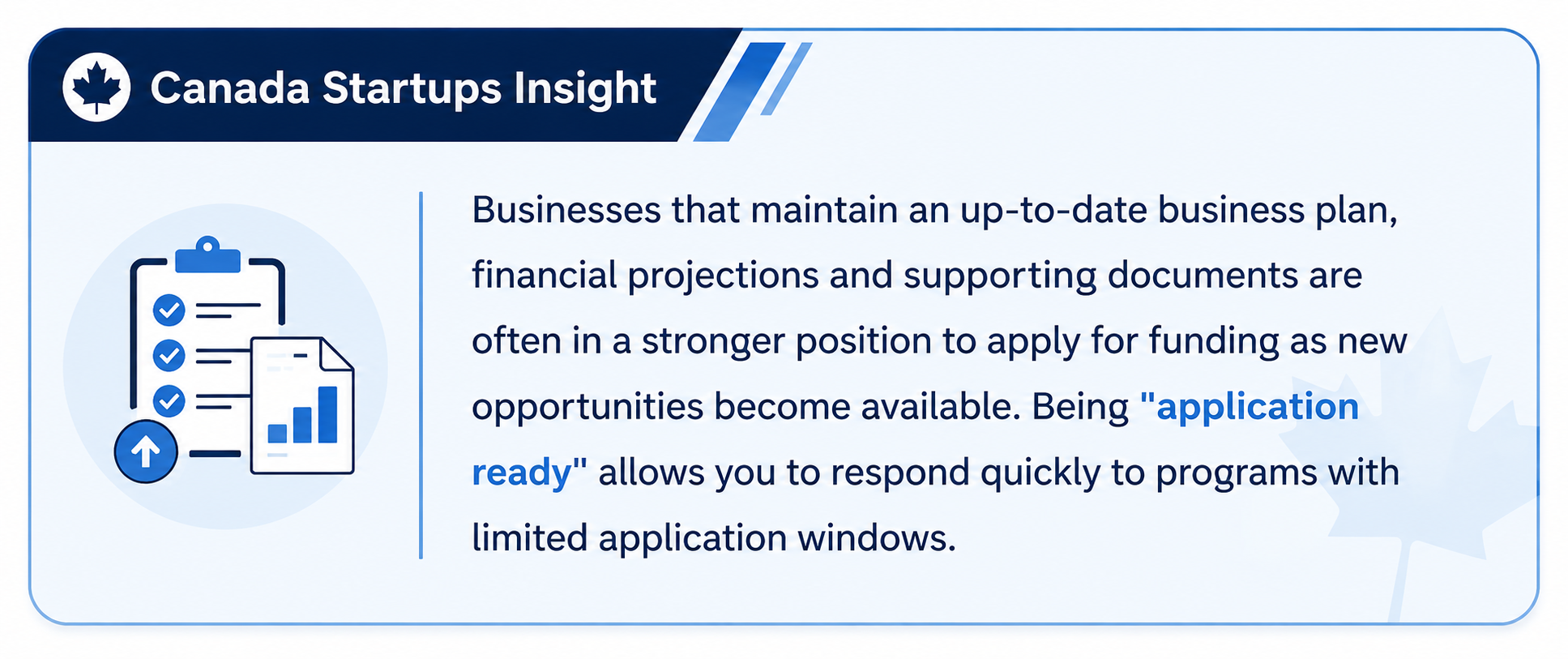
Your business plan, financials and a pitch deck are often the top 3 requirements for funding!
Preparing these documents in advance can significantly reduce the time required to complete applications and help ensure that your submission is complete. Many funding agencies will not review incomplete applications or those missing required supporting documentation.
Can I apply before incorporating?
Yes. In many cases, you can begin researching and even applying for business grants before your business is officially incorporated or registered. Some funding programs are designed to support entrepreneurs who are still in the planning or startup stage.
However, many grant providers require your business to be legally registered before funding can be approved or released. While an application may be accepted during the planning phase, the funding agency may ask you to provide proof of registration or incorporation before entering into a funding agreement or issuing any payment.
If you’re still developing your business idea, it’s often beneficial to begin identifying suitable funding opportunities early. This allows you to understand the eligibility requirements, prepare the necessary documentation, and complete your business registration in time to satisfy the program’s conditions.
What happens if I’m rejected?
A rejected application does not mean your business is ineligible for funding. Every funding program has its own objectives, eligibility requirements and evaluation criteria, so being declined by one funding provider does not prevent you from qualifying for others.
There are thousands of funding opportunities available across Canada, including grants, government loans, tax credits, wage subsidies and private funding programs. Many businesses are unsuccessful with one application but later secure funding through a different program that better matches their industry, business stage or project.
If your application is rejected, review the reason for the decision if it has been provided. This can help you identify whether your business was ineligible, whether additional supporting information was needed or whether the proposed project simply did not align closely enough with the program’s objectives.
Rather than viewing a rejection as the end of your funding journey, use it as an opportunity to strengthen your application, update your business documents and continue searching for other suitable funding opportunities. New funding programs open throughout the year, and your business may become eligible for additional options as it grows or as your project evolves.
Persistence with funding application is key to getting grant funding!
Can I edit my application?
It depends on the funding provider and the stage of the application process. Some funding agencies allow applicants to update or correct information before the application deadline, while others do not permit any changes once an application has been submitted.
If you discover an error or need to provide additional information after submitting your application, contact the funding agency as soon as possible. Some providers may allow minor corrections or request additional documentation during the review process, particularly if clarification is needed before making a funding decision.
To avoid delays or potential rejection, review your application carefully before submitting it. Confirm that all required documents have been included, every question has been answered accurately, and the information provided is complete and consistent.
Do I need a business plan?
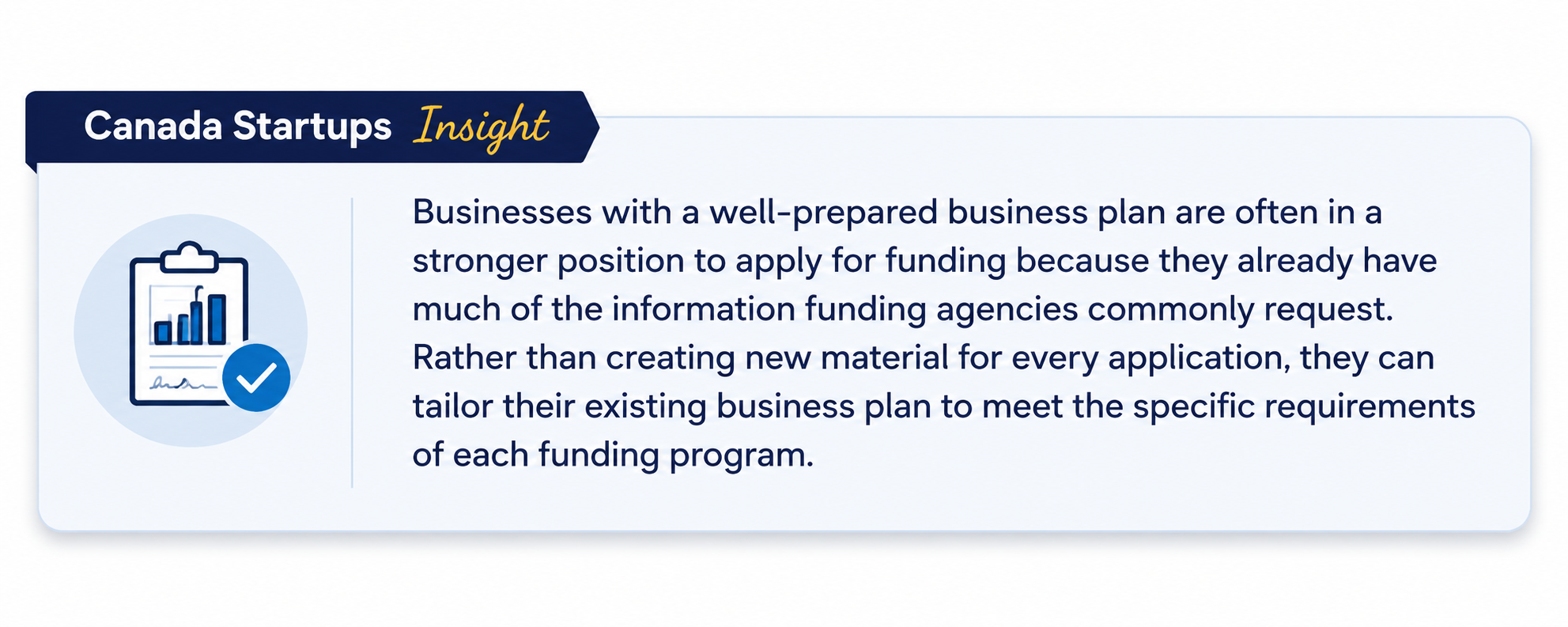
It’s always recommended to have a solid business plan before you apply for any funding!
It depends on the funding program. Some grant applications require only basic business information, while others ask applicants to submit a detailed business plan as part of the evaluation process.
A business plan helps funding providers understand your business, your goals, how the funding will be used, and the expected outcomes of the project. Even when a business plan is not specifically required, having one prepared can strengthen your application by demonstrating that you have a clear strategy and a well-planned approach to achieving your objectives.
Many funding agencies also request information that is typically found in a business plan, such as your business model, market analysis, financial projections, growth strategy and project budget. Having these details prepared in advance can make the application process faster and easier.
Can I apply online?
Yes. Most business grant applications in Canada can be completed online through the funding provider’s website or application portal. Many government departments, funding agencies, nonprofit organizations and private funders now use digital application systems that allow businesses to submit applications, upload supporting documents and track the status of their submission electronically.
However, the application process varies between funding providers. Some programs use a simple online form, while others require applicants to create an account, complete multiple sections, upload supporting documentation or participate in follow-up interviews or presentations before a funding decision is made.
Before starting an online application, take time to review the program guidelines and prepare all required documents. Having your business plan, financial information, project budget and supporting documents ready can help you complete the application more efficiently and reduce the likelihood of missing important information.
What if I miss the deadline?
If you miss a grant application deadline, you will generally have to wait until the funding program opens again, if it is offered on a recurring basis. Most funding providers do not accept late applications, regardless of the reason, and applications submitted after the deadline are typically not considered.
Fortunately, missing one deadline does not mean you’ve missed all funding opportunities. There are thousands of funding programs available across Canada, and new grants, loans, tax credits, wage subsidies and private funding opportunities open throughout the year. Depending on your business and project, there may be alternative programs with similar objectives and different application periods.
If a grant is particularly important to your business, monitor the funding provider for future application rounds and use the additional time to strengthen your application, prepare your supporting documents and ensure you are ready to apply when the program reopens.
Can someone apply on my behalf?
Yes. In many cases, a consultant, funding advisor, accountant or other authorized representative can assist with preparing and submitting a grant application on behalf of your business. However, the business owner remains responsible for ensuring that all information provided is accurate, complete and truthful.
Some funding providers require the business owner or an authorized signing officer to approve the application, sign funding agreements or communicate directly with the agency during the review process. Other programs may allow a representative to manage most of the application process with the applicant’s written authorization.
If you choose to have someone apply on your behalf, ensure they understand your business, your project and the funding program’s requirements. You should also review the completed application before it is submitted to confirm that all information accurately represents your business and the proposed use of the funding.
Need Help Applying?
Preparing a grant application can be time-consuming, particularly when funding programs require business plans, financial projections, project budgets or supporting documentation.
If you’d like assistance identifying funding opportunities or preparing stronger applications, the team at Canada Startups provides tools and resources designed to help Canadian entrepreneurs throughout the funding process, including:
- Business Plan Builder
- Financial Projection Tool
- Funding Search Tool
- Expert Review & Guidance
- Pitch Deck Builder
- Funding Application Support
**Learn more about the **Canada Startups Platform
Where does grant money come from?
Most entrepreneurs assume that all business grants come from the federal government. In reality, funding is available from a wide variety of organizations across Canada, each with its own objectives, eligibility requirements and funding priorities.
Business grant funding may be provided by federal, provincial, territorial and local governments, government-supported organizations, nonprofit agencies, industry associations and private corporations. Some programs focus on encouraging innovation and job creation, while others support exports, sustainability, technology adoption, workforce development or regional economic growth.
Understanding who provides funding is just as important as understanding the funding itself. Different organizations support different types of businesses, industries and projects, meaning a business that is not eligible for one grant may qualify for several others offered by different funding providers.
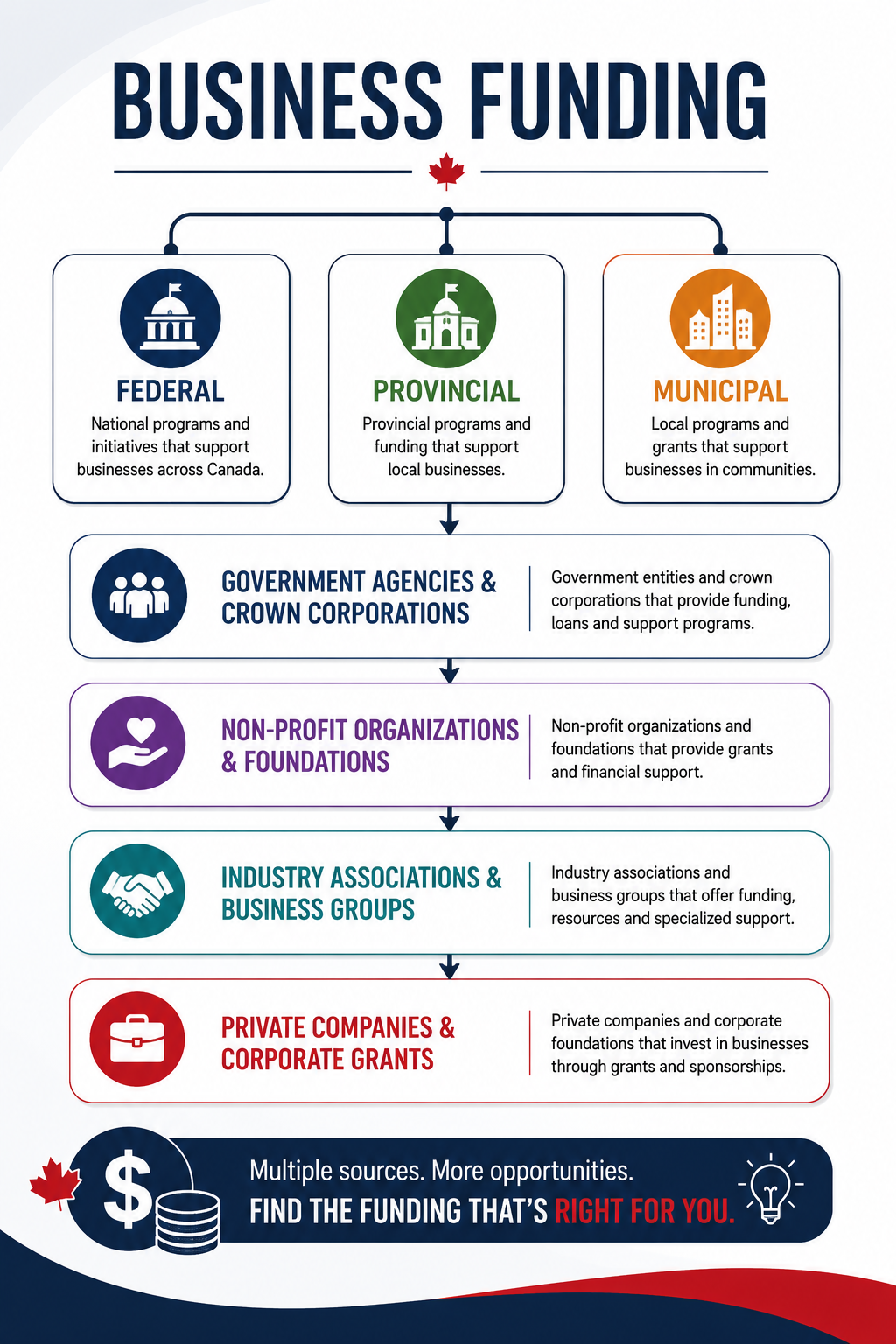
Accessing funding from multiple sources increases your chances of funding success.
Federal Government Funding
The Government of Canada invests billions of dollars each year into programs that support economic growth, innovation and business development. Federal funding programs often focus on projects that create jobs, improve productivity, encourage research and development, expand exports, strengthen Canada’s global competitiveness or accelerate the adoption of new technologies.
Federal grants are typically available across multiple provinces and industries, although many programs are designed for businesses operating within specific sectors or pursuing projects that align with national priorities. Depending on the program, funding may support hiring employees, purchasing equipment, developing new products, adopting digital technologies, conducting research or expanding into international markets.
Because federal funding programs are often well known, they can also be among the most competitive, making it important to carefully review eligibility requirements before applying.
Provincial Government Funding
Every province and territory operates its own business funding programs designed to address regional economic priorities. While many provincial grants support objectives similar to federal programs, they are often tailored to the industries and economic strengths of each region.
For example, one province may place greater emphasis on manufacturing and advanced technology, while another focuses on agriculture, tourism, clean energy or natural resources. Provincial funding may also support workforce development, innovation, business expansion, export growth and local economic development.
Because these programs are developed at the provincial level, eligibility requirements, funding amounts and application processes vary considerably. Businesses should always research opportunities available within the province where they operate or intend to establish their business.
Municipal Government Funding
Many entrepreneurs overlook municipal funding opportunities, yet cities and local economic development offices often provide grants designed to encourage business growth within their communities.
Municipal funding programs may support downtown revitalization, commercial property improvements, tourism initiatives, community development projects, environmental improvements, and local business expansion. While municipal grants are often smaller than federal or provincial programs, they can provide valuable financial assistance for businesses undertaking projects that benefit the local economy.
Eligibility requirements are usually based on the municipality where the business operates, meaning businesses should explore funding opportunities available through their local government or economic development office.
Government-Supported Agencies
In addition to traditional government departments, many funding programs are delivered through government-supported agencies, regional development organizations and innovation centres.
Many government-supported agencies administer funding programs on behalf of governments while also providing business advisory services, commercialization support, mentoring and industry expertise. They may also provide mentorship, business advisory services, commercialization support and networking opportunities alongside financial assistance.
Working with these organizations can provide businesses with access to specialized funding opportunities that may not be widely advertised through general government websites.
Private Organizations
Private corporations, charitable foundations, nonprofit organizations, industry associations and other independent organizations also invest millions of dollars each year into supporting Canadian businesses through grants, competitions, business awards and specialized funding programs.
Many private companies offer funding to encourage innovation, entrepreneurship, supplier diversity, sustainability and industry development. Others provide grants through corporate social responsibility initiatives, community investment programs or strategic partnerships that support businesses aligned with their values or business objectives.
Unlike many government programs, private funding opportunities are often designed around specific industries, innovation challenges or corporate initiatives rather than broad economic policy objectives.
Similarly, nonprofit organizations and charitable foundations frequently provide funding to businesses, social enterprises and entrepreneurs whose projects contribute to community development, workforce training, environmental sustainability, education, health, arts and culture, Indigenous economic development, women-owned businesses, youth entrepreneurship and other mission-driven initiatives.
Industry associations may also provide grants, scholarships, innovation funding, research support or business development programs specifically for businesses operating within their sector.
Because many entrepreneurs focus exclusively on government funding, these private, nonprofit and foundation funding opportunities are often overlooked despite offering valuable financial support across a wide range of industries, communities and business stages. Expanding your funding search beyond government programs can significantly increase the number of opportunities available to your business.
Which Funding Source Is Best?
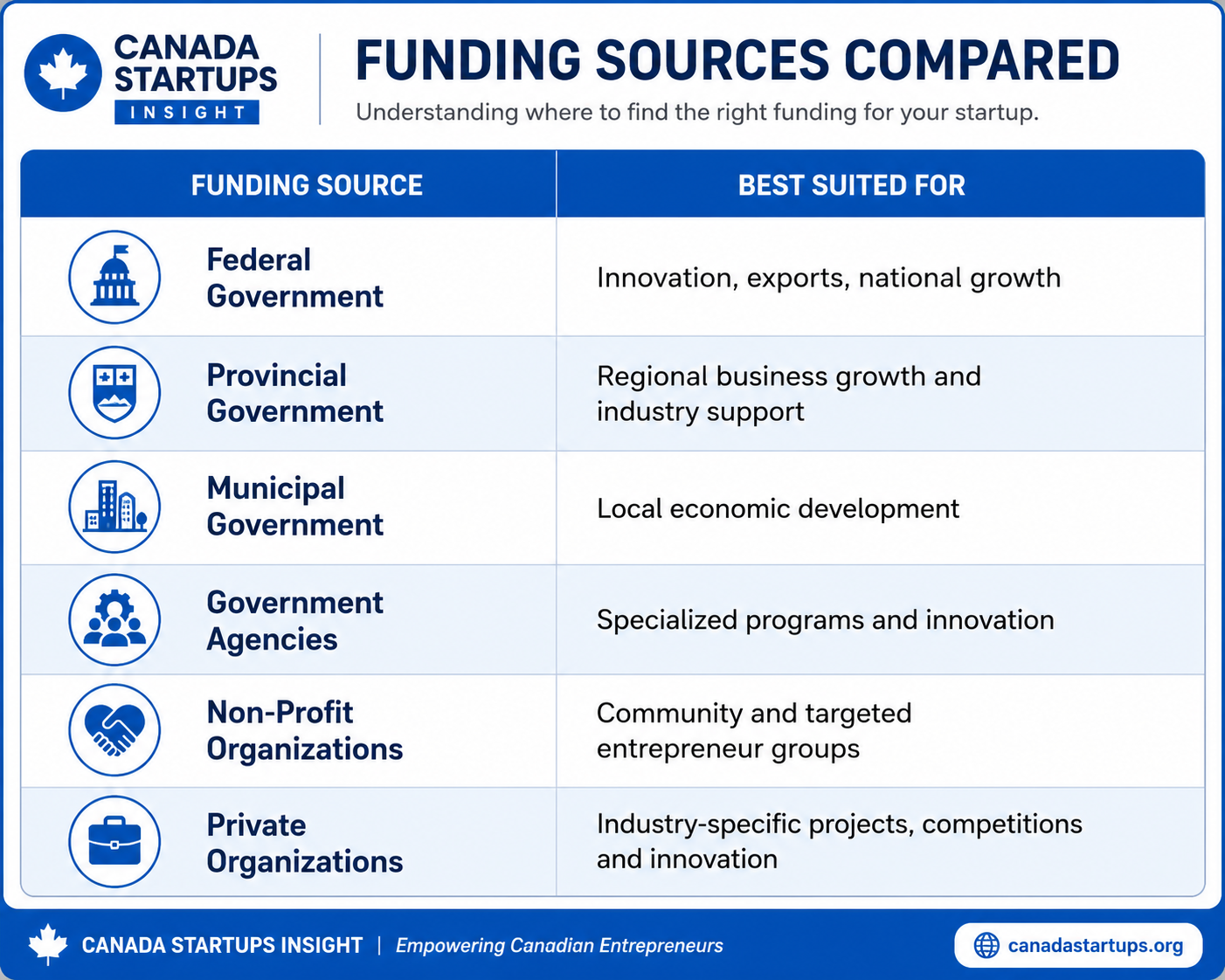
Which form of funding is best for your business?
There is no single funding source that is best for every business. The most suitable funding opportunity depends on your business stage, industry, location, and the purpose of the project you are seeking funding for.
Federal programs may offer larger funding amounts for projects with national significance, while provincial and municipal programs often focus on supporting regional economic development. Nonprofit organizations and private corporations may provide highly specialized funding opportunities that align closely with particular industries, communities or business objectives.
Rather than limiting your search to one source, consider exploring opportunities across multiple funding providers. A broader funding strategy can significantly increase the number of programs available to your business and improve your overall chances of securing financial support.
Common Mistakes When Searching for Funding
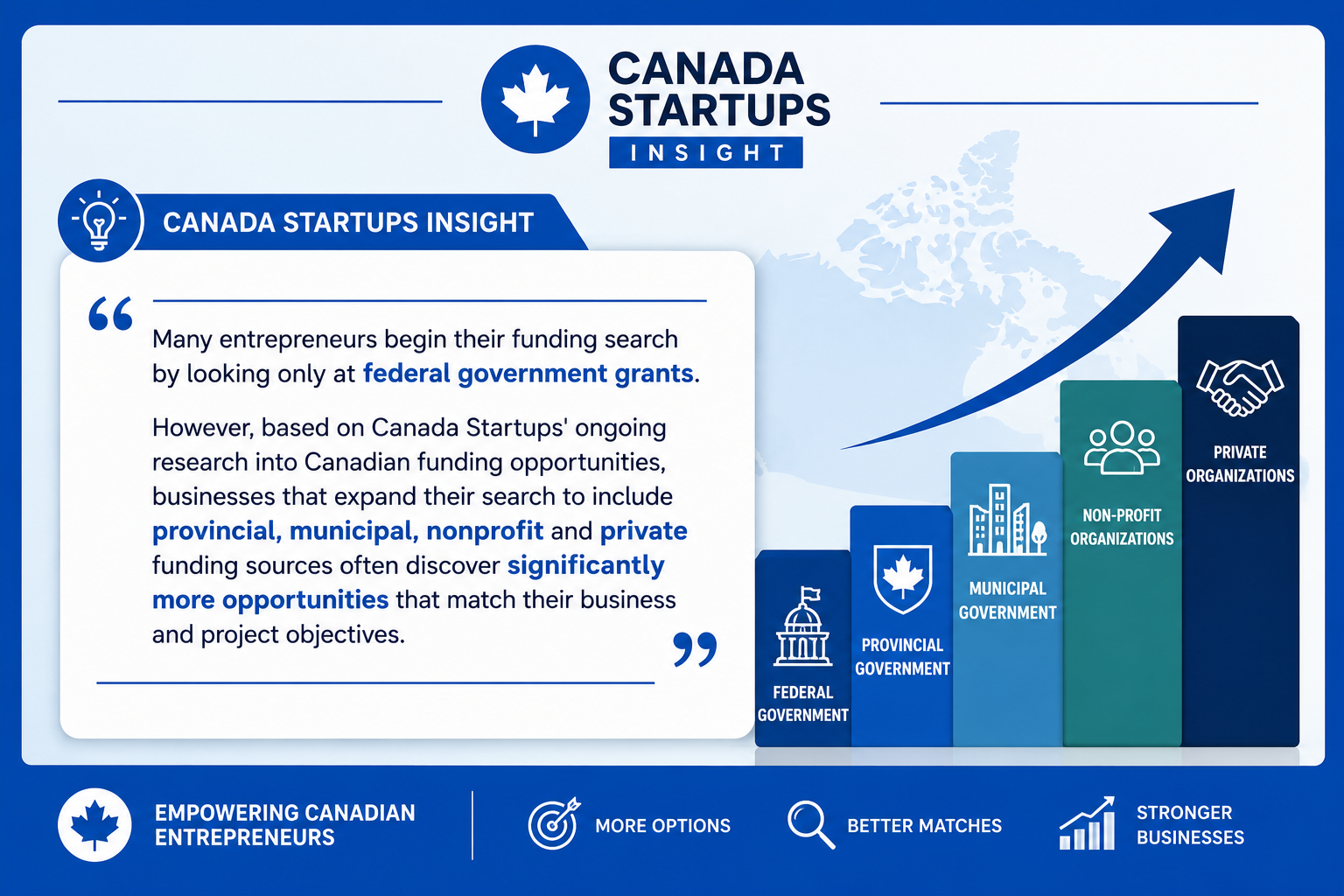
Most people make the mistake by limiting their capabilities and potential with funding.
Finding funding isn’t just about identifying grants, it’s about identifying the right funding opportunities. Many entrepreneurs limit their options or reduce their chances of success by making avoidable mistakes during the funding search process. Understanding these common mistakes can help you build a broader and more effective funding strategy.
Only Searching Federal Government Grants
Many entrepreneurs begin and end their funding search with federal government programs. While federal funding is important, it represents only one part of Canada’s funding landscape. Provincial, municipal, nonprofit and private funding providers also offer thousands of funding opportunities each year, many of which receive fewer applications than nationally recognized federal programs.
Overlooking Municipal Funding Opportunities
Municipal governments and local economic development organizations frequently offer grants and incentive programs designed to support businesses within their communities. Because these programs receive less publicity than federal or provincial initiatives, they are often overlooked despite providing valuable funding for local businesses.
Ignoring Private, Non-Profit and Foundation Funding
Many businesses assume that only governments provide grants. In reality, private corporations, charitable foundations, nonprofit organizations and industry associations also invest millions of dollars each year into supporting entrepreneurship, innovation and community economic development. Expanding your funding search beyond government programs can significantly increase the number of funding opportunities available.
Applying to Only One Funding Program
Submitting a single grant application and waiting for a decision is rarely the most effective funding strategy. Because every funding provider has different objectives and eligibility requirements, businesses often improve their chances of securing funding by applying to multiple programs that align with their project, while respecting any applicable funding or stacking rules.
Not Researching Industry-Specific Funding
Many industries have specialized funding programs that are not available to the general business community. Manufacturing, agriculture, technology, tourism, healthcare, construction and many other sectors often have dedicated funding opportunities designed specifically for businesses operating within those industries. Limiting your search to general business grants may cause you to overlook programs that are a much stronger match for your business.
Focusing Only on Grants
Although grants are highly attractive because they generally do not require repayment when conditions are met, they are only one form of business funding. Government loans, wage subsidies, tax credits, innovation funding and private investment programs may provide additional financial support depending on your business and project. Considering all available funding options often leads to a stronger overall funding strategy.
Frequently Asked Quesitons When Searching for Funding
Searching for business funding often raises questions, particularly when funding is available from so many different sources. Below are answers to some of the most frequently asked questions about where business funding comes from and how to identify the opportunities that may be right for your business.
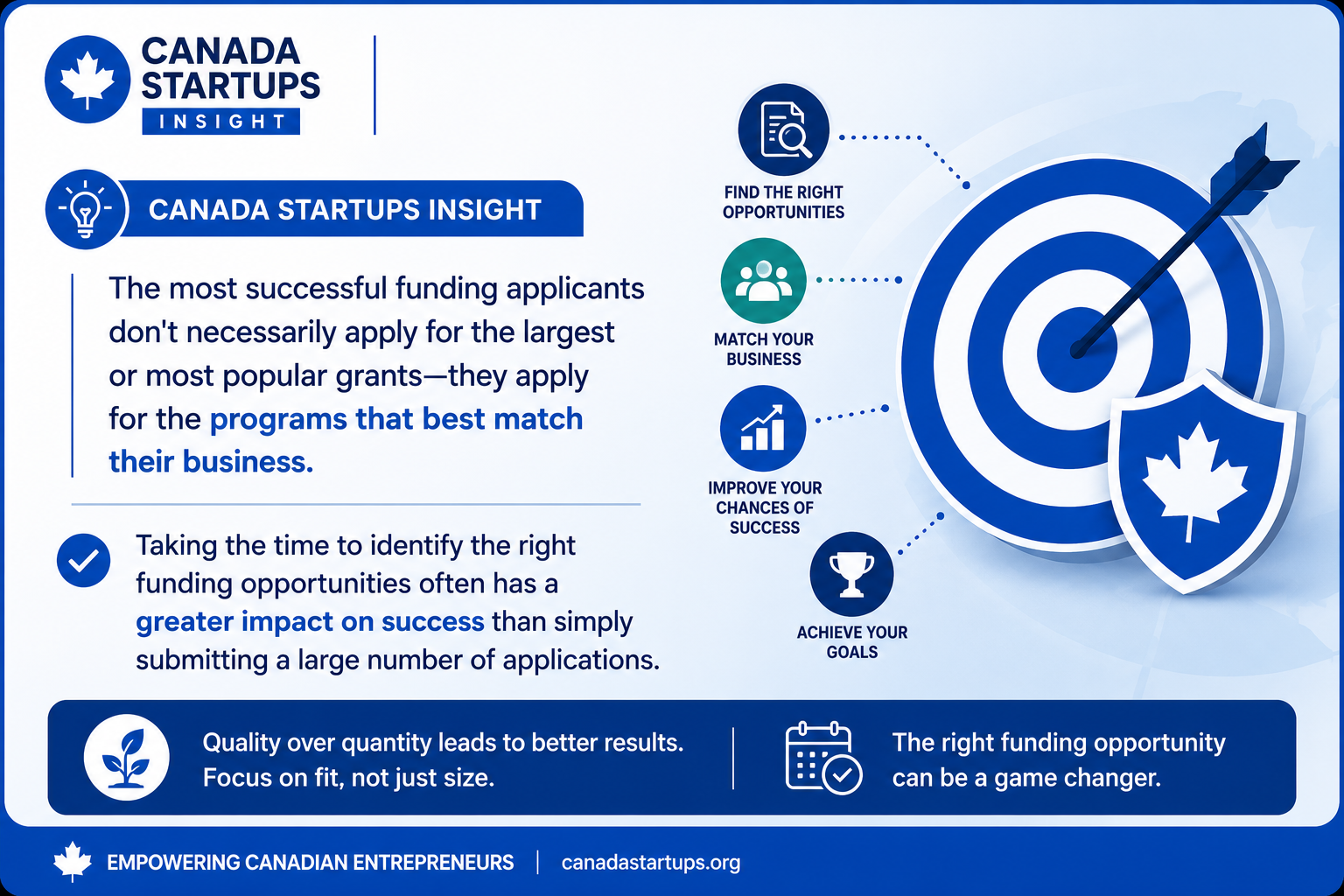
It’s important to take your time with funding.
Do all grants come from the government?
No. While federal, provincial and municipal governments provide many business grant programs, they are not the only source of funding available to Canadian entrepreneurs. Business grants are also offered by government-supported agencies, nonprofit organizations, charitable foundations, industry associations and private corporations.
Each funding provider has its own objectives and eligibility requirements. Some programs are designed to encourage innovation, job creation or exports, while others focus on supporting women entrepreneurs, Indigenous businesses, youth, environmental initiatives, community development or specific industries.
Limiting your funding search to government grants alone may cause you to overlook valuable opportunities. Expanding your search across multiple funding sources can significantly increase the number of programs available to your business and improve your overall funding strategy.
Can private companies offer grants?
Yes. Many private corporations provide business grants, competitions, business awards and innovation funding to support entrepreneurs and small businesses.
Private funding programs are often designed to encourage innovation, supplier diversity, sustainability, entrepreneurship or industry development. Some organizations also provide funding as part of their corporate social responsibility initiatives or community investment programs.
Unlike government grants, private funding opportunities are often focused on specific industries, business challenges or corporate objectives. Businesses that align closely with those objectives may find excellent funding opportunities that receive less competition than larger government programs.
Because many entrepreneurs search only government websites, private funding opportunities are frequently overlooked despite offering valuable financial support.
Do municipalities provide grants?
Yes. Many municipalities across Canada offer grants and incentive programs designed to encourage local business growth and economic development.
Municipal funding may support downtown revitalization, commercial property improvements, tourism initiatives, environmental projects, accessibility improvements, community development and local business expansion. While municipal grants are often smaller than federal or provincial programs, they can provide meaningful financial assistance for projects that benefit the local community.
Eligibility is usually based on where your business operates, meaning programs differ from one municipality to another. Entrepreneurs should check with their local municipality or economic development office to identify funding opportunities available within their region.
Which level of government offers the most funding?
There is no single level of government that consistently offers the most funding for every business. Federal, provincial and municipal governments each play different roles within Canada’s funding landscape.
Federal programs often support projects with national priorities such as innovation, research, exports and technology adoption. Provincial governments typically focus on regional industries and economic development, while municipalities invest in projects that strengthen local communities and businesses.
The best funding opportunities depend on your business location, industry, stage of growth and the project you are seeking funding for. Rather than focusing on one level of government, businesses should explore opportunities across all levels to maximize the funding available.
Can I combine government and private funding?
In many cases, yes. Businesses are often able to receive funding from both government and private organizations for the same project, provided the funding programs allow it.
Some government programs include stacking limits, which place restrictions on the total amount of government assistance a project can receive. However, private funding may not always be included in those limits, depending on the program’s terms and conditions.
Before accepting funding from multiple sources, carefully review each program’s guidelines and disclose any other funding you have received or applied for if required. Understanding these requirements helps ensure compliance while allowing you to maximize the financial support available for your business.
Are nonprofit grants legitimate?
Yes. Many nonprofit organizations and charitable foundations provide legitimate funding opportunities for Canadian entrepreneurs and businesses.
Unlike governments, nonprofit organizations typically offer grants that support projects aligned with their mission. These may include women-owned businesses, Indigenous entrepreneurs, youth entrepreneurship, environmental sustainability, workforce development, community initiatives, arts and culture, education and social enterprise.
As with any funding opportunity, businesses should review the organization’s eligibility requirements, application process and funding objectives before applying. Many nonprofit grants provide valuable financial assistance and are an important part of Canada’s overall business funding ecosystem.
Which funding source is easiest?
There is no funding source that is universally easier to obtain than another. Every funding program has its own eligibility requirements, evaluation criteria and level of competition.
Some smaller municipal, nonprofit or private funding programs may receive fewer applications than nationally recognized federal grants, potentially reducing competition. However, they may also have more specific eligibility requirements or narrower funding objectives.
The strongest funding strategy is not to search for the “easiest” grant, but to identify programs that closely match your business, industry, location and project. Businesses that apply to funding opportunities aligned with their objectives are generally in a stronger position than those applying broadly without considering program fit.
Why do governments provide business grants?
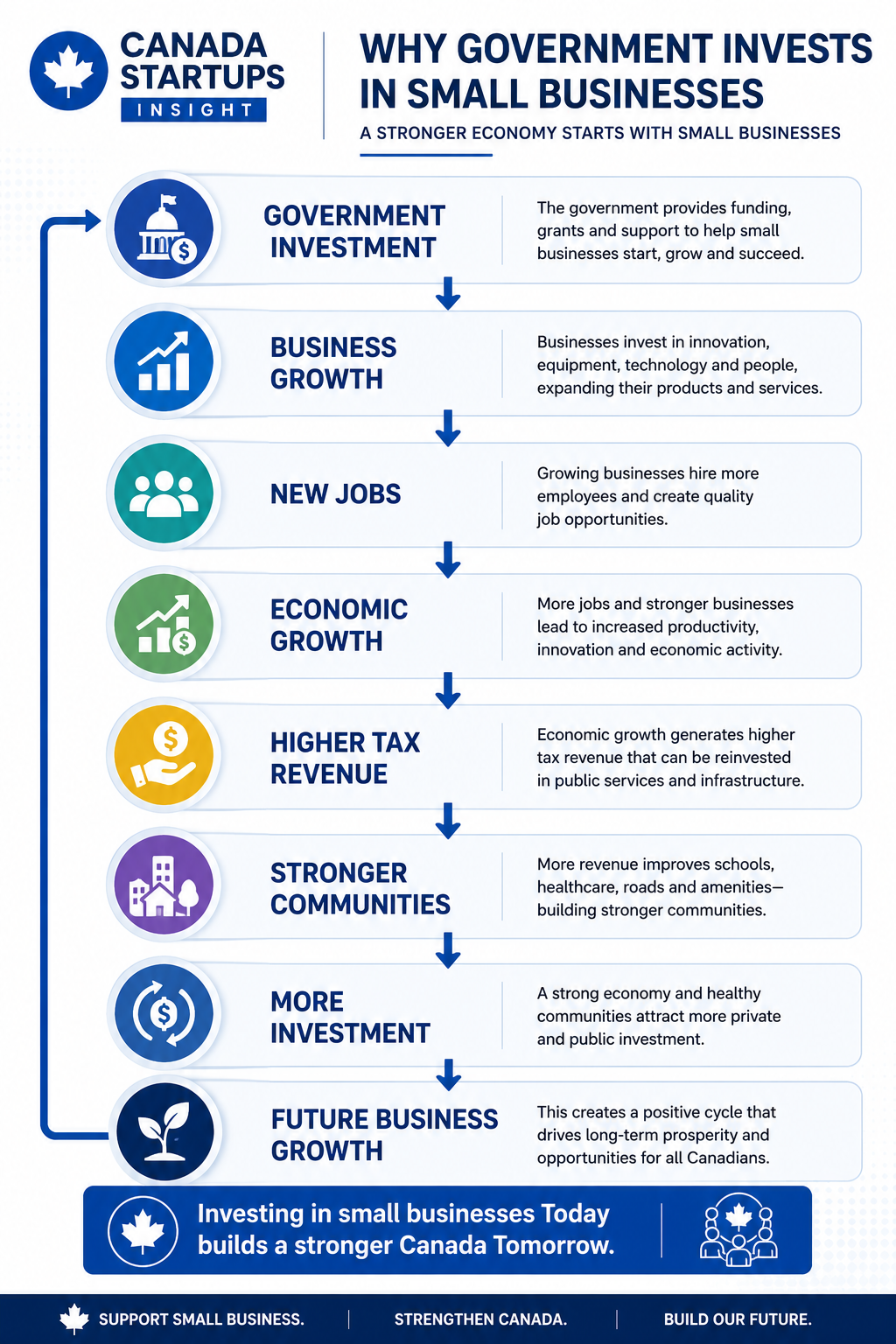
The government isn’t giving away money, it’s investing in outcomes.
Business grants are not simply financial assistance provided to businesses; they are strategic investments made by governments to strengthen Canada’s economy. Rather than viewing grants as “free money,” it’s helpful to understand that governments fund businesses because they expect those investments to create long-term economic and social benefits.
When businesses grow, they create jobs, generate tax revenue, encourage innovation, strengthen local communities and improve Canada’s overall economic competitiveness. By supporting businesses that align with these objectives, governments can stimulate economic activity while encouraging entrepreneurs to invest in projects that might otherwise be delayed or financially difficult to undertake.
Every grant program is designed around one or more policy objectives. Some programs encourage businesses to hire new employees, while others promote research and innovation, technology adoption, exports, environmental sustainability, workforce development or regional economic growth. This is why every funding program has specific eligibility requirements and eligible expenses, the funding is intended to achieve a measurable outcome rather than simply provide unrestricted financial assistance.
Understanding the purpose behind business grants is one of the most important parts of developing a successful funding strategy. Businesses that can clearly demonstrate how their project supports the objectives of a funding program are often in a much stronger position than businesses that focus only on requesting financial assistance.
The Most Common Reasons Governments Fund Businesses
Governments provide business grants with a clear purpose. Every funding program is designed to support specific economic objectives that benefit businesses, communities and the Canadian economy. Understanding these objectives can help you better identify funding opportunities that match your business and improve the quality of your grant applications.
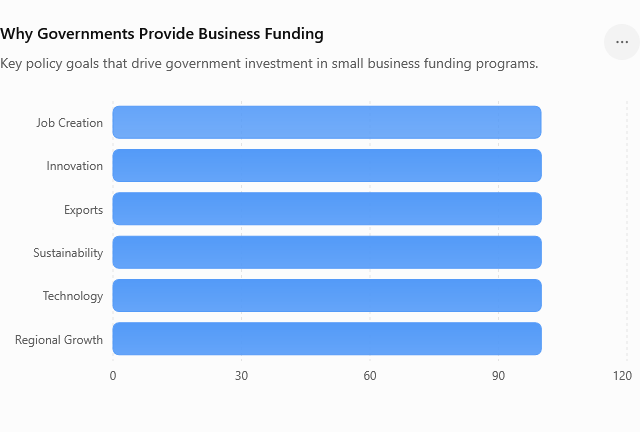
Key purpose of government backed funding.
Job Creation
One of the primary reasons governments provide business grants is to encourage job creation. Small businesses are a major contributor to Canada’s economy, and helping them hire new employees strengthens local communities while reducing unemployment. Many funding programs specifically support hiring initiatives by providing grants for wages, employee training, apprenticeships and workforce development. Governments view these investments as a way to create long-term employment opportunities, increase household income and stimulate additional economic activity. Businesses planning to expand their workforce or create new positions often have access to a wider range of funding opportunities because their projects directly support one of the government’s highest economic priorities.
Innovation
Innovation is essential to maintaining Canada’s long-term economic competitiveness. Governments invest in businesses developing new products, services, technologies and processes because innovation can improve productivity, strengthen industries and create new commercial opportunities. Funding programs frequently support research and development, product commercialization, prototype development and advanced manufacturing projects. By encouraging businesses to innovate, governments help Canadian companies remain competitive in both domestic and international markets while fostering economic growth and attracting future investment into high-value industries.
Technology Adoption
Governments encourage businesses to adopt new technologies because modern tools often improve productivity, efficiency and competitiveness. Funding programs may help businesses purchase software, implement automation, adopt artificial intelligence, improve cybersecurity or invest in digital transformation projects. Technology investments can reduce operating costs, improve customer service and help businesses scale more effectively. By supporting technology adoption, governments strengthen the overall competitiveness of Canadian businesses while encouraging innovation and preparing companies for future economic challenges.
Regional Economic Development
Business funding is often used to strengthen local and regional economies by encouraging investment in communities across Canada. Many programs are designed to support businesses operating in rural areas, smaller municipalities or regions experiencing economic transition. Funding may help businesses expand operations, create employment opportunities, revitalize commercial districts or attract new investment into underserved communities. Governments recognize that supporting businesses at the regional level contributes to stronger local economies, increased employment and improved quality of life for residents.
Export Development
Helping Canadian businesses reach international markets is another major objective of many funding programs. Exporting allows businesses to increase sales, diversify revenue and strengthen Canada’s economy through international trade. Governments frequently provide funding to support market research, trade missions, international marketing, regulatory compliance and export readiness. Businesses that successfully expand beyond Canada not only generate additional revenue but also create new jobs and strengthen Canada’s position in the global marketplace.
Environmental Sustainability
Governments increasingly invest in projects that improve environmental sustainability and reduce the impact businesses have on the environment. Funding programs may support energy-efficient equipment, renewable energy projects, waste reduction initiatives, emissions reduction technologies and environmentally responsible manufacturing processes. These investments help businesses lower operating costs while contributing to Canada’s long-term environmental objectives. As sustainability becomes a greater priority across many industries, businesses implementing greener technologies or environmentally responsible practices may find additional funding opportunities specifically designed to support these initiatives.
What Governments Look For Before Providing Funding
Although every funding program has its own eligibility requirements and evaluation process, most funding providers assess applications using a similar set of principles. Rather than focusing only on the business itself, governments evaluate the potential impact of the proposed project and whether it aligns with the objectives of the funding program.
Businesses that clearly demonstrate economic value, community impact and a realistic plan for success are often in a stronger position than those that focus primarily on requesting financial assistance. Before approving funding, agencies typically consider several important factors.
Economic Benefit
One of the primary questions funding providers ask is whether the proposed project will generate economic value. This may include creating jobs, increasing business revenue, improving productivity, encouraging investment or strengthening a particular industry. Governments invest in projects that contribute to Canada’s economy and provide measurable benefits beyond the individual business receiving the funding.
Community Benefit
Many funding programs are designed to create positive outcomes within local communities. Projects that improve employment opportunities, strengthen local supply chains, increase accessibility, support underserved groups or contribute to community development often align closely with government funding objectives. Demonstrating how your project benefits others, not just your business, can strengthen your application.
Long-Term Viability
Funding providers want to support businesses that have a realistic opportunity for long-term success. Applicants should demonstrate that the business has a clear strategy, achievable goals and the ability to continue operating after the funding has been used. A well-developed business plan, realistic financial projections and a sustainable growth strategy help show that the project is built for long-term success rather than short-term funding.
Return on Investment
Governments view grant funding as an investment rather than a gift. They want to understand what outcomes will be achieved in exchange for the funding provided. This return on investment may include new employment opportunities, increased exports, higher productivity, innovation, environmental improvements or stronger regional economic development. Clearly explaining the expected results of your project helps funding providers evaluate its overall value.
Project Feasibility
Even an excellent business idea must be practical and achievable. Funding agencies assess whether the proposed project has a realistic timeline, appropriate budget, qualified management team and the resources necessary to successfully complete the work. Applications supported by clear planning, accurate budgets and well-prepared documentation generally demonstrate greater project feasibility.
Common Projects Governments Fund
Although every funding program has its own objectives and eligible expenses, many government grants are designed to support similar types of business activities. Rather than providing unrestricted cash, funding is typically directed toward projects that encourage business growth, job creation, innovation and long-term economic development.
The table below highlights some of the most common projects governments support through business funding programs. While eligibility varies between programs, these categories represent many of the expenses that funding agencies frequently invest in across Canada.
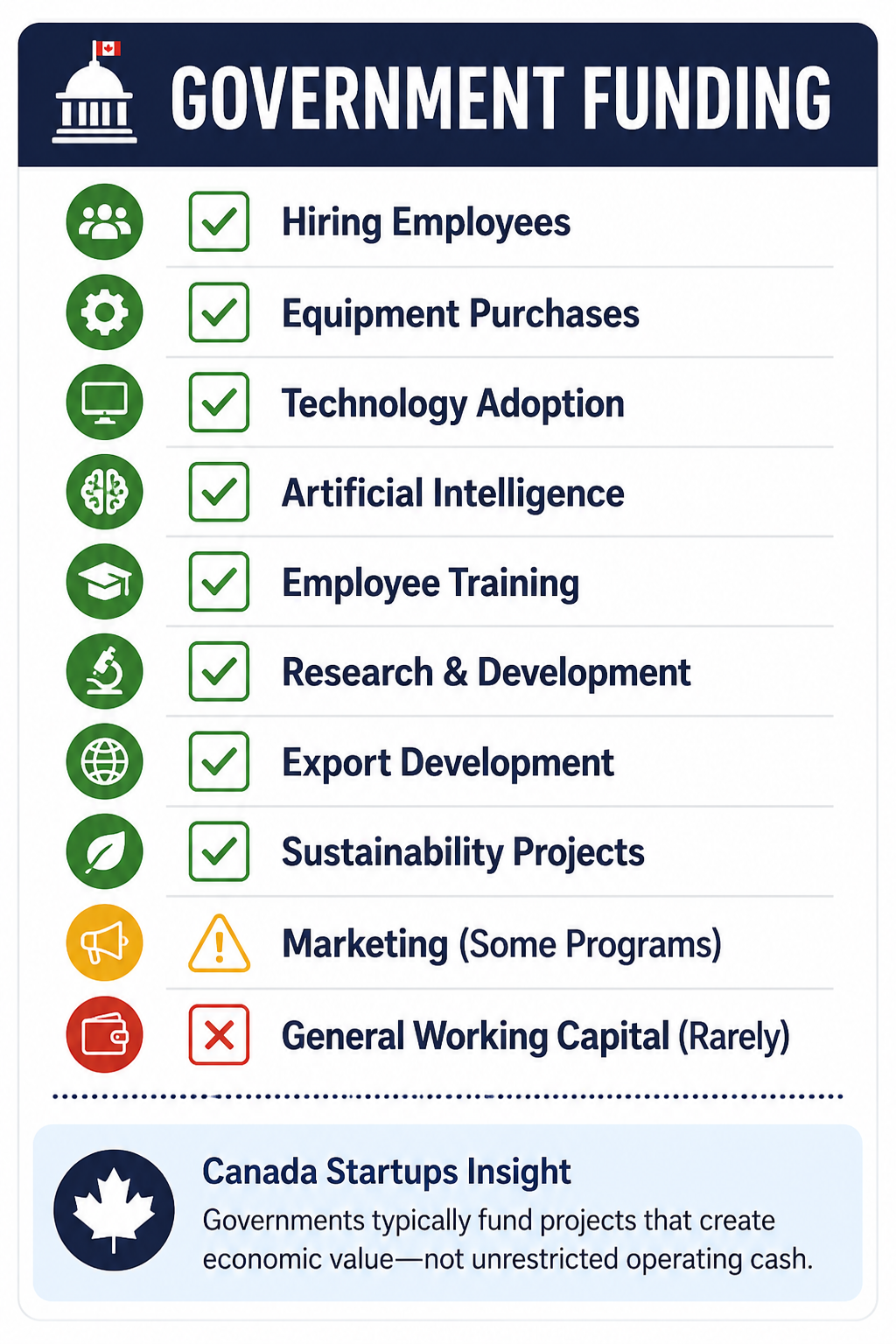
A number of expense tyles can be funded via government funding.
Projects That Are Less Commonly Funded
While there are many expenses that funding agencies focus on and can help cover, the less likely expenses to be covered include:
- Paying existing debt
- Covering rent
- General operating expenses
- Inventory (unless program-specific)
- Owner salaries (in many programs)
- Personal expenses
As you search for funding, it’s important to evaluate all types of options and consider breaking up those expenses that may not be covered, to unravel what may be possible.
Canada Startups Insight
One of the biggest misconceptions entrepreneurs have is believing governments provide grants simply because a business needs financial assistance. In reality, funding is awarded to projects that help governments achieve specific economic objectives. Businesses that clearly demonstrate those outcomes often submit much stronger applications.
Common Mistakes Businesses Make
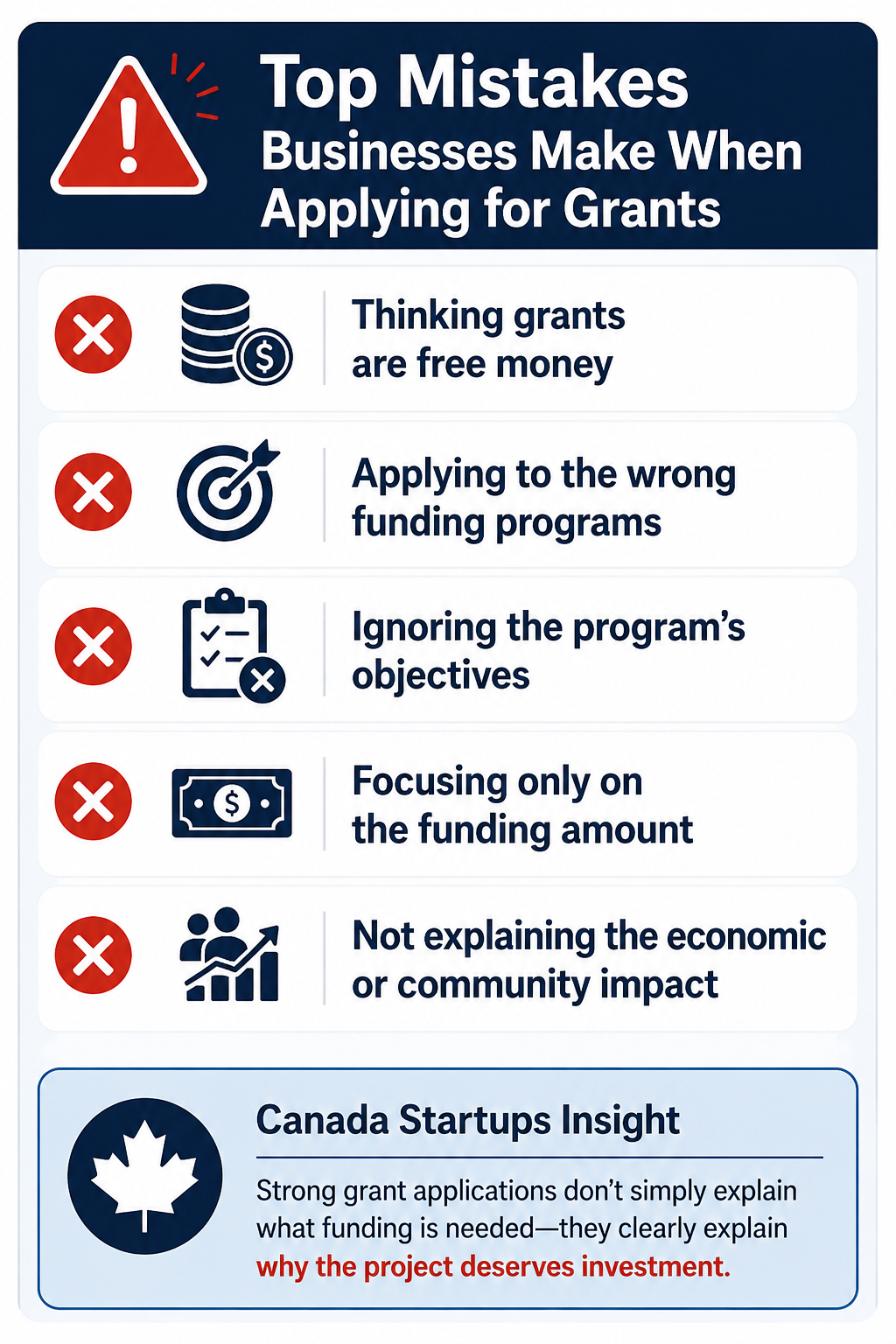
Take your time; read the criteria - don’t make the most common mistakes
Understanding why governments provide funding is only part of preparing a successful grant application. Many businesses have strong ideas and worthwhile projects but fail to secure funding because they overlook what funding providers are actually trying to achieve.
Avoiding the following mistakes can help you identify more suitable funding opportunities and prepare applications that better align with the objectives of the funding program.
Thinking Grants Are Free Money
One of the biggest misconceptions about business grants is that they exist simply to provide financial assistance. In reality, governments invest in projects that create measurable economic value, such as job creation, innovation, technology adoption or regional economic development. Most grant programs have specific eligibility requirements, approved expenses and reporting obligations. Understanding these conditions before applying helps businesses focus on projects that funding providers are actually looking to support.
Applying Without Matching the Program’s Objectives
Every funding program has a purpose. Some support hiring employees, while others focus on research, exports, sustainability or technology adoption. Businesses that apply without demonstrating how their project supports the objectives of the funding program often have weaker applications than those that clearly explain the expected outcomes. Taking the time to understand the purpose of the funding program before applying can significantly improve the quality of your application.
Ignoring the Funding Provider’s Priorities
Funding agencies evaluate more than just the business itself, they assess whether the proposed project aligns with their priorities and delivers measurable benefits. Businesses that focus only on their own needs may overlook the factors that are most important to the funding provider, such as economic growth, productivity, workforce development or community impact. Reading the program guidelines carefully helps ensure your application addresses the objectives that matter most to the funding agency.
Focusing Only on the Funding Amount
Many entrepreneurs begin by searching for the largest grants available. While funding amounts are important, the most successful applications are usually submitted to programs that closely match the business and its project. A smaller grant that perfectly aligns with your objectives may offer a much greater chance of approval than a larger grant designed for a completely different purpose.
Not Explaining the Community or Economic Impact
Funding providers want to understand the difference your project will make beyond your own business. Whether your project creates jobs, improves productivity, supports local suppliers, reduces environmental impact or strengthens your community, clearly explaining these outcomes can significantly strengthen your application. Businesses that demonstrate measurable economic or community benefits are often better positioned than those focused only on their own financial needs.
Canada Startups Insight
One of the biggest differences between successful and unsuccessful grant applications is not the quality of the business- it is how well the application demonstrates that the proposed project supports the objectives of the funding program. Businesses that focus on the outcomes they will create, rather than simply the funding they need, often submit stronger and more competitive applications.
Frequently Asked Questions About Government Grants
Although every funding program has its own objectives and eligibility requirements, many government grants support similar types of business projects. Rather than providing unrestricted cash, funding is typically directed toward activities that encourage business growth, innovation, job creation, and long-term economic development.
Why doesn’t the government fund every business?
Government funding is limited and designed to achieve specific economic objectives rather than support every business that applies. Each grant program operates within a defined budget and has its own eligibility requirements, funding priorities and evaluation criteria. As a result, only projects that closely align with the objectives of the program are considered for funding.
In many cases, funding agencies receive significantly more applications than they have available funding. Even businesses with strong ideas and well-prepared applications may not receive funding simply because the program is oversubscribed or other projects align more closely with the agency’s priorities.
Rather than trying to fund every business, governments focus on investing in projects that are expected to create measurable economic benefits, such as job creation, innovation, productivity improvements, exports or regional economic development.
Do governments make money from business grants?
Governments do not expect to earn a direct financial return from business grants in the same way a bank earns interest on a loan. Instead, they invest in projects that are expected to generate broader economic and social benefits over time.
When businesses grow, they hire employees, purchase goods and services, expand into new markets and contribute more taxes through payroll, income and sales. These activities strengthen local economies, create employment opportunities and encourage additional private investment.
Rather than measuring success by recovering the grant itself, governments evaluate whether the funding helped achieve the objectives of the program, such as supporting innovation, increasing productivity, improving exports or strengthening Canada’s long-term economic competitiveness.
Are business grants an investment?
Yes. Governments generally view business grants as an investment in Canada’s economy rather than simply providing financial assistance to individual businesses. Every funding program is designed to encourage projects that produce measurable economic outcomes and long-term public benefits.
These outcomes may include creating new jobs, increasing productivity, developing innovative products, adopting advanced technologies, expanding exports or strengthening regional economies. By helping businesses invest in projects that might otherwise be delayed or financially difficult to undertake, governments aim to stimulate sustainable economic growth.
Understanding this perspective is important because successful grant applications focus not only on the funding required but also on the value the proposed project will create for the broader economy and community.
Why are business grants competitive?
Business grants are competitive because funding providers have limited budgets and often receive far more applications than they can approve. Rather than funding every eligible business, agencies must prioritize projects that best support the objectives of the program while delivering the greatest economic or community benefit.
Applications are typically evaluated on several factors, including eligibility, project quality, expected outcomes, financial planning and how well the proposal aligns with the funding provider’s priorities.
Businesses that clearly explain the impact of their project such as creating jobs, improving productivity, adopting new technology or supporting regional development are often in a stronger position than those focused primarily on the amount of funding being requested.
Can governments cancel grant programs?
Yes. Business funding programs may be updated, suspended, expanded or discontinued as government priorities, budgets and economic conditions change. New programs are also introduced regularly to address emerging industries, workforce needs, environmental initiatives and changing economic circumstances.
For this reason, businesses should avoid relying on a single funding opportunity or assuming that a program will always be available. Some grants operate annually, while others are one-time initiatives or remain open only until the available funding has been fully allocated.
Monitoring funding opportunities throughout the year and maintaining up-to-date business documents helps ensure you are prepared when new programs become available.
Do governments expect repayment?
Most business grants do not require repayment provided the recipient complies with the funding agreement and uses the funds for approved expenses outlined by the funding provider. Unlike traditional loans, grants are intended to support specific projects rather than create debt for the business.
However, funding agreements often include conditions that recipients must satisfy. These may include completing the approved project, maintaining records, submitting progress reports or providing proof that the funding was spent on eligible expenses.
If the terms of the agreement are not met, or if the funding is used for purposes outside the approved project, the funding provider may require some or all of the grant to be repaid. Always review the funding agreement carefully before accepting grant funding.
Can governments reject good businesses?
Yes. A successful business does not automatically qualify for grant funding. Funding providers evaluate how well the proposed project aligns with the objectives of the funding program rather than judging the overall quality or profitability of the business itself.
A business may have excellent products, experienced management and strong financial performance but still be declined if the proposed project does not meet the program’s eligibility requirements or funding priorities. Likewise, another business may receive funding because its project more closely supports objectives such as job creation, innovation, technology adoption or regional economic development.
A rejection does not necessarily mean the business is not worthy of funding, it often means the project was simply not the right fit for that particular program.
Business Grant Essentials
Before moving on, remember these key points about business grants:
✅ Most business grants do not require repayment when program conditions are met.
✅ Grants are designed to fund specific projects - not provide unrestricted operating cash.
✅ Every funding program has its own eligibility requirements and objectives.
✅ Government funding is only one part of Canada’s funding ecosystem.
✅ Businesses can often apply for multiple funding programs, subject to individual program rules.
✅ Preparing the right documents before applying can significantly improve your funding readiness.
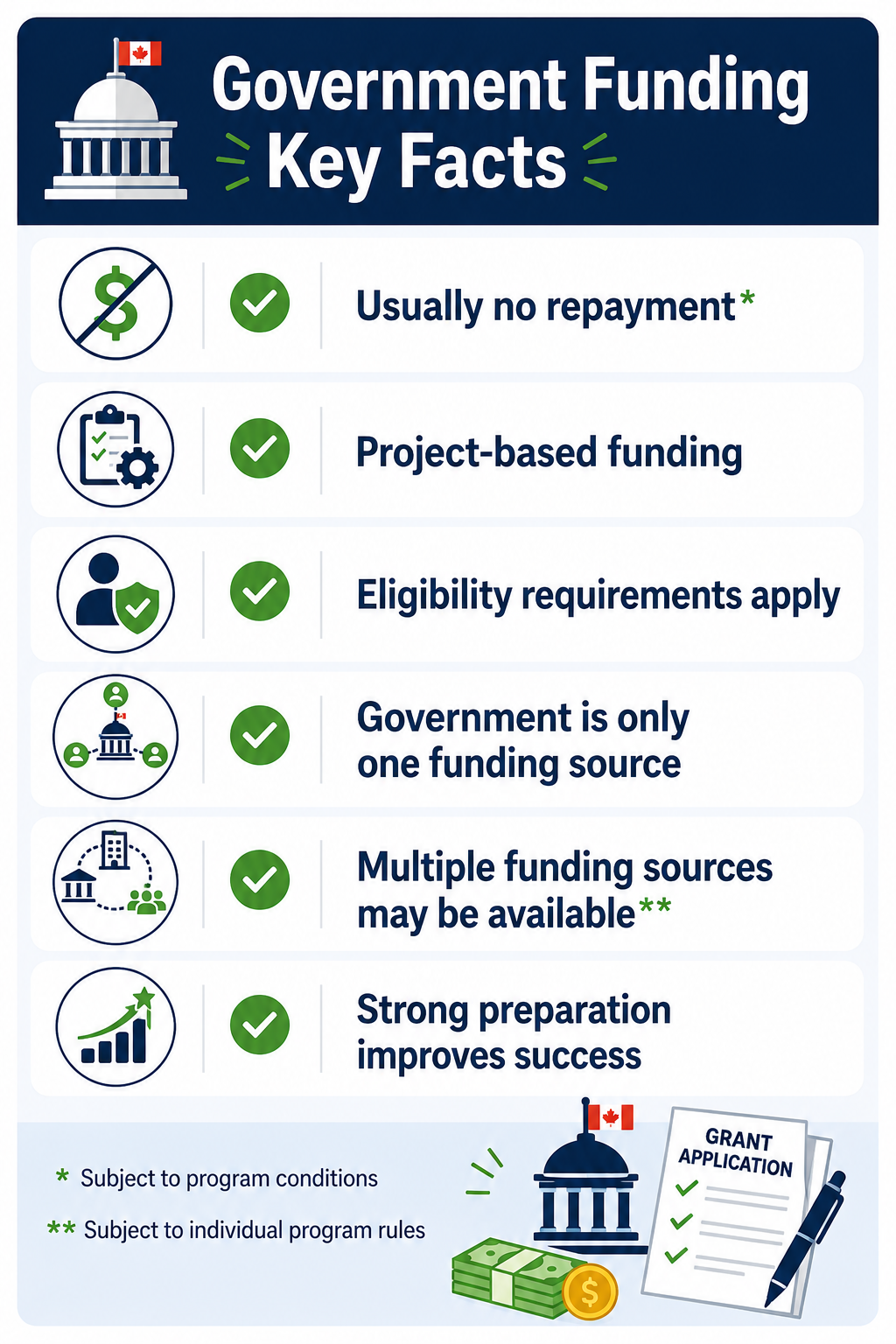
Key government funding facts
Canada Startups Takeaway
The businesses that are most successful with grant funding are rarely the ones simply looking for financial assistance. They are the businesses that understand how grants work, prepare thoroughly, and apply to funding programs that closely align with their project and business objectives.
Canada’s Business Funding Landscape (2026)
Explain that Canada has one of the largest public business funding ecosystems in the world, made up of grants, loans, tax incentives, wage subsidies and private funding opportunities. Because funding is delivered by multiple levels of government and independent organizations, understanding the landscape helps businesses identify more opportunities rather than relying on a single program.
Canada’s Business Funding Landscape at a Glance
Before exploring specific funding programs, it’s helpful to understand the size and diversity of Canada’s business funding ecosystem. Every year, governments, government-supported organizations, nonprofit agencies and private organizations invest billions of dollars into helping Canadian businesses start, grow and innovate.
Funding is available through thousands of individual programs designed to support businesses at different stages of development, across virtually every industry and province. While many entrepreneurs focus only on government grants, Canada’s funding landscape also includes loans, tax credits, wage subsidies, investment programs and industry-specific funding opportunities.
Understanding the overall funding landscape provides valuable context before beginning your funding search. Rather than relying on a single grant, businesses that explore multiple funding sources often discover significantly more opportunities that align with their goals and projects.
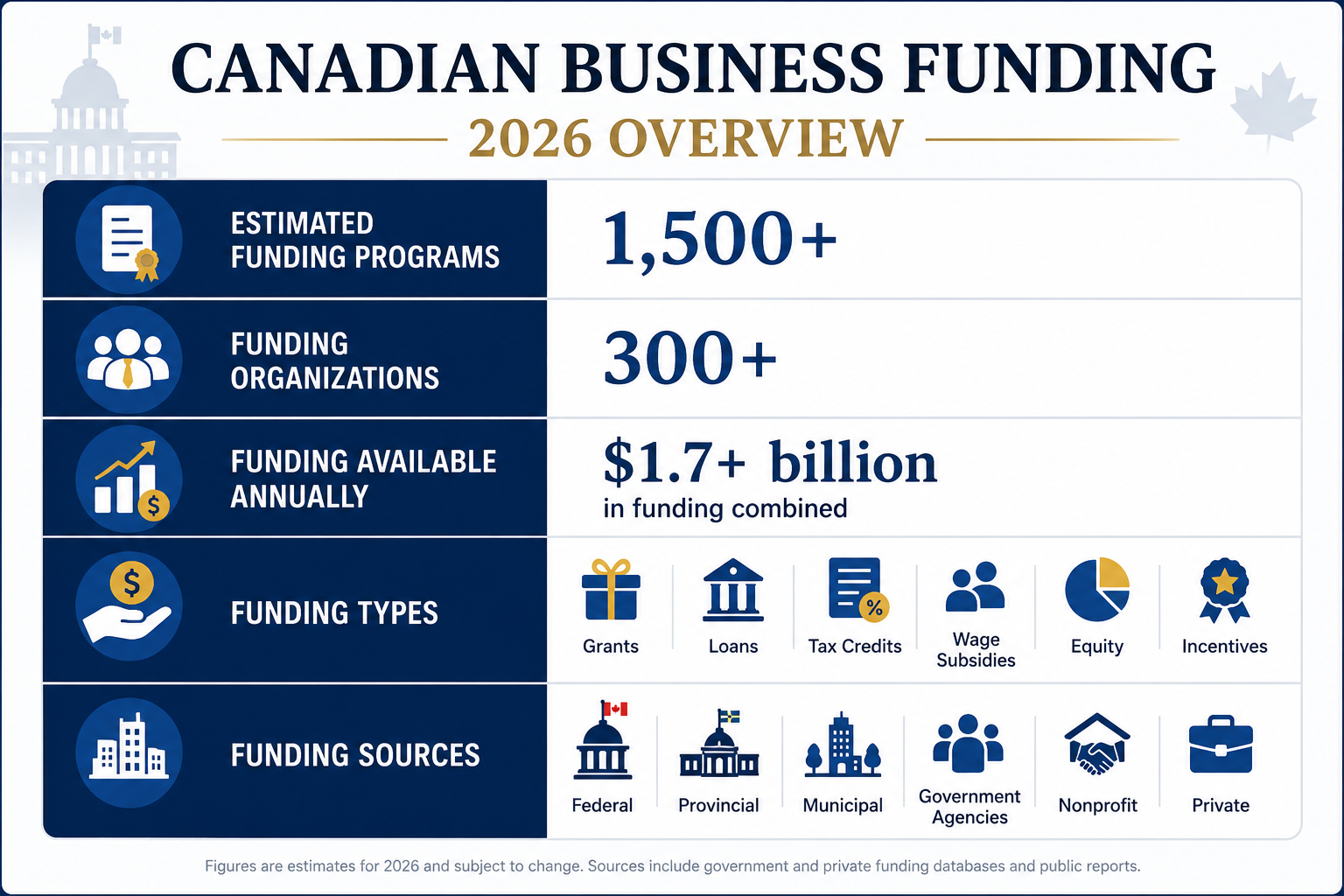
Canada Startups Funding Database Insight 2026
Canada Startups Insight
Based on Canada Startups’ ongoing research into Canadian funding opportunities, one of the biggest misconceptions among entrepreneurs is believing that only a handful of government grants exist. In reality, Canada’s funding ecosystem consists of thousands of programs administered by hundreds of organizations, with new opportunities opening throughout the year across multiple industries and regions.
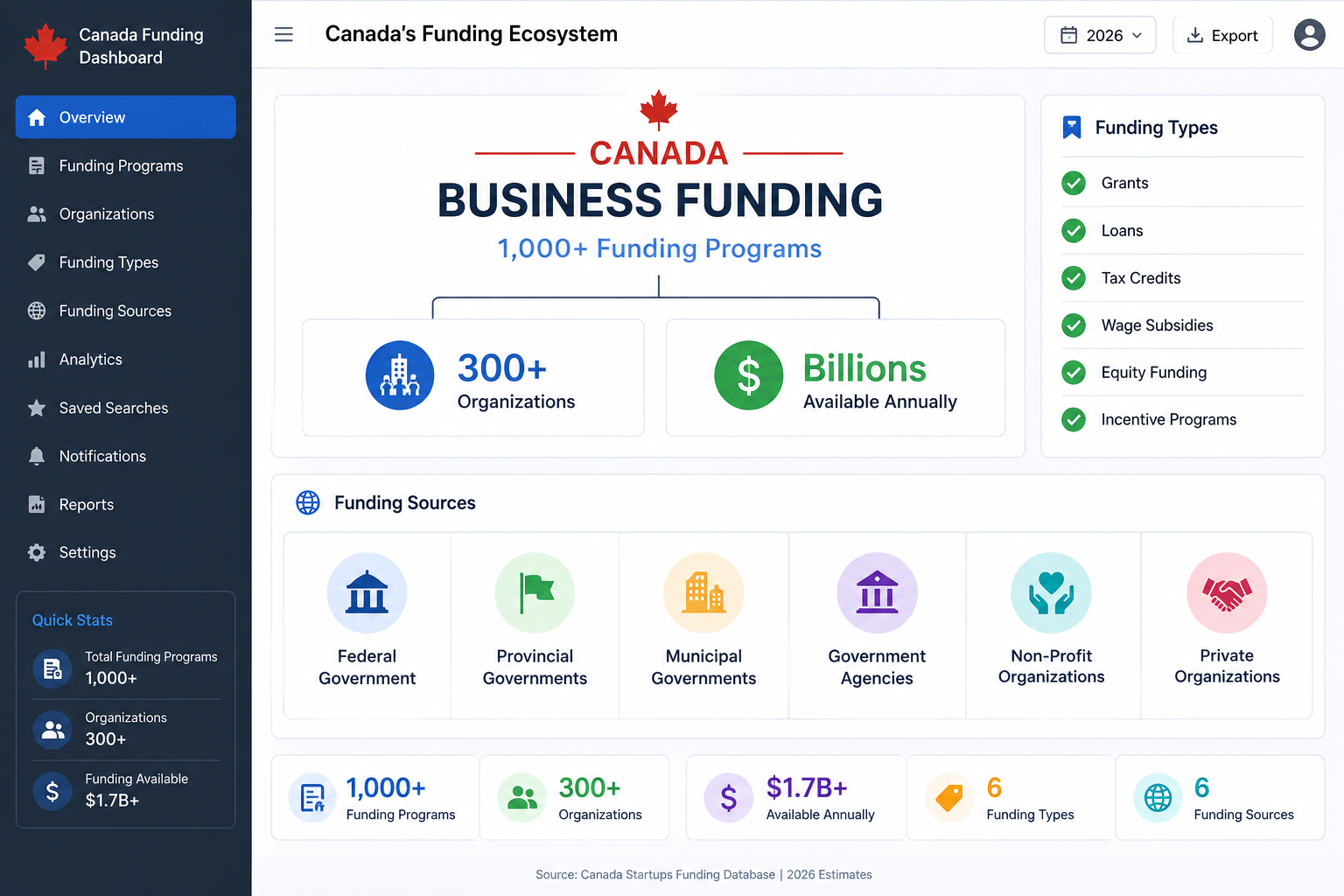
Expanded look at over $1.7+ billion in funding available to Canadian entrepreneurs
While these figures demonstrate the overall size of Canada’s funding ecosystem, they tell only part of the story. The next sections explore where funding is concentrated, which industries receive the most support and how opportunities vary across provinces, industries and business stages.
How Many Business Funding Programs Exist?
One of the biggest misconceptions among entrepreneurs is that only a small number of government grants are available. In reality, Canada’s business funding ecosystem is made up of well over 1,500 funding programs offered by governments, financial institutions, nonprofit organizations, industry associations and private organizations.
These funding opportunities extend far beyond traditional grants. Businesses may also be eligible for loans, tax credits, wage subsidies, equity investment programs, competitions and other financial incentives designed to support different stages of business growth.
Because every funding program has its own objectives, eligibility requirements and application process, understanding the different types of funding available can significantly expand the number of opportunities your business may qualify for.
The table below provides an overview of the estimated number of funding programs currently available across Canada’s business funding landscape.
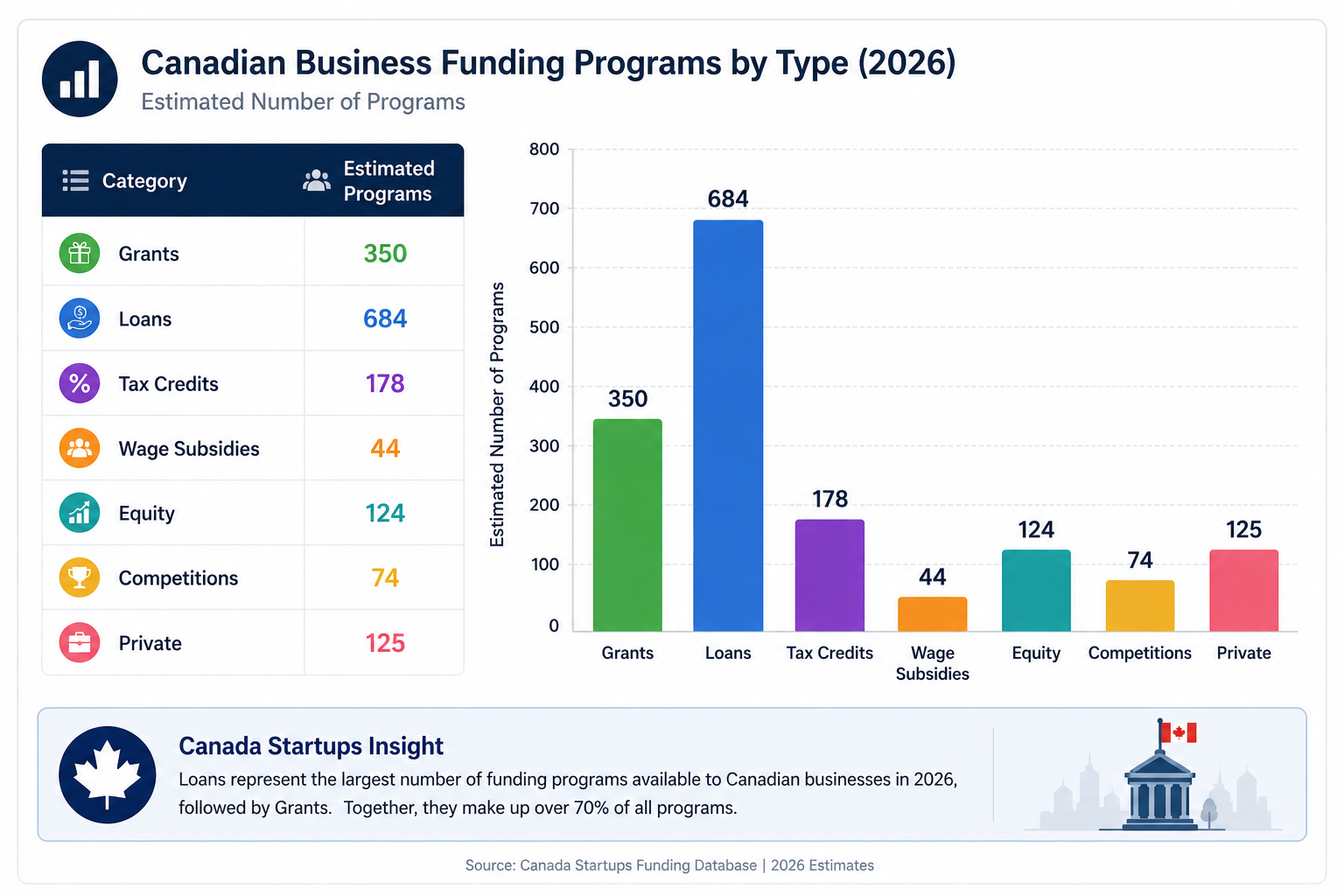
Over 1,500 different funding options to help you as a small business in Canada
Understanding the Numbers
While grants often receive the most attention, they represent only one part of Canada’s overall funding ecosystem. Loans account for the largest number of funding programs, providing businesses with access to capital for startup costs, expansion, equipment purchases and working capital. Tax credits, wage subsidies and equity funding each play an important role by supporting business investment, hiring and long-term growth.
Many entrepreneurs focus exclusively on grants because they are generally non-repayable when program conditions are met. However, businesses that consider multiple funding types often discover significantly more opportunities that align with their goals and financial needs.
It’s also important to remember that not every funding program is available to every business. Eligibility may depend on factors such as your province, industry, business stage, project type or ownership characteristics. As a result, the total number of funding opportunities available to your business will depend on your specific circumstances.
Which Provinces Offer the Most Funding?
Canada’s business funding landscape is distributed across every province and territory, but the number and type of funding opportunities available varies considerably. Factors such as population, economic size, industry concentration and government priorities all influence how many funding programs are offered within each region.
Larger provinces generally have access to more funding opportunities because they have more businesses, larger economies and a greater number of government departments, regional development organizations and industry associations administering funding programs. However, having more funding programs does not necessarily mean businesses have a better chance of securing funding.
The table below highlights the estimated number of business funding programs available by province, along with some of the industries most commonly supported and examples of major funding organizations operating within each region.
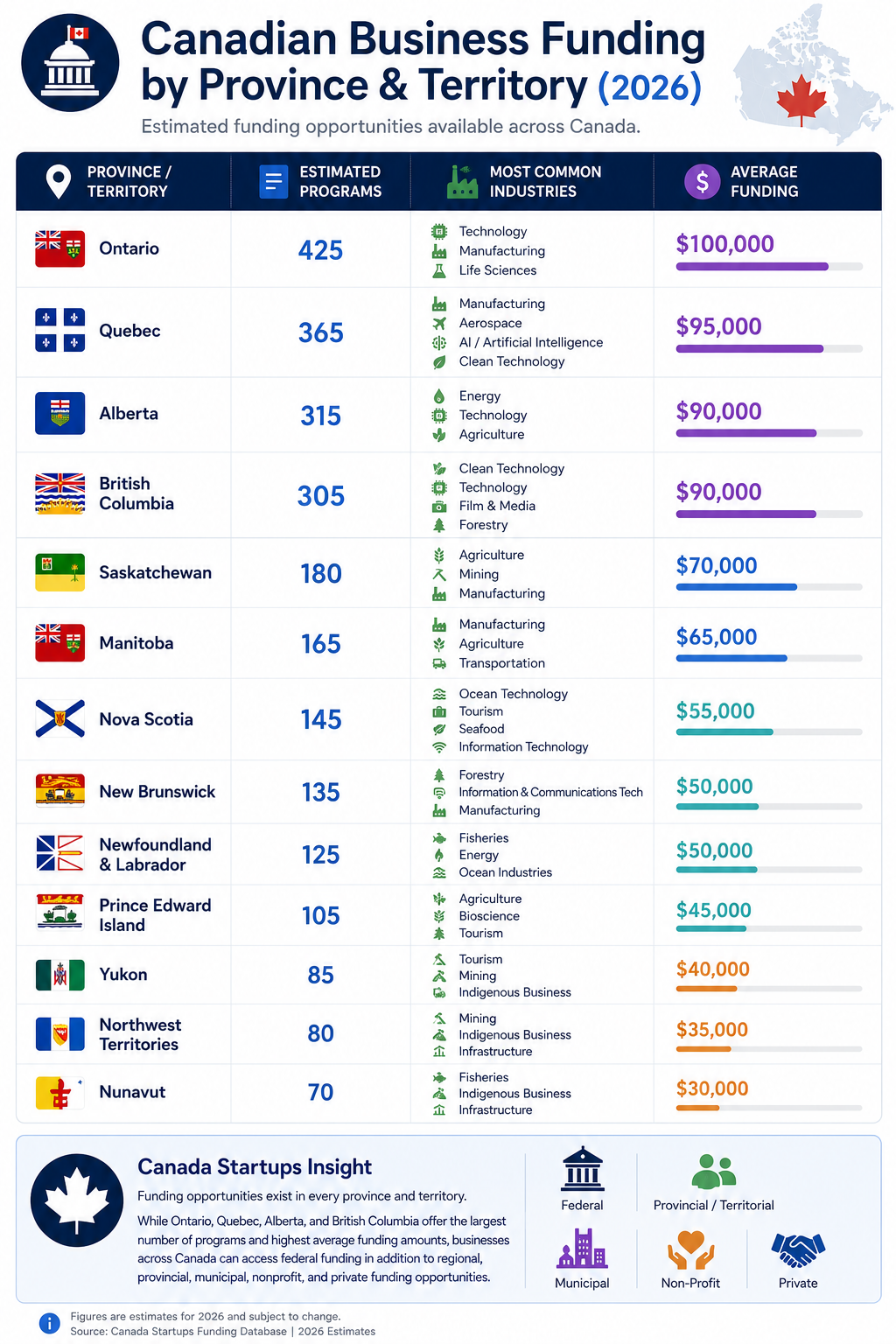
Where is the money?
Why Do Some Provinces Have More Funding Than Others?
The number of funding opportunities available within each province or territory is influenced by several economic and demographic factors. Larger provinces generally have more businesses, more government departments, larger economic development budgets and a greater number of nonprofit, industry and private funding organizations.
Ontario and Quebec, for example, have large and diversified economies that include technology, manufacturing, life sciences, artificial intelligence, aerospace and clean technology. This creates demand for a wider variety of programs supporting different industries, business stages and project types.
Alberta and British Columbia also have extensive funding ecosystems, but their priorities reflect their regional economies. Alberta offers substantial support for energy, agriculture, technology and industrial development, while British Columbia has a strong concentration of programs related to clean technology, digital industries, forestry, film and environmental innovation.
Smaller provinces and territories may have fewer programs in total, but they frequently offer highly targeted funding for regional priorities. Atlantic Canada has significant support for ocean industries, fisheries, tourism, food production and rural development. The territories often emphasize infrastructure, mining, tourism and Indigenous business development.
The number of programs should therefore be viewed as one measure of funding availability, not as a measure of whether one province is better for entrepreneurs. A province with fewer programs may still offer excellent opportunities for businesses that closely match its economic priorities.
Canada Startups Insight
A larger number of programs does not automatically mean funding will be easier to obtain. Provinces with larger funding ecosystems also tend to have more businesses competing for those opportunities.
Businesses in smaller regions may encounter fewer programs overall, but they can sometimes benefit from specialized regional initiatives, narrower applicant pools and funding designed specifically to encourage local economic development.
The strongest funding strategy is based on program fit, not simply the number of opportunities listed in a province.
Common Mistakes When Searching by Province
The existing version feels weak because the points are too general. I would make each mistake explain the actual consequence.
Assuming the Province With the Most Programs Is Automatically the Best
Ontario, Quebec, Alberta and British Columbia have the largest estimated number of funding programs, but they also have larger business populations and more applicants. A higher program count does not necessarily mean an individual business has a higher chance of receiving funding.
Businesses should focus on the quality of the match between their project and the funding criteria rather than choosing a location based only on the total number of programs.
Searching Only Provincial Government Websites
Provincial programs represent only one part of the funding available within a region. Businesses may also qualify for federal grants, regional development programs, municipal incentives, nonprofit funding, private competitions and industry-specific opportunities.
Restricting a search to one government website can cause a business to overlook a significant portion of the funding ecosystem.
Ignoring Regional Industry Priorities
Funding programs often reflect the industries that are economically important within each province or territory. A technology project may have more options in one region, while an agriculture, tourism, mining or ocean-industry project may align more closely with programs elsewhere.
Applicants should identify how their industry connects with provincial priorities rather than searching only for general small business grants.
Assuming Smaller Provinces Have Little Funding
Smaller provinces and territories generally have fewer programs, but many opportunities are designed specifically to attract investment, create jobs and support regional development.
Businesses in these areas may qualify for specialized programs that are unavailable in larger urban markets. Federal and private funding may also be available regardless of province.
Applying Based Only on Business Location
Location is important, but it is rarely the only eligibility factor. Funding providers may also evaluate the location of the project, where employees will be hired, where equipment will be installed and where the economic benefits will occur.
A business operating nationally should review the geographic requirements carefully rather than assuming its registered address determines eligibility.
Overlooking Municipal and Community Funding
Cities, municipalities and local economic development organizations may offer funding for commercial improvements, accessibility, tourism, downtown revitalization, sustainability and local hiring.
These programs may be smaller than provincial grants, but they can be highly relevant to local projects and may receive less national attention.
Assuming the Same Program Exists Nationwide
Some programs are available across Canada, while others operate only within a specific province, territory, municipality or regional development area. Similar programs may also have different names, funding limits and eligibility rules from one province to another.
Businesses should verify the geographic coverage of every program before preparing an application.
Frequently Asked Questions About Funding by Province
Funding availability varies across Canada, and eligibility often depends on where a business operates or where a proposed project will take place. The following answers address some of the most common questions about applying for business funding across different provinces and territories.
Which province offers the most business funding?
Based on Canada Startups’ 2026 funding estimates, Ontario has the largest number of identified programs, followed by Quebec, Alberta and British Columbia.
This is largely connected to population, economic size, business activity and the number of organizations administering funding. However, a higher number of programs does not guarantee easier approval because larger provinces also tend to have more applicants and greater competition.
Can I apply for funding outside my province?
Sometimes. Federal and private programs may accept applicants from across Canada, while provincial and municipal programs usually require the business or funded project to operate within their jurisdiction.
A business expanding into another province may qualify for certain programs if the project will create jobs, establish operations or generate economic benefits in that region. Always confirm the geographic eligibility rules before applying.
Does living in a smaller province reduce my funding options?
Not necessarily. Smaller provinces and territories may have fewer programs in total, but they often provide specialized support for regional development, rural businesses and priority industries.
Businesses can also access federal, nonprofit and private programs that are available nationally. The relevance of the programs matters more than the total number listed within the province.
Does my business need to be registered in the province offering the grant?
Many provincial programs require the business to be registered, operating or completing the funded project within that province. However, requirements vary.
Some programs may accept businesses planning to establish operations in the region, while others require an existing physical presence, employees or revenue-generating activity. The program guidelines should clearly define what qualifies as operating within the jurisdiction.
Can a business operating in multiple provinces apply for more funding?
Potentially. A business operating in several provinces may qualify for programs in more than one jurisdiction, particularly when it has employees, facilities or active projects in each location.
However, the same project or expense cannot always be funded multiple times. Applicants must disclose other funding and comply with any stacking limits or duplication rules.
Are federal grants available in every province and territory?
Many federal programs are available nationwide, but eligibility can still vary by industry, project type, business size and region. Some federal funding is also delivered through regional development agencies that serve specific areas of Canada.
Businesses should therefore search both national federal programs and the federal agencies responsible for their region.
Is competition lower in smaller provinces?
It can be, but this should not be assumed. Smaller regions may have fewer applicants, but they may also have smaller program budgets or narrower eligibility requirements.
The strongest advantage often comes from having a project that directly supports the region’s priorities, such as rural employment, tourism growth, Indigenous entrepreneurship, agriculture, infrastructure, or industry diversification.
Which Industries Receive the Most Business Funding?
Not every industry receives the same level of funding. While businesses in virtually every sector can access financial support, governments and funding organizations often prioritize industries that contribute significantly to economic growth, innovation, employment, and Canada’s long-term competitiveness.
Many funding programs are designed around strategic industries that support national and provincial economic priorities. These industries often receive a greater number of funding opportunities because they encourage research, technology adoption, exports, sustainability, workforce development and regional investment.
The table below highlights some of the industries that typically have access to the greatest number of funding opportunities across Canada’s business funding landscape.
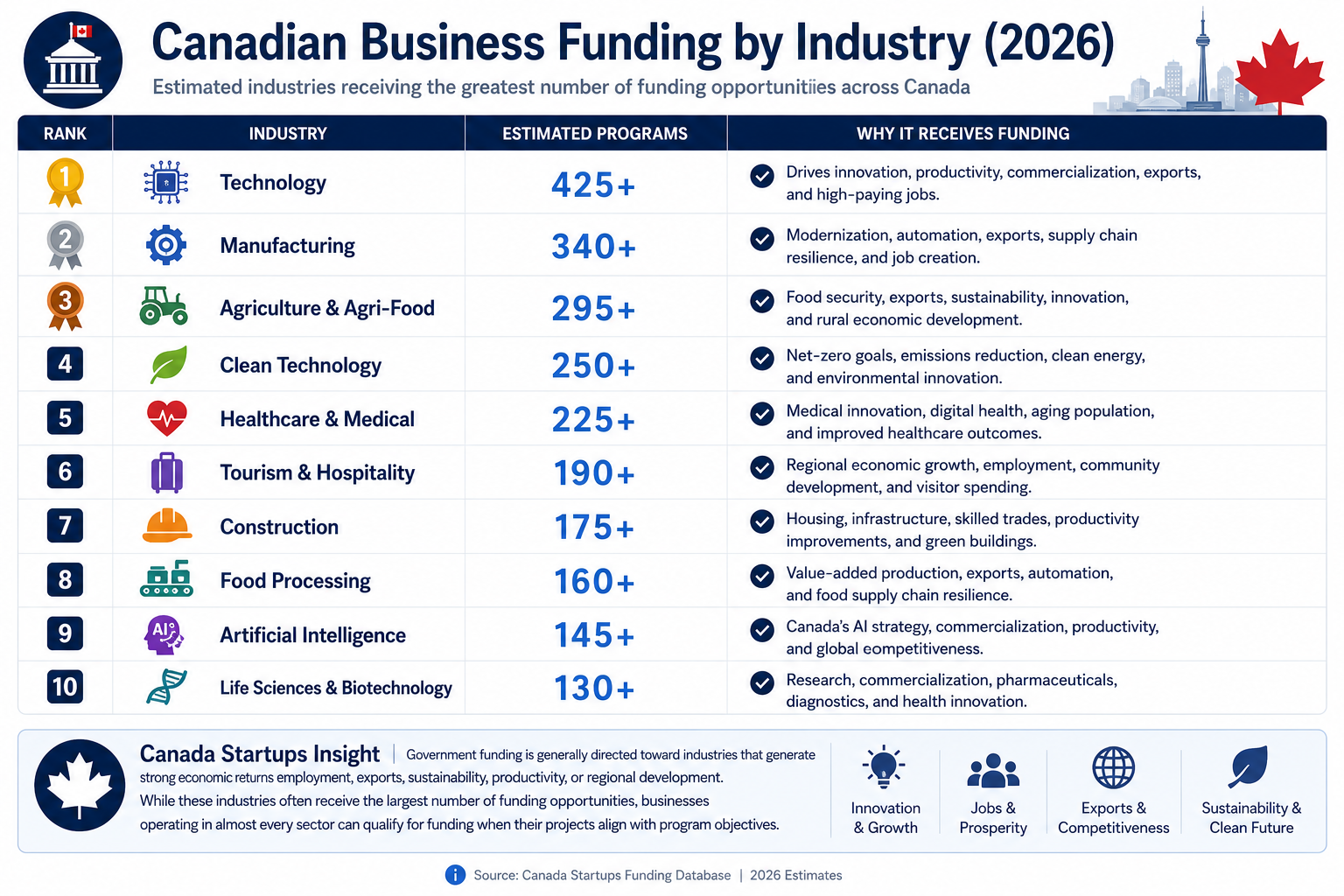
Technology, Manufacturing and Agriculture lead the top funded industries in Canada
Why These Industries Receive More Funding
Funding is generally directed toward industries that generate measurable economic benefits and align with government priorities. While every sector has opportunities available, industries with strong growth potential, export capacity or innovation often receive a greater number of dedicated funding programs.
Technology
Technology businesses continue to receive significant funding because they drive innovation, improve productivity and strengthen Canada’s digital economy. Funding frequently supports software development, cybersecurity, artificial intelligence, digital transformation and commercialization of new technologies.
Manufacturing
Manufacturing remains one of Canada’s largest funding sectors because it creates employment, supports exports and strengthens domestic supply chains. Programs commonly help businesses modernize equipment, adopt automation, improve productivity and expand production capacity.
Agriculture
Agriculture is one of Canada’s most strategically supported industries due to its importance to food security, exports and rural economic development. Funding often focuses on equipment purchases, environmental sustainability, innovation, food production and farm modernization.
Clean Technology
Governments increasingly prioritize businesses developing environmentally sustainable products and processes. Funding commonly supports renewable energy, emissions reduction, waste management, clean manufacturing and energy-efficient technologies.
Healthcare
Healthcare funding often focuses on improving patient outcomes, commercializing medical innovations, digital health solutions, biotechnology and healthcare technologies that improve the quality and efficiency of care.
Tourism
Tourism funding helps businesses attract visitors, strengthen local economies and increase regional employment. Programs frequently support marketing initiatives, tourism infrastructure, visitor experiences and community development.
Construction
Construction businesses may qualify for funding related to workforce development, safety improvements, digital technologies, equipment purchases and environmentally sustainable building practices.
Food Processing
Food processing receives considerable support because it adds value to Canadian agriculture, strengthens food supply chains and increases export opportunities. Funding often supports processing equipment, automation, food safety improvements and facility expansion.
Artificial Intelligence
Artificial Intelligence has become one of Canada’s fastest-growing funding priorities. Governments and private organizations continue investing in AI research, commercialization, implementation and workforce development as businesses adopt advanced technologies across multiple industries.
Life Sciences
Life sciences funding supports pharmaceutical research, biotechnology, medical devices, diagnostics and commercialization. Because the sector contributes significantly to innovation and economic growth, numerous programs encourage research partnerships and scientific advancement.
Canada Startups Insight
One of the biggest misconceptions entrepreneurs have is believing that funding is reserved only for technology companies. While technology and innovation receive considerable attention, businesses across manufacturing, agriculture, tourism, construction, healthcare, food production and many other industries continue to access substantial funding each year.
Rather than asking whether your industry receives funding, a better question is whether your project aligns with the objectives of the available funding programs.
Why Businesses Miss Industry-Specific Funding Opportunities
Many businesses assume funding opportunities are limited to certain industries or only available through well-known grant programs.
In reality, industry-specific funding is often overlooked because businesses search too narrowly, misunderstand eligibility requirements, or fail to recognize that many programs are designed around specific projects and economic priorities rather than the industry itself. Understanding these common misconceptions can help uncover funding opportunities that might otherwise be missed.
Assuming Funding Only Exists for Technology Companies
Technology businesses often receive significant attention because governments invest heavily in innovation, digital transformation and commercialization. However, funding is available across virtually every sector of Canada’s economy, including manufacturing, agriculture, tourism, construction, healthcare and food processing.
Many entrepreneurs eliminate themselves from consideration before they even begin searching because they assume their industry receives little or no support. In reality, most industries have funding programs designed around their own economic priorities and business challenges.
Searching Only for “Small Business Grants”
Many industry-specific funding opportunities are never advertised as general small business grants. Instead, they may be described as innovation programs, commercialization initiatives, modernization funding, export development, productivity incentives or sector-specific investment programs.
Businesses that search only for the phrase “small business grant” often overlook a significant number of funding opportunities designed specifically for their industry.
Looking at the Industry Instead of the Project
One of the biggest misconceptions is believing that funding is awarded simply because a business operates within a particular industry.
Most funding providers evaluate the proposed project rather than the industry alone.
For example, a construction company purchasing environmentally efficient equipment may qualify for sustainability funding, while a retail business implementing artificial intelligence may qualify for technology funding.
The project, not just the business, often determines eligibility.
Assuming Every Business in the Same Industry Qualifies
Two manufacturing businesses operating in the same province may qualify for completely different funding programs depending on their size, years in operation, export activity, technology adoption or hiring plans.
Industry is only one eligibility factor. Funding providers also consider location, business stage, ownership structure, project objectives and expected economic outcomes.
Ignoring Emerging Funding Priorities
Canada’s funding priorities continue to evolve.
Artificial Intelligence, clean technology, cybersecurity, advanced manufacturing and sustainability have seen significant growth in dedicated funding over recent years.
Businesses that continue searching only for traditional grants may overlook new programs created to support emerging industries and technologies.
Frequently Asked Questions About Industry Funding
Business owners often wonder whether funding is concentrated in certain industries and whether their sector has access to meaningful opportunities. The following questions address some of the most common misconceptions about industry-specific business funding in Canada.
Why do some industries receive more funding than others?
Funding generally follows economic priorities rather than favouring one industry over another. Governments and funding organizations invest more heavily in sectors that create employment, improve productivity, encourage innovation, strengthen exports or contribute to Canada’s long-term competitiveness. As economic priorities evolve, funding priorities often change as well.
Does receiving more funding mean one industry is more important?
Not necessarily.
Higher funding levels usually reflect broader economic objectives rather than the value of one industry over another. For example, agriculture receives substantial funding because of food security, while technology receives funding because of innovation and productivity. Both industries play different but equally important roles within Canada’s economy.
Can businesses in lower-funded industries still receive grants?
Absolutely.
Nearly every industry has access to funding opportunities. The difference is often the number of dedicated programs rather than whether funding exists at all. Businesses that align their projects with government priorities; such as hiring, technology adoption, exports or sustainability - can often access funding regardless of their industry.
Do industries receive funding, or do projects receive funding?
This is one of the most important distinctions in Canadian business funding.
While many programs target specific industries, funding decisions are typically based on the proposed project rather than the business itself. Two companies operating in the same industry may receive completely different funding outcomes depending on the objectives and expected impact of their projects.
Which industries are receiving the fastest-growing investment?
Recent years have seen increased investment in Artificial Intelligence, clean technology, digital transformation, advanced manufacturing, life sciences and environmental sustainability. These sectors align closely with Canada’s long-term economic, productivity and environmental objectives, resulting in the introduction of many new funding initiatives.
What Types of Business Funding Exist in Canada?
Many entrepreneurs begin their funding search by looking exclusively for business grants. While grants are one of the most attractive forms of funding because they often do not require repayment when program conditions are met, they represent only one part of Canada’s broader funding ecosystem.
Businesses across Canada can access financial support through a wide range of funding programs designed to achieve different objectives. Some programs provide non-repayable contributions to help businesses grow, while others offer financing, tax incentives, investment capital or specialized business support.
Understanding the different types of funding available is important because many businesses qualify for opportunities beyond traditional grants. In many cases, combining multiple funding sources can create a stronger financing strategy while reducing the amount of capital a business needs to borrow from conventional lenders.
The infographic below illustrates the primary categories of business funding available to Canadian entrepreneurs.
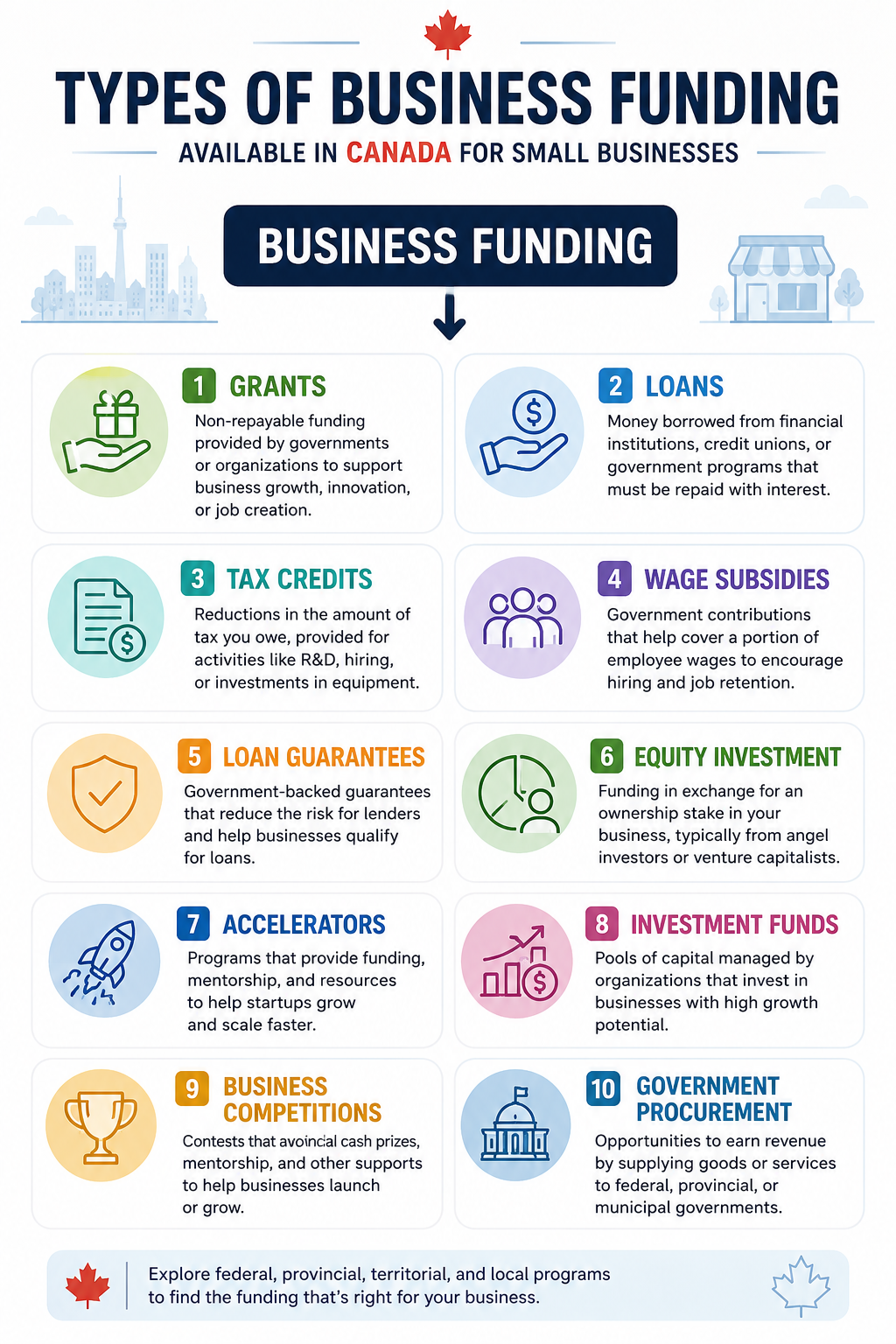
Accessing funding from a variety of sources increases your chances of success.
The Different Types of Business Funding
Business funding comes in many forms, each designed to help businesses achieve different goals and stages of growth.
While grants often receive the most attention because they typically do not require repayment, they represent only one part of Canada’s broader funding landscape. From loans and tax credits to wage subsidies, equity investment and government procurement opportunities, understanding the different types of funding available can help businesses identify more opportunities and build a stronger financing strategy.
Business Grants
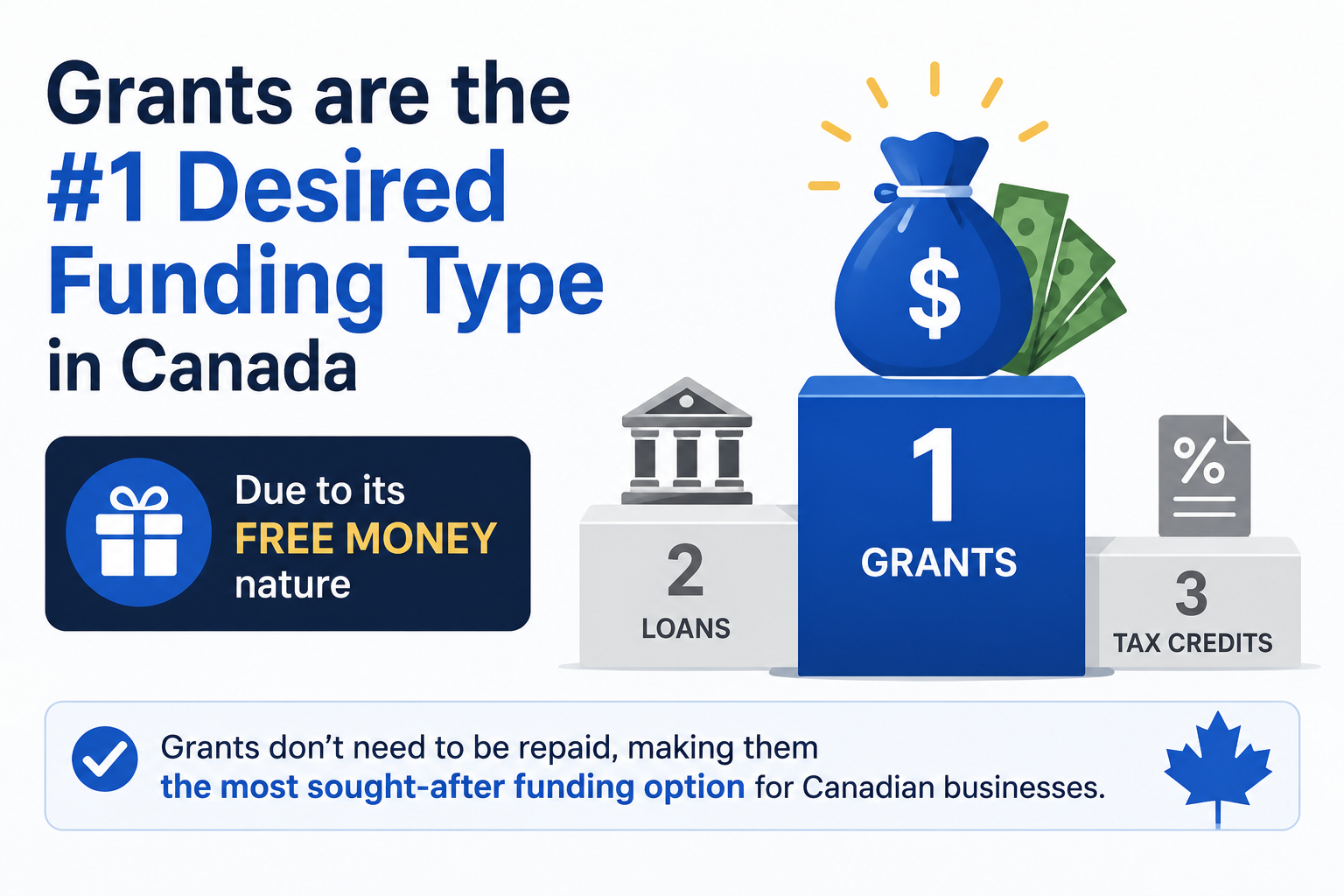
Everyone loves free money!
Business grants provide non-repayable financial assistance to support specific projects such as hiring employees, purchasing equipment, adopting new technology, conducting research or expanding operations. Although grants generally do not require repayment when funding conditions are met, they are highly competitive and typically include eligibility requirements, reporting obligations and restrictions on how the funds can be used.
Business Loans
Loans provide businesses with access to capital that must be repaid over time, usually with interest. Government-backed loans, commercial lending programs and specialized financing organizations may offer more favourable terms than traditional bank financing, particularly for startups, innovation projects or business expansion. Loans remain one of the largest categories of business funding available in Canada.
Tax Credits
Tax credits help reduce the amount of income tax or payroll tax a business owes. Many programs reward activities such as research and development, scientific innovation, digital media production, clean technology investments or employee training. Unlike grants, tax credits are often claimed after eligible expenses have been incurred and may provide significant long-term financial benefits.
Wage Subsidies
Wage subsidy programs reimburse a portion of employee wages to encourage businesses to hire new staff, students, apprentices or individuals from underrepresented groups. These programs help businesses expand their workforce while reducing hiring costs and supporting employment across Canada.
Loan Guarantees
Rather than providing funding directly, loan guarantee programs reduce the lender’s financial risk by guaranteeing a portion of the loan. This helps businesses that may not otherwise qualify for traditional financing obtain the capital they need for startup costs, equipment purchases or expansion projects.
Equity Investment
Equity funding provides businesses with capital in exchange for partial ownership of the company. Unlike loans, equity investments generally do not require repayment, but investors receive a share of future growth and profits. Venture capital firms, angel investors and government-supported investment funds commonly provide equity financing to high-growth businesses.
Accelerators and Incubators
Business accelerators and incubators support entrepreneurs by providing mentorship, training, networking opportunities, office space and, in some cases, seed funding. While many programs provide only modest financial assistance, the business support and industry connections offered through these organizations can be just as valuable as direct funding.
Investment Funds
Public and private investment funds provide financing to businesses pursuing high-growth opportunities, commercialization projects or strategic expansion. Depending on the fund, financing may be structured as loans, equity investments, convertible debt or other forms of business capital.
Business Competitions and Awards
Business competitions provide entrepreneurs with an opportunity to secure funding by presenting their business ideas, products or growth strategies to a panel of judges. Many competitions award non-repayable cash prizes, mentorship, business services or investment opportunities to winning applicants.
Government Procurement Programs
Governments also support businesses by purchasing products and services through procurement programs. While procurement is not grant funding, securing government contracts can generate significant revenue, improve business credibility and create long-term growth opportunities. Many procurement initiatives also include programs designed specifically for Indigenous businesses, innovative companies and small businesses.
Why Understanding Every Funding Type Matters
Many businesses unintentionally limit their funding potential by searching only for grants. While grants are highly desirable because they generally do not require repayment, they also represent one of the most competitive forms of business funding.
By expanding a funding search to include loans, tax credits, wage subsidies, investment programs and private funding, businesses often discover significantly more opportunities to finance their projects. A diversified funding strategy can also reduce financial risk by combining multiple sources of capital rather than relying on a single program.
Why Businesses Overlook Different Types of Funding
Understanding the different forms of business funding is only the first step. Many entrepreneurs unintentionally reduce their financing options because they focus on a single type of funding or misunderstand how Canada’s funding ecosystem operates.
The following misconceptions often prevent businesses from identifying opportunities that may be better suited to their project, industry or stage of growth.
Believing Grants Are the Only Valuable Form of Funding
Because grants generally do not require repayment when program conditions are met, many entrepreneurs build their entire funding strategy around securing grant funding. While grants are highly valuable, they represent only one category within Canada’s broader funding ecosystem.
Government-backed loans, wage subsidies, tax credits, equity investment and procurement opportunities may provide significantly greater financial value depending on the business and the project. Limiting a funding search to grants alone can result in many suitable opportunities being overlooked.
Assuming Every Funding Program Provides Direct Cash
Not every funding program deposits money into a business bank account. Some programs reimburse eligible expenses after they have been incurred, others reduce future tax obligations through tax credits, while wage subsidies help offset payroll costs over time.
Understanding how each funding type works helps businesses choose financing that matches both their project and their cash flow requirements rather than expecting every program to function like a traditional grant.
Choosing Funding Before Defining the Project
Many entrepreneurs begin by asking “Where can I get funding?”
A stronger approach is to first define the business objective.
Whether the project involves purchasing equipment, hiring employees, adopting new technology, expanding exports or developing a new product will often determine which funding categories become available. Businesses that begin with a clearly defined project generally discover far more funding opportunities than those searching broadly for money.
Ignoring Programs That Provide More Than Funding
Some of Canada’s most valuable business support programs provide mentorship, technical expertise, accelerator programs, networking opportunities, commercialization assistance and investor introductions rather than direct financial contributions.
While these programs may not provide immediate capital, they often improve a business’s long-term growth potential and increase its ability to secure future funding or investment.
Evaluating Funding Only by Repayment Requirements
Many entrepreneurs immediately dismiss loans because they require repayment. However, low-interest government financing, loan guarantees and patient capital can sometimes be a more appropriate solution than waiting months for a highly competitive grant decision.
The best funding strategy considers the total value of the program, including financing terms, business support, timing and long-term growth potential, rather than repayment alone.
Frequently Asked Questions About Business Funding Types
Canada’s funding ecosystem extends far beyond traditional business grants. Understanding how different funding types work allows businesses to build stronger financing strategies and identify opportunities that align with their specific projects and growth objectives.
Is a business grant the same as business funding?
No. A business grant is one category within Canada’s broader funding ecosystem. Business funding also includes loans, tax credits, wage subsidies, loan guarantees, equity investment, accelerator programs, investment funds, procurement opportunities and business competitions. Depending on the project, another funding type may be more appropriate than a traditional grant.
Which type of funding offers the greatest financial benefit?
There is no single funding type that is best for every business. Grants provide non-repayable funding, loans offer immediate access to capital, tax credits reduce future tax obligations and wage subsidies lower employment costs. The most valuable option depends on your project, financial needs and business objectives rather than the funding category itself.
Can different funding types be combined?
Often, yes. Many businesses build their financing strategy by combining multiple funding sources. For example, a business may finance equipment through a government-backed loan, hire employees using a wage subsidy and later recover eligible research expenses through a tax credit. Program conditions and stacking rules vary, so applicants should always review each funding agreement carefully.
Why do governments offer so many different funding types?
Different forms of funding are designed to solve different business challenges. Grants encourage investment in priority projects, loans improve access to capital, tax credits reward eligible activities after they occur and wage subsidies support employment growth. Together, these funding tools encourage business development while allowing governments to address a wide range of economic objectives.
Should startups focus only on grants?
Not necessarily. While grants are attractive because they generally do not require repayment, early-stage businesses often benefit from a combination of startup financing, accelerator programs, competitions, mentorship, equity investment and government-backed loans. Exploring multiple funding types can significantly expand the financing options available during the early stages of business growth.
Which funding type is most commonly overlooked?
Tax credits, wage subsidies, procurement opportunities and industry-specific investment programs are frequently overlooked because many entrepreneurs begin and end their funding search with grants. Expanding the search to include all forms of business funding often reveals significantly more opportunities than searching for grants alone.
Choosing the Right Type of Business Funding
Not all business funding works the same way. Some programs provide non-repayable financial assistance, while others offer financing, tax incentives or support for specific business activities. Understanding the differences between each funding type can help you choose the most appropriate financing strategy for your business, project and stage of growth.
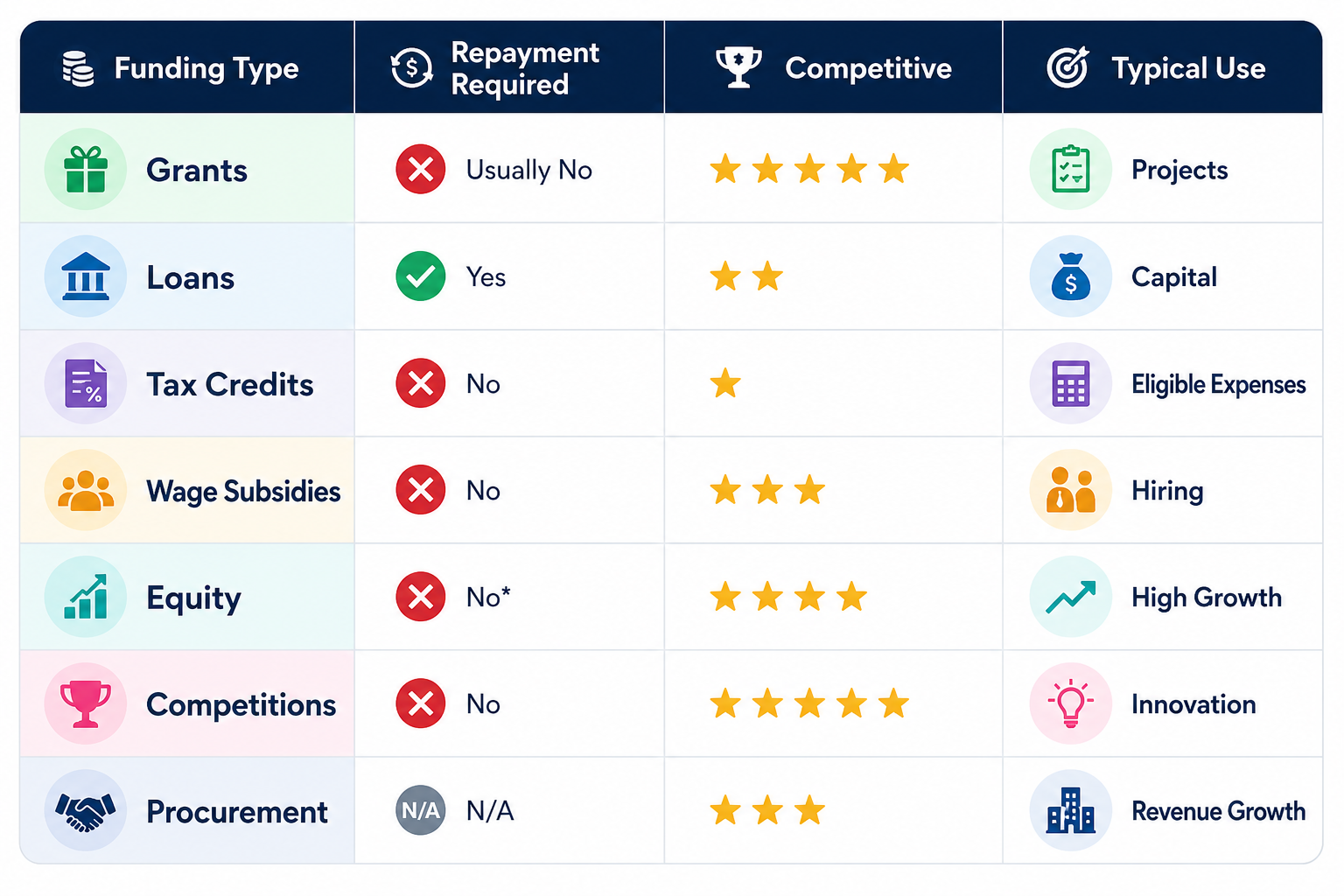
Each type of funding comes with it’s own pro’s and con’s.
Which Level of Government Provides the Most Business Funding?
Many entrepreneurs assume that most business funding comes from the federal government. While the Government of Canada administers many of the country’s largest funding programs, it represents only one part of Canada’s broader funding ecosystem.
Business funding is distributed across multiple levels of government, with each level serving a different purpose and supporting different economic priorities. Federal programs often focus on national objectives such as innovation and exports, while provincial governments invest in regional industries and workforce development. Municipal governments, meanwhile, typically support local economic growth, downtown revitalization and community development.
Rather than asking which level of government offers the most funding, businesses should understand the role each plays within Canada’s overall funding landscape. Exploring opportunities across all levels of government often provides access to significantly more funding than relying on a single source.
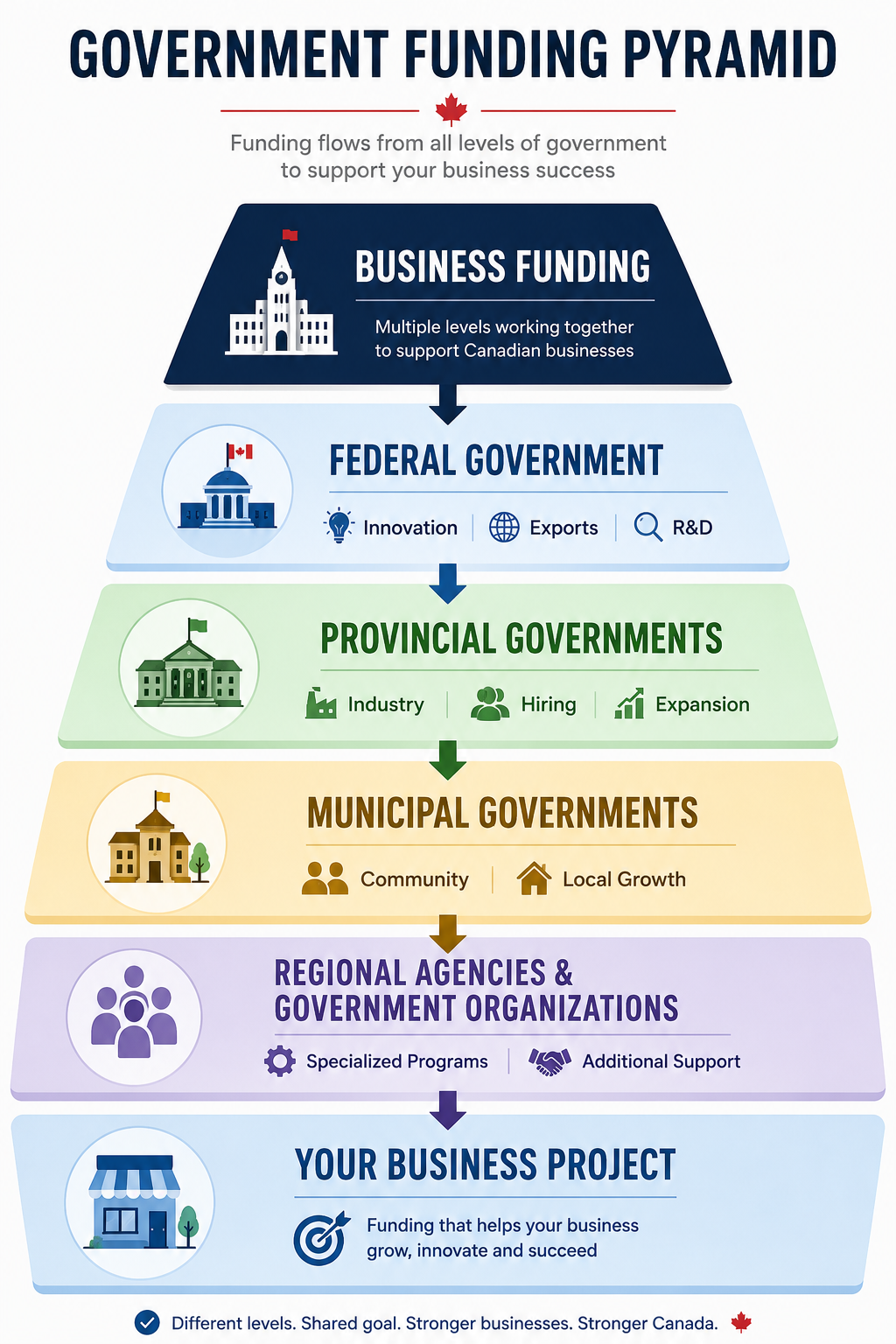
All funding in Canada shares the same goal - growth!
Federal Government Funding
The federal government administers many of Canada’s largest and most recognizable business funding programs. These programs are generally designed to advance national economic priorities, encourage innovation and improve Canada’s long-term competitiveness.
Federal funding commonly supports:
- Research and development
- Artificial intelligence
- Technology commercialization
- Export development
- Clean technology
- Manufacturing modernization
- National workforce development
- Scientific innovation
- Productivity improvements
Because federal programs are often available across multiple provinces, they tend to attract a large number of applicants and are frequently among the most competitive funding opportunities available.
Federal funding is often best suited to businesses pursuing projects with broad economic impact, significant growth potential or national relevance.
Provincial Government Funding
Provincial governments develop funding programs that reflect the unique industries, economic strengths and workforce priorities of their region.
Unlike federal programs, provincial funding is often tailored to local business needs. Manufacturing may receive greater support in one province, while agriculture, tourism, energy, mining or digital industries become priorities elsewhere.
Provincial funding frequently supports:
- Equipment purchases
- Business expansion
- Hiring and workforce development
- Technology adoption
- Export readiness
- Skills training
- Productivity improvements
- Industry modernization
Because these programs are developed locally, businesses often find funding opportunities that are more closely aligned with their industry and operating environment.
Municipal Government Funding
Municipal governments generally administer smaller funding programs, but they often provide some of the most targeted assistance available to local businesses.
Rather than focusing on national economic priorities, municipalities invest in projects that strengthen their own communities and encourage local economic development.
Municipal funding commonly supports:
- Downtown revitalization
- Commercial façade improvements
- Tourism development
- Accessibility improvements
- Green building initiatives
- Community events
- Local hiring
- Small business growth
Many entrepreneurs overlook municipal funding because these programs receive less publicity than federal or provincial initiatives. However, they often provide excellent opportunities for businesses completing projects within a specific city or municipality.
Regional Development Agencies
In addition to traditional levels of government, Canada operates several regional development agencies that deliver funding tailored to specific geographic regions.
These organizations bridge the gap between federal priorities and regional economic needs by supporting businesses through grants, loans, advisory services and commercialization programs.
Regional agencies frequently focus on:
- Rural economic development
- Innovation
- Export growth
- Community investment
- Indigenous entrepreneurship
- Business diversification
- Commercialization
Because these agencies specialize in regional priorities, they often administer funding programs unavailable through general government websites.
Government Agencies and Crown Corporations
Many business funding programs are delivered through specialized government agencies and Crown corporations rather than directly through government departments.
These organizations often focus on particular industries or economic objectives, such as scientific research, agriculture, export financing, clean technology, manufacturing or innovation.
In addition to funding, they may also provide:
- Technical expertise
- Advisory services
- Mentorship
- Industry partnerships
- Commercialization support
- International market development
Working with these organizations often provides businesses access to funding opportunities alongside specialized business support.
Which Level Should You Search First?
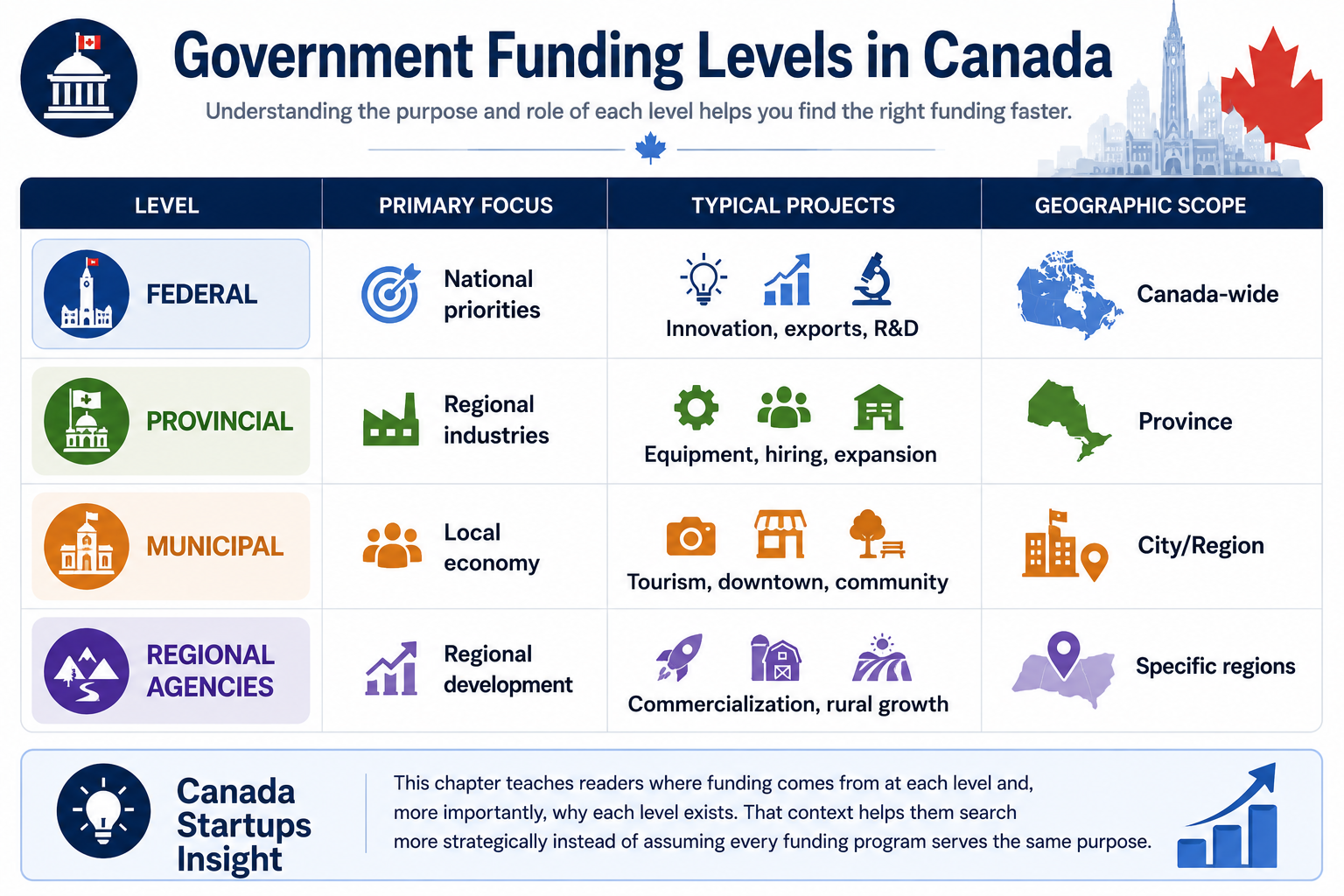
Consider all types of funding!
There is no single level of government that consistently provides the “best” funding opportunities.
Instead, businesses should search across multiple levels simultaneously.
A technology company may qualify for:
- Federal innovation funding
- Provincial technology grants
- Municipal digital adoption incentives
- Regional commercialization funding
Similarly, a tourism business may combine:
- Municipal tourism funding
- Provincial tourism grants
- Federal export or workforce programs
- Regional economic development initiatives
The strongest funding strategies rarely rely on a single funding source. Instead, they identify opportunities across multiple levels of government while ensuring the project satisfies the eligibility requirements of each program.
Canada Startups Insight
Many entrepreneurs begin their funding search by looking only at federal government grants. However, based on Canada Startups’ ongoing research into Canadian funding opportunities, businesses that expand their search to include provincial, municipal, regional development agencies and specialized government organizations often discover significantly more opportunities that align with their projects and business objectives.
Frequently Asked Questions About Government Funding Levels
Funding opportunities exist across multiple levels of government, each with its own priorities, eligibility requirements and funding objectives. Understanding these differences can help businesses build a broader and more effective funding strategy.
Which level of government offers the largest funding programs?
Federal programs often provide some of Canada’s largest individual funding opportunities because they support national priorities such as innovation, exports, clean technology and research. However, provincial programs may offer comparable funding for projects that align closely with regional economic priorities.
Should I search federal funding before provincial funding?
No. The strongest funding strategy is to search both simultaneously. Many businesses qualify for funding at multiple levels of government, and limiting a search to one jurisdiction may result in missed opportunities.
Can I receive funding from more than one level of government?
Often, yes. Businesses may receive funding from federal, provincial and municipal programs for the same project or for different aspects of a project, provided the funding agreements permit it and any stacking limits are respected.
Why do different governments fund different projects?
Each level of government has different responsibilities and economic priorities. Federal programs typically address national objectives, provinces focus on regional industries and workforce development, while municipalities invest in projects that strengthen local communities and economic activity.
How Is Business Funding Distributed Throughout the Year?
One of the biggest misconceptions about business funding is believing that all grants and funding programs are available year-round. In reality, funding providers distribute financial assistance using a variety of application models, each with its own timelines, deadlines and evaluation process.
Some programs remain open throughout the year, while others accept applications only once annually or during scheduled intake periods. Certain funding opportunities are awarded on a first-come, first-served basis, whereas others evaluate every application after the closing date before selecting successful applicants.
Understanding how funding is distributed can help businesses plan ahead, prepare their documentation in advance and avoid missing valuable funding opportunities because they were waiting for the “perfect” grant to open.
The Most Common Funding Distribution Models
Not all funding programs operate the same way. While many businesses focus on finding the right grant or loan, understanding how funding is distributed is just as important. Some programs accept applications year-round, others have fixed annual deadlines, and some close as soon as available funding is exhausted. Knowing the distribution model behind a funding program can help you prepare your application, apply at the right time, and improve your chances of securing funding. The following sections explain the most common funding distribution models and the best strategy for approaching each one.
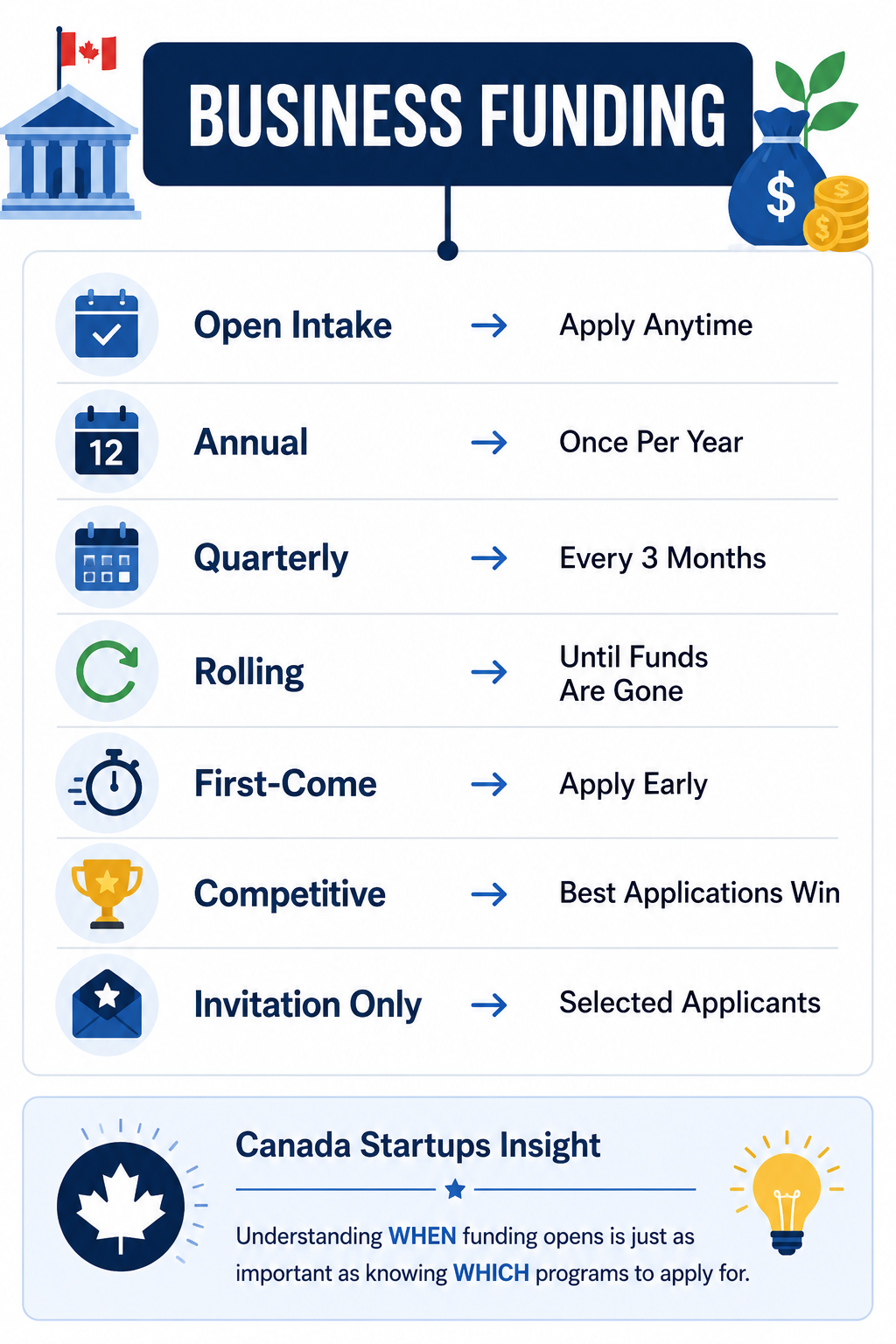
Keeping an eye our regularly ensures you don’t miss any funding options.
Open Intake Programs
Open intake programs accept applications throughout most or all of the year without a fixed application deadline. Businesses can typically apply whenever they are ready, provided funding remains available.
These programs are often used for financing, tax incentives and certain government funding initiatives where applications are reviewed continuously.
Best strategy: Apply as soon as your project is ready rather than delaying unnecessarily.
Annual Funding Programs
Annual programs open once each year and usually have a single application period or deadline. Funding providers review all applications together before selecting successful projects.
Many large innovation, research and sector-specific grant programs follow this model because it allows agencies to compare applications against one another before allocating funding.
Best strategy: Begin preparing several months before the application period opens.
Quarterly Funding Programs
Some organizations distribute funding several times each year through quarterly application rounds. This provides businesses with multiple opportunities to apply without waiting an entire year if they miss one intake.
Quarterly funding is common among private foundations, business competitions, nonprofit organizations and certain industry associations.
Best strategy: If unsuccessful during one intake, strengthen your application and apply during the next funding round.
Rolling Application Programs
Rolling programs evaluate applications continuously as they are received until the available funding has been allocated. Unlike annual programs, businesses do not compete against every applicant at a single deadline.
However, because funding is limited, businesses that apply earlier often have access to more available funding than those who wait until later in the funding cycle.
Best strategy: Apply early whenever possible.
First-Come, First-Served Funding
Some funding programs approve applications in the order they are received until the available budget has been fully committed.
These programs often close without warning once funding has been exhausted, making preparation especially important.
Businesses that already have their business plan, financial information and supporting documents prepared are generally in a much stronger position to submit applications quickly after a program opens.
Best strategy: Be prepared before the program launches.
Competitive Funding Programs
Competitive funding programs evaluate all eligible applications before deciding which projects will receive funding.
Rather than approving applications based on submission order, funding providers compare projects against one another using evaluation criteria such as innovation, economic impact, project feasibility and alignment with program objectives.
Many government grants operate under this model.
Best strategy: Focus on submitting the strongest application - not simply the earliest one.
Invitation-Only Programs
Some funding opportunities cannot be applied for directly. Instead, businesses are invited to participate after being nominated, completing earlier stages of a program or meeting specific investment or commercialization milestones.
Invitation-only funding is common among venture capital programs, accelerators, research partnerships and certain government innovation initiatives.
Although less common, these programs often provide substantial financial support alongside mentoring, commercialization assistance and strategic partnerships.
Best strategy: Build relationships within your industry and participate in programs that may lead to future invitations.
Common Misconceptions About Funding Timelines
Understanding when funding becomes available is just as important as understanding the eligibility requirements. Many businesses miss funding opportunities not because they fail to qualify, but because they misunderstand how funding programs are scheduled and administered.
The following misconceptions often lead businesses to miss deadlines, delay applications or overlook funding opportunities that may have been available throughout the year.
Believing Every Funding Program Accepts Applications Year-Round
One of the most common misconceptions is that business funding is always available whenever a business needs it. While some programs operate on an open or rolling basis, many others accept applications only during specific intake periods.
Some grants open once each year, others operate quarterly, while many competitive funding programs remain open for only a few weeks before closing. Waiting until funding is urgently needed may mean missing the next application cycle entirely.
Businesses that understand funding schedules are often in a much stronger position because they can prepare projects months before applications become available.
Waiting for a Grant to Open Before Preparing
Many entrepreneurs delay preparing business plans, financial projections, supplier quotations and supporting documentation until a funding program officially opens.
By the time applications become available, deadlines may be only a few weeks away, leaving little time to gather documentation or strengthen the proposal. This often results in rushed applications, incomplete submissions and avoidable mistakes.
Businesses that prepare continuously throughout the year can respond much faster when suitable funding opportunities become available.
Assuming Every Funding Provider Uses the Same Application Model
Not all funding programs operate the same way. Some evaluate applications immediately upon submission, while others wait until the closing date before reviewing every application together.
Likewise, first-come, first-served programs reward businesses that apply early, while competitive programs place greater emphasis on the quality of the application than the submission date.
Understanding how each funding provider distributes funding allows businesses to develop a more effective application strategy instead of approaching every program the same way.
Thinking Missing One Deadline Means Missing Funding
Many entrepreneurs become discouraged after missing the deadline for a particular grant and assume they must wait another year before applying for funding.
In reality, Canada’s funding landscape consists of thousands of programs offered by governments, nonprofit organizations, private companies and industry associations throughout the year. While one funding opportunity may close, another with similar objectives may open shortly afterward.
Businesses that continue monitoring the funding landscape often discover alternative programs that better match their project than the opportunity they originally missed.
Assuming Funding Timelines Never Change
Funding schedules are not fixed forever. Governments regularly introduce new programs, extend existing initiatives, postpone intake periods or close programs after budgets have been fully allocated.
Economic conditions, government priorities and annual budgets all influence when funding becomes available. Businesses that monitor funding regularly rather than relying on historical opening dates are generally better prepared to respond when new opportunities are announced.
Frequently Asked Questions About Funding Timelines
Business funding is released using a variety of application models throughout the year, and understanding these schedules can significantly improve your funding strategy. The following questions address some of the most common timing-related questions entrepreneurs have when planning their funding search.
Are business grants available throughout the entire year?
Some are, but many are not. Canada’s funding ecosystem includes open intake, rolling, annual, quarterly, competitive and invitation-only programs, each with its own schedule and application process.
Rather than assuming funding is always available, businesses should monitor programs throughout the year and understand when their preferred funding opportunities typically open. Maintaining up-to-date business documents also allows businesses to respond quickly when new programs become available.
What is the difference between rolling intake and first-come, first-served funding?
Although these terms are often confused, they operate differently.
Rolling intake programs review applications continuously as they are received, and applicants may continue applying until the program closes.
First-come, first-served programs also accept applications continuously, but funding is allocated in submission order until the available budget has been exhausted. In these programs, delaying an application can significantly reduce the likelihood of receiving funding, even if the business is fully eligible.
When should I begin preparing for business funding?
Ideally, preparation should begin well before a funding program opens. Business plans, financial projections, project budgets, supplier quotations and other supporting documentation often require considerable time to prepare.
Businesses that maintain funding-ready documents throughout the year are generally able to submit stronger applications and respond more quickly when suitable funding opportunities become available.
What happens if I miss a funding deadline?
Missing a deadline rarely means losing access to business funding altogether. Many organizations reopen programs annually, while others introduce new funding initiatives throughout the year.
Rather than waiting for the same program to return, businesses should continue monitoring other funding providers, as alternative grants, loans, tax credits or private funding opportunities may already be available for similar projects.
How often do new funding programs open?
New funding opportunities become available throughout the year as governments announce budgets, agencies launch initiatives, private organizations introduce competitions and existing programs reopen for new intake periods.
Because there is no single national funding calendar, businesses that monitor funding regularly are often able to identify new opportunities much earlier than those searching only when immediate financing is needed.
Is it better to apply early or wait until the deadline?
The answer depends on the funding model. For first-come, first-served and many rolling intake programs, applying early is often advantageous because funding may become fully allocated before the published closing date.
For competitive funding programs, however, success is usually determined by the strength of the application rather than the submission date. Regardless of the model, businesses should avoid waiting until the final days before a deadline, as this increases the risk of incomplete applications and missed requirements.
Canada’s Largest Business Funding Categories
While funding is often associated with specific industries or levels of government, most business funding programs are actually built around projects and business activities rather than the business itself.
In other words, funding providers generally do not ask, “What industry does this business operate in?” Instead, they ask, “What is the business trying to accomplish?”
Across Canada’s funding landscape, certain categories of business investment consistently receive the greatest level of financial support because they align with government priorities such as job creation, productivity, innovation, exports and economic growth.
The chart below highlights some of the most commonly funded business activities across Canada.
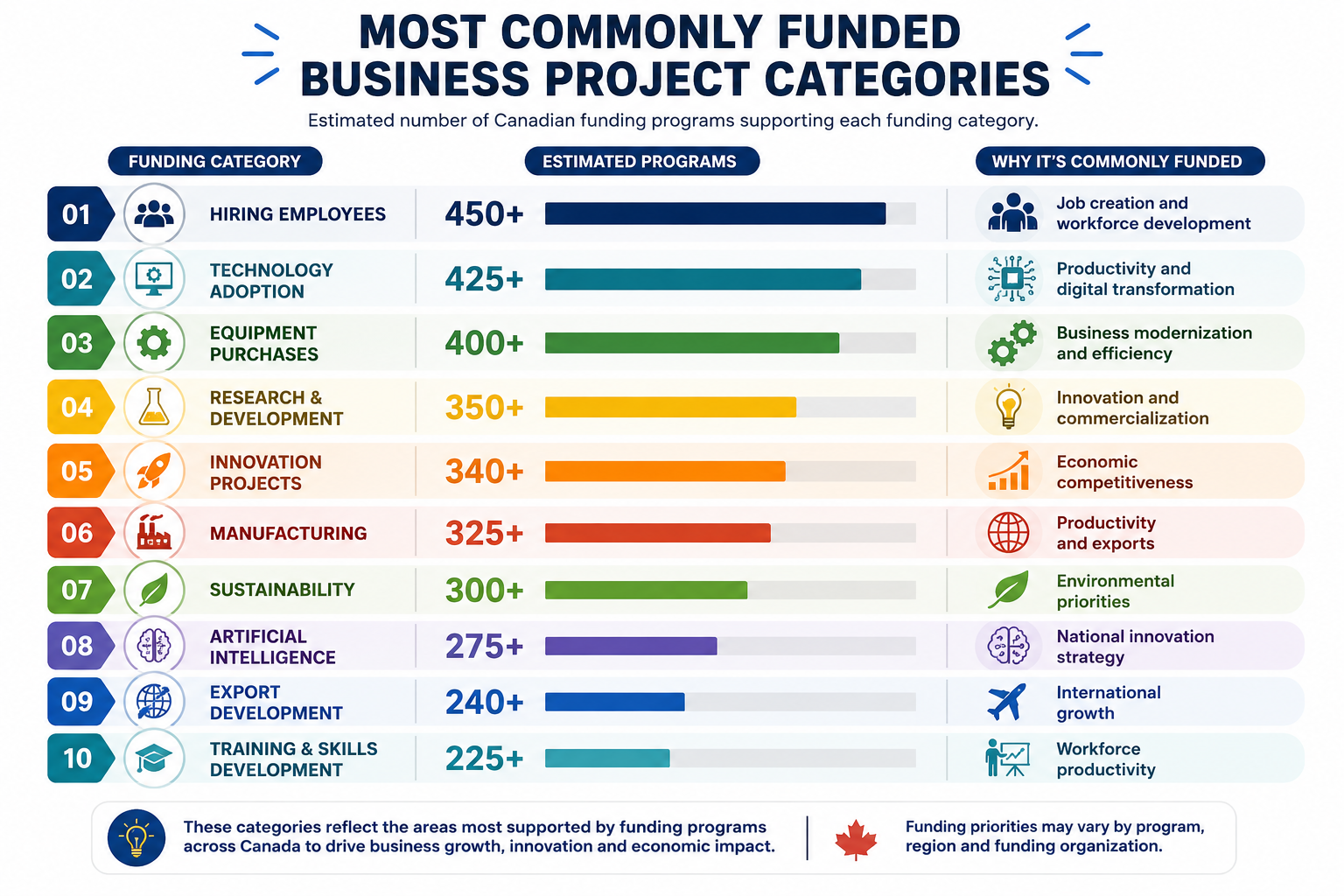
Funding is available across all industries
Why These Categories Receive More Funding
Rather than distributing funding equally across every type of business expense, governments and funding organizations prioritize projects that generate measurable economic outcomes. These categories consistently receive greater support because they contribute directly to Canada’s long-term economic objectives.
Hiring Employees
Job creation remains one of the highest priorities for governments at every level. Businesses that create new employment opportunities contribute to stronger local economies, increased household income and long-term economic growth.
Funding frequently supports:
- New employees
- Apprentices
- Students
- Internships
- Workforce expansion
- Skills development
Technology Adoption
Helping businesses adopt modern technology improves productivity, competitiveness and long-term growth.
Funding often supports:
- Software implementation
- Digital transformation
- Automation
- Cybersecurity
- Cloud systems
- Digital infrastructure
Equipment Purchases
Many businesses require significant capital investment to expand production, improve efficiency or increase capacity.
Funding commonly supports:
- Machinery
- Manufacturing equipment
- Agricultural equipment
- Medical equipment
- Construction equipment
- Specialized technology
Research & Development
Research and development drives innovation across Canada’s economy.
Programs frequently support:
- Product development
- Scientific research
- Prototype creation
- Commercialization
- Laboratory testing
- Experimental development
Innovation
Innovation funding extends beyond formal research.
Businesses introducing new products, improving processes or commercializing technologies often qualify for programs encouraging productivity and economic competitiveness.
Manufacturing
Manufacturing receives extensive funding because it supports exports, supply chains and domestic production.
Programs frequently encourage:
- Automation
- Facility modernization
- Equipment upgrades
- Export readiness
- Productivity improvements
Sustainability
Governments continue increasing investment in environmentally responsible business practices.
Funding commonly supports:
- Energy efficiency
- Emissions reduction
- Renewable energy
- Waste reduction
- Green buildings
- Environmental innovation
Artificial Intelligence
Artificial Intelligence has become one of Canada’s fastest-growing funding priorities.
Programs encourage businesses to:
- Develop AI products
- Adopt AI systems
- Improve productivity
- Commercialize AI technologies
- Train AI workforces
Export Development
Helping Canadian businesses expand internationally strengthens the economy while increasing trade.
Funding commonly supports:
- Trade missions
- International marketing
- Market research
- Export certification
- Regulatory compliance
Training & Workforce Development
Businesses investing in employee development frequently qualify for funding.
Programs often support:
- Professional training
- Technical certifications
- Apprenticeships
- Leadership development
- Skills upgrading
Canada Startups Insight
One of the biggest misconceptions entrepreneurs have is believing funding is awarded because of the type of business they own. In reality, funding providers are usually investing in what the business plans to do rather than what the business already is.
A retail business purchasing advanced software may qualify for technology funding, while a manufacturing company hiring apprentices may access workforce development funding. Understanding the project behind the funding often reveals opportunities that businesses would otherwise overlook.
Why Businesses Miss Funding in These Categories
Understanding the most commonly funded business activities is only part of building a successful funding strategy. Many businesses miss valuable funding opportunities because they misunderstand how funding providers categorize projects and evaluate applications.
Rather than organizing funding strictly by industry, many programs are built around the outcomes a project will deliver. Businesses that understand this distinction are often able to identify significantly more funding opportunities than those searching only for general business grants.
Thinking Funding Is Based Primarily on Industry
Many entrepreneurs begin their funding search by looking for grants specifically targeted to their industry. While industry is often an important eligibility factor, it is rarely the only one, and in many cases, it is not the primary consideration.
Funding providers frequently organize programs around business activities such as hiring employees, adopting new technology, purchasing equipment, improving sustainability or expanding into export markets. These funding categories often apply across multiple industries.
For example, a construction company investing in artificial intelligence may qualify for technology funding, while a retail business purchasing energy-efficient equipment may be eligible for sustainability funding. Businesses that search only by industry often overlook funding opportunities tied directly to the project they intend to undertake.
Trying to Fund General Operating Costs Instead of Growth Projects
One of the most common misconceptions is believing business funding exists primarily to help cover everyday operating expenses such as rent, utilities, existing payroll or general working capital.
Most funding providers take a very different approach. They invest in projects expected to create measurable economic outcomes, including business expansion, job creation, productivity improvements, technology adoption, exports or environmental sustainability.
Businesses that separate day-to-day operating expenses from strategic growth investments often identify far more funding opportunities because they begin thinking in terms of projects rather than expenses.
Assuming One Project Qualifies for Only One Funding Category
Many entrepreneurs assume they must find a single funding program that perfectly matches their project. In reality, one business investment may satisfy the objectives of several different funding categories simultaneously.
For example, purchasing automated manufacturing equipment could support manufacturing modernization, technology adoption, productivity improvement, workforce development and environmental sustainability, depending on how the project is structured and which funding provider is evaluating it.
Looking at a project from multiple perspectives often uncovers funding opportunities that would never appear during a traditional grant search.
Focusing on the Expense Instead of the Economic Outcome
Funding providers are rarely interested in what a business wants to purchase alone. They are far more interested in what that purchase will accomplish.
A request for funding to purchase software is generally less compelling than explaining how the software will automate operations, improve productivity, create new jobs, increase exports or strengthen competitiveness.
The strongest funding applications connect every proposed expense to a measurable business or economic outcome. Businesses that explain the value their project will create often submit much stronger applications than those focused only on the cost of the investment.
Overlooking Funding Categories Outside the Original Project
Many projects naturally evolve as businesses begin planning them. Hiring new employees may require staff training, purchasing equipment may involve technology upgrades, and expanding production may create export opportunities.
Rather than viewing a project as a single expense, businesses should consider every component of the investment. A project involving equipment, technology, workforce development and sustainability improvements may qualify under several funding categories instead of just one.
Thinking broadly about the project often leads to a broader range of funding opportunities.
Frequently Asked Questions About Funding Categories
Funding providers organize programs around the types of projects they are trying to encourage rather than simply the industries they support. Understanding how these funding categories work can help businesses identify more opportunities and build stronger funding strategies.
Are funding programs based on the business or the project?
Most funding providers evaluate the proposed project before they evaluate the business itself. While factors such as industry, location, business stage and ownership may influence eligibility, the project often determines which funding opportunities become available.
For example, two businesses operating in completely different industries may both qualify for the same technology funding program if they are implementing similar digital transformation projects. Understanding this distinction often helps businesses discover funding opportunities they might otherwise overlook.
Can one project qualify under multiple funding categories?
Yes. Many projects naturally align with several funding priorities at the same time.
A manufacturing expansion, for example, may involve purchasing equipment, hiring employees, implementing automation, improving energy efficiency and increasing export capacity. Each of these activities may qualify under different funding categories depending on the objectives of individual funding providers.
Viewing projects from multiple perspectives often increases the number of funding opportunities available.
Why do hiring, technology and equipment receive so much funding?
These categories consistently receive significant funding because they generate measurable economic outcomes that align closely with government priorities.
Hiring creates employment, technology improves productivity, equipment modernizes businesses and innovation strengthens Canada’s long-term competitiveness. Because these investments contribute directly to economic growth, governments continue to prioritize them across many funding programs.
What types of expenses are least likely to receive funding?
General operating expenses are typically among the least commonly funded business costs.
Expenses such as rent, existing payroll, debt repayment, inventory for everyday operations and owner compensation usually do not generate the measurable economic outcomes that many funding programs are designed to encourage. While exceptions exist, most funding providers focus on investments that help businesses grow rather than simply maintain existing operations.
Can businesses outside these major funding categories still receive funding?
Absolutely.
The categories highlighted in this chapter represent some of the most commonly funded business activities, not the only ones. Businesses across virtually every industry and sector can qualify for funding when their projects align with a funding provider’s objectives.
Rather than asking whether your business fits a funding category, a better question is whether your project creates the outcomes the funding program was designed to support.
How Canada’s Business Funding Priorities Have Changed
Canada’s business funding landscape has changed significantly over the past two decades. While governments have always invested in entrepreneurship and economic development, the priorities behind that investment have evolved alongside technological advancement, global economic conditions and changing national objectives.
Funding that was once focused primarily on job creation, manufacturing and regional development has gradually expanded to include digital transformation, artificial intelligence, environmental sustainability, commercialization and global competitiveness.
Understanding how funding priorities have changed provides valuable insight into where funding is likely to continue growing in the years ahead.
The Evolution of Business Funding in Canada
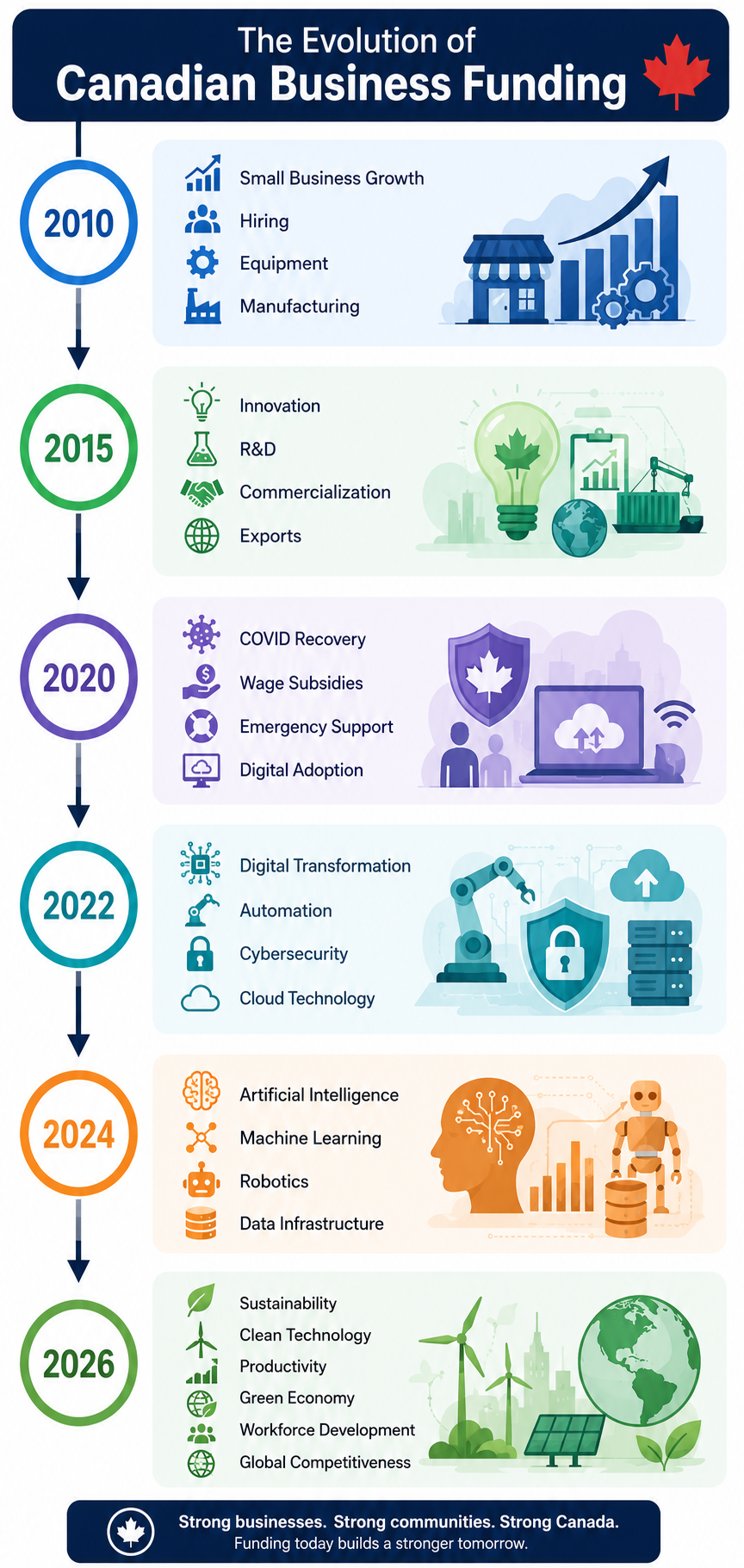
Funding continues to evolve based on the market and demand
2010 - Supporting Small Business Growth
Around the beginning of the decade, many funding programs focused on helping businesses recover from the global financial crisis while encouraging entrepreneurship and economic stability.
Common priorities included:
- Small business startup support
- Job creation
- Equipment purchases
- Manufacturing expansion
- Regional economic development
- Workforce development
Governments invested heavily in helping businesses create employment opportunities and strengthen local economies through traditional business growth initiatives.
2015 - Innovation and Commercialization
As Canada’s economy became increasingly knowledge-driven, funding priorities shifted toward innovation and helping businesses commercialize new products and technologies.
Governments expanded support for:
- Research & Development
- Product commercialization
- Startup ecosystems
- Technology companies
- Digital innovation
- Export development
This period saw increased investment in helping Canadian businesses compete internationally through innovation rather than production alone.
2020 - COVID-19 Business Recovery
The COVID-19 pandemic dramatically changed Canada’s funding landscape.
Governments introduced unprecedented financial support designed to help businesses survive economic disruption while protecting employment across the country.
Funding priorities expanded to include:
- Emergency business support
- Wage subsidies
- Rent assistance
- Business continuity
- Recovery programs
- Digital adaptation
Although many emergency programs have since ended, they permanently changed how governments respond to economic crises and highlighted the importance of rapid funding delivery.
2022 - Accelerating Digital Transformation
Following the pandemic, funding priorities shifted toward helping businesses modernize and improve productivity through technology.
Governments increasingly supported projects involving:
- Digital transformation
- Cloud technologies
- Automation
- Cybersecurity
- E-commerce
- Business modernization
Rather than simply helping businesses recover, funding programs began encouraging businesses to become more competitive through technology adoption.
2024 - Artificial Intelligence and Advanced Technologies
Artificial Intelligence quickly became one of Canada’s fastest-growing funding priorities.
Governments recognized AI as a strategic driver of productivity, innovation and long-term economic competitiveness, resulting in significant investment across multiple industries.
Funding expanded to support:
- Artificial Intelligence
- Machine learning
- Data infrastructure
- Robotics
- Advanced manufacturing
- AI commercialization
Importantly, AI funding extended beyond technology companies. Businesses in manufacturing, healthcare, agriculture, retail and professional services also became eligible for programs encouraging AI adoption.
2025–2026 - Sustainability and Canada’s Future Economy
Today’s funding landscape reflects a broader vision for Canada’s future economy.
While innovation remains a major priority, governments are increasingly investing in projects that improve environmental sustainability, strengthen domestic supply chains and prepare businesses for long-term economic transformation.
Current funding priorities commonly include:
- Clean technology
- Energy efficiency
- Green manufacturing
- Artificial Intelligence
- Productivity improvement
- Export competitiveness
- Workforce development
- Commercialization
- Supply chain resilience
Businesses whose projects align with these priorities often have access to a broader range of funding opportunities than those focused solely on traditional business expansion.
Looking Ahead: The Future of Business Funding in Canada
While no one can predict exactly which funding programs governments and organizations will introduce in the future, the overall direction of Canada’s business funding landscape has become increasingly clear. Funding priorities continue to evolve alongside economic conditions, technological advancement, environmental objectives and workforce needs.
Based on Canada Startups’ ongoing analysis of Canadian funding opportunities, businesses can expect continued emphasis on projects that improve productivity, encourage innovation and strengthen Canada’s long-term economic competitiveness.
Areas that have seen consistent growth in funding opportunities include:
- Artificial Intelligence (AI) and machine learning adoption
- Clean technology, emissions reduction and decarbonization
- Advanced manufacturing and industrial automation
- Cybersecurity and digital infrastructure
- Workforce development, skills training and labour shortages
- Supply chain resilience and domestic production
- Digital transformation across traditional industries
- Research, commercialization and Canadian innovation
While the specific funding programs, eligibility requirements and available budgets will continue to change, the underlying economic objectives behind these investments have remained remarkably consistent. Governments continue to prioritize projects that create jobs, improve productivity, strengthen exports, encourage innovation and support a more sustainable and globally competitive Canadian economy.
For entrepreneurs, this means thinking beyond today’s funding opportunities and considering how future projects align with the long-term direction of Canada’s economy. Businesses that invest in technology, workforce development, sustainability and innovation are likely to remain well positioned as new funding initiatives emerge.
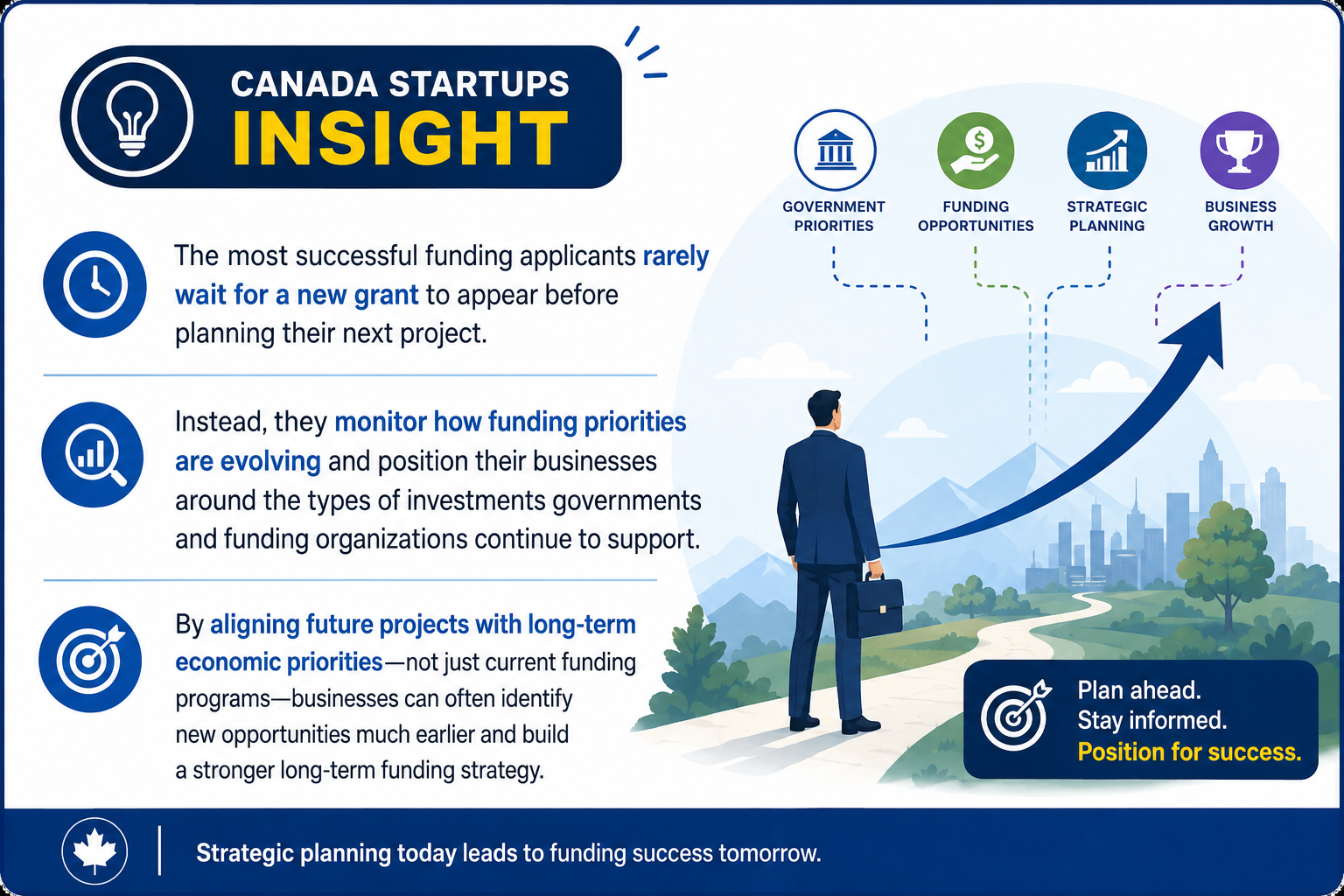
Plan ahead and stay informed - position for success!
Canada Startups Funding Insights: What Our Data Reveals
Canada’s business funding landscape can be difficult to understand through public program listings alone. To identify what entrepreneurs are actually searching for, where funding demand is concentrated and which challenges prevent businesses from moving forward, Canada Startups reviewed activity across its funding database, expert funding searches, member accounts and application support platform.
The findings reveal a clear pattern: Canadian entrepreneurs are most frequently looking for funding to hire employees, launch businesses and purchase equipment. They are also often seeking relatively modest funding amounts, with the largest share requesting $25,000 or less.
The data also highlights a significant preparedness gap. Many applicants begin searching for funding before completing a business plan, financial projections or other documents commonly requested by funding providers.
The following insights are based on Canada Startups’ internal platform and member activity from January 1st 2026 to July 28th 2026.
Canada Startups Platform at a Glance
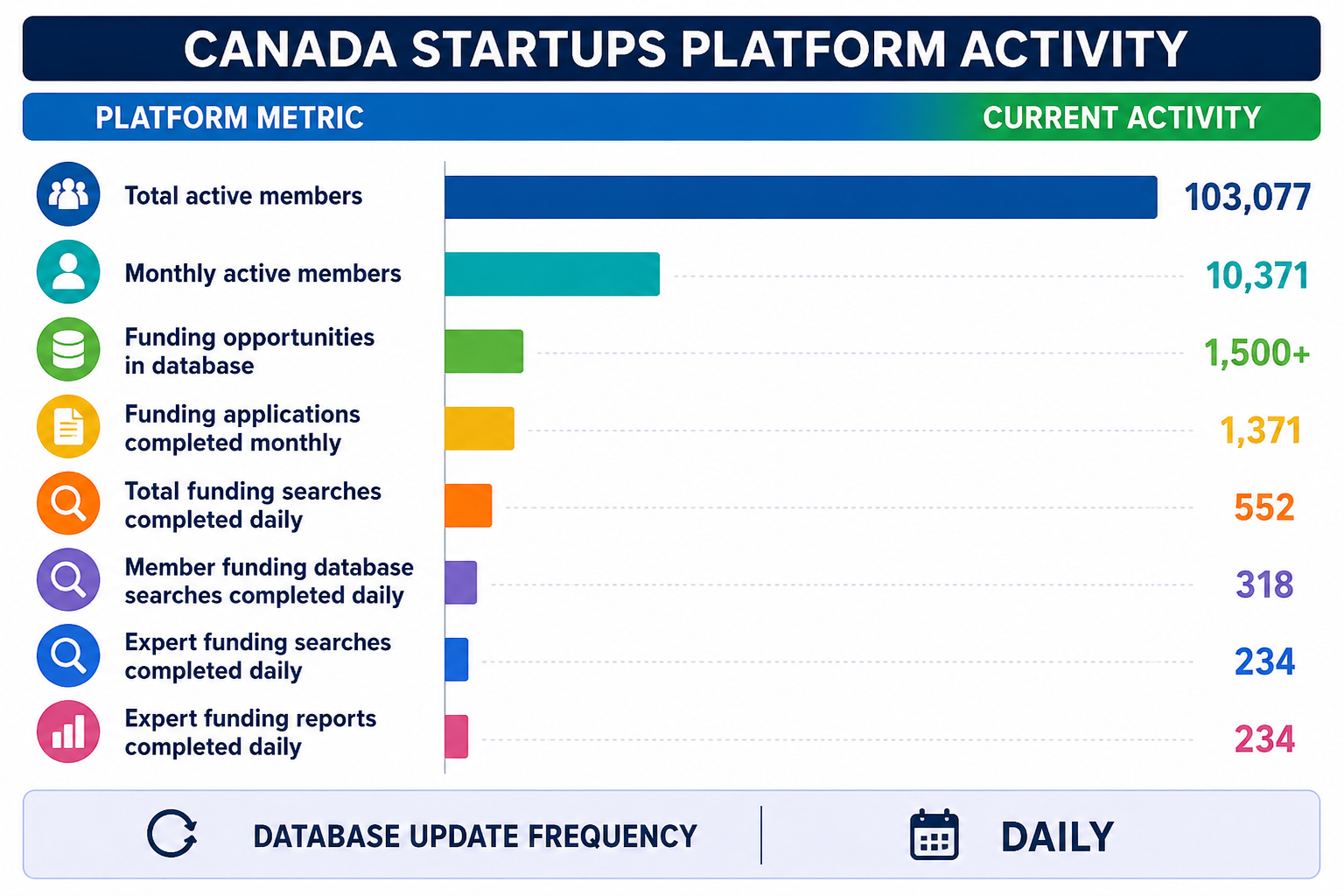
Stats from the Canada Startups Platform for January 2026 to July 2026
What Types of Funding Do Entrepreneurs Search for Most?
Canada Startups’ internal search activity shows that entrepreneurs are not searching only for general business grants. Their searches are usually connected to a specific business objective, such as hiring employees, launching a business, purchasing equipment or expanding operations.
The ten most common funding searches are:
- Grants for Hiring
- Startup Funding
- Business Grants
- Wage-support grants
- Equipment grants
- Grants to start a business
- Grants to expand
- Technology grants
- First-time business grants
- Women in business grants
What the search data tells us
Hiring and wage support appear near the top of the list, reinforcing the importance of employment-related funding within Canada’s business funding ecosystem. Entrepreneurs are also strongly focused on startup costs, equipment and expansion.
The results indicate that most businesses are not simply searching for unrestricted cash. They are trying to finance a defined stage or expense, including launching, hiring, purchasing equipment or implementing technology.
The prominence of searches for first-time businesses and startup funding also reflects the large number of early-stage entrepreneurs using the platform.
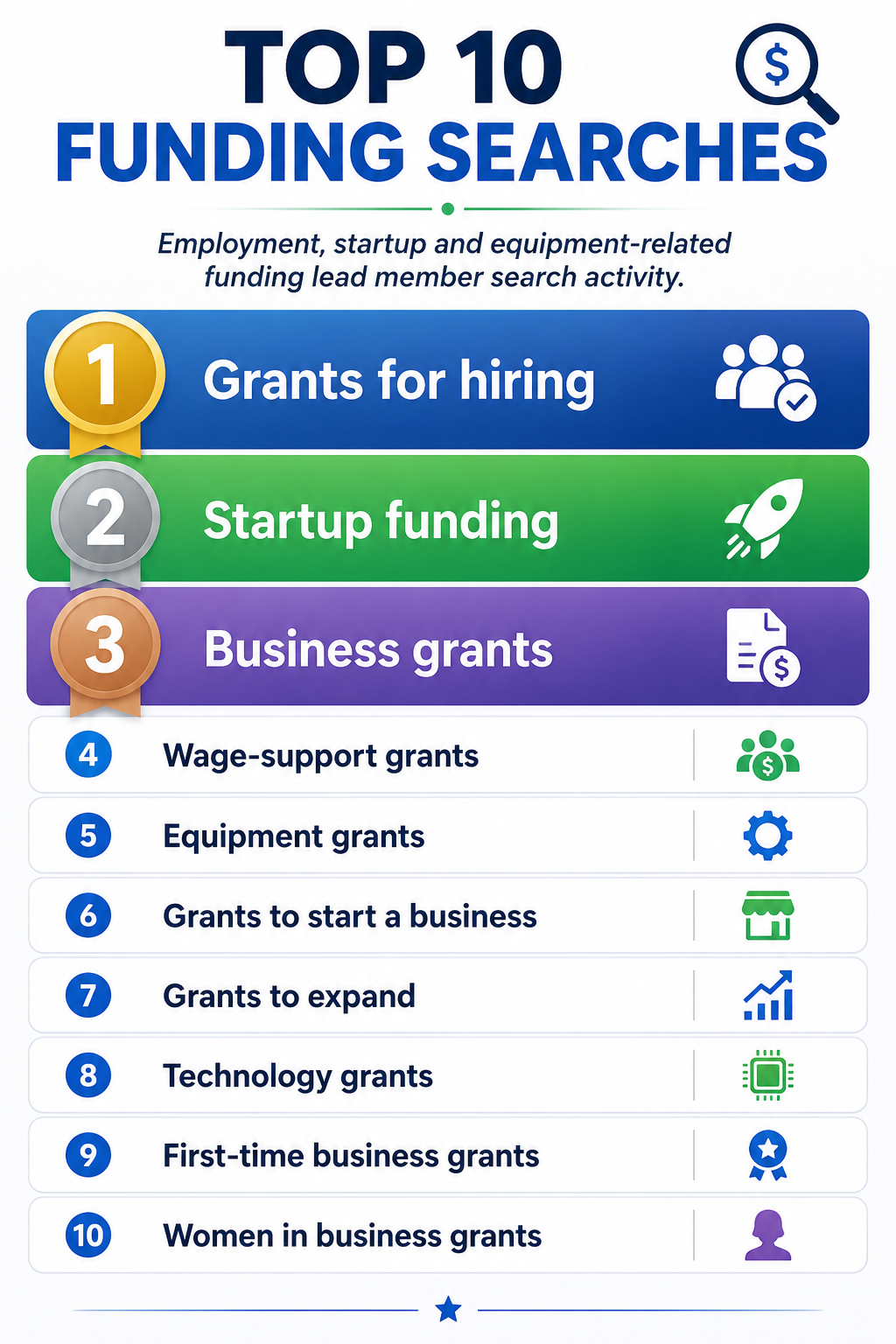
Grants remain highest priority for Canada Startup members
Which Provinces Generate the Most Funding Searches?
Funding search activity is concentrated primarily in Canada’s four largest provincial business markets.
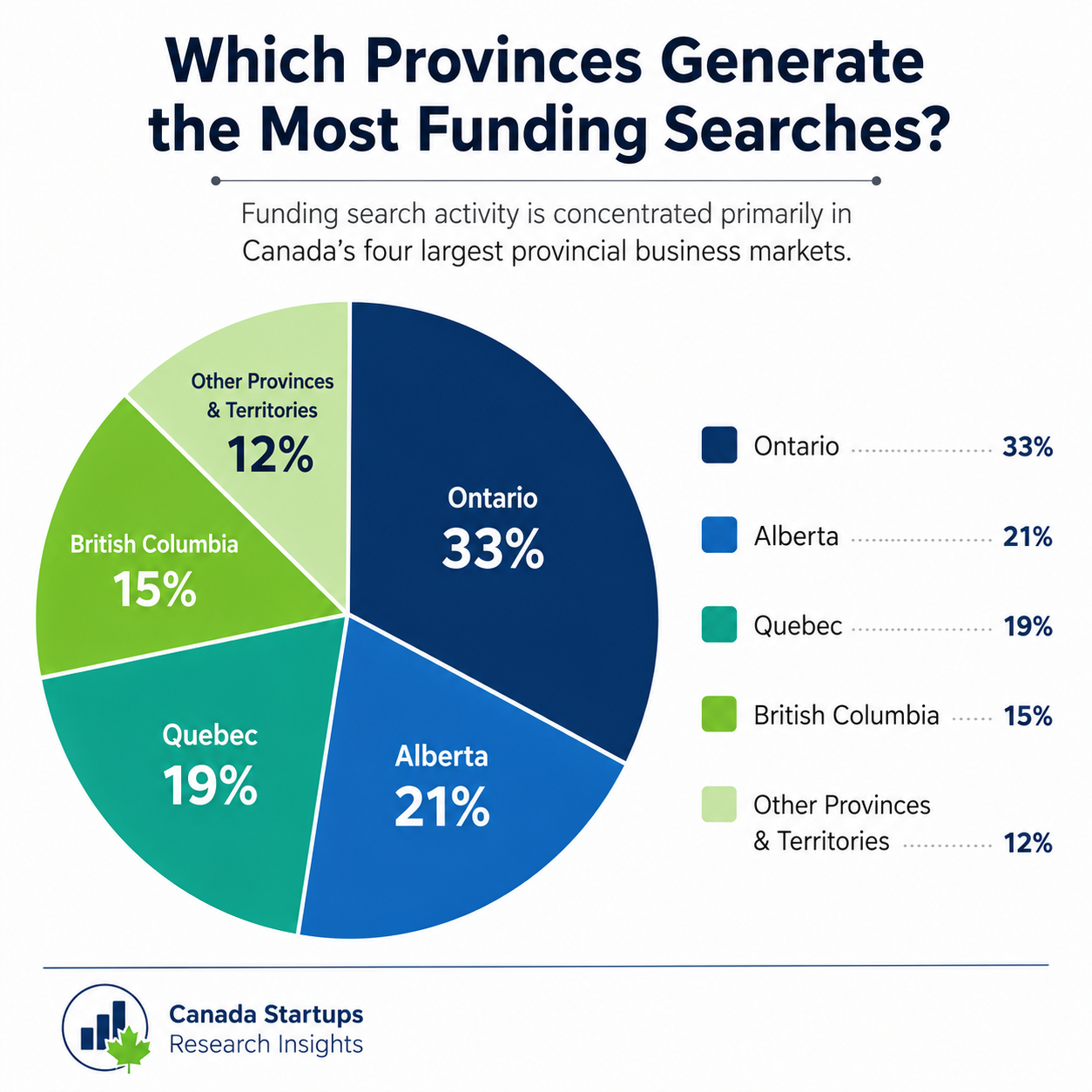
Search share reflects Canada Startups platform activity and should not be interpreted as each province’s share of total Canadian funding.
Ontario represents approximately one-third of the provincial funding searches recorded, followed by Alberta, Quebec and British Columbia.
This does not necessarily mean these provinces provide easier access to funding. Higher search activity is influenced by population, business density, platform membership and the number of entrepreneurs actively seeking support.
Alberta’s strong share is particularly notable because it exceeds British Columbia and approaches Quebec, indicating substantial demand for startup, agriculture, energy, technology, equipment and business-expansion funding.
The remaining 12% of searches are distributed across Manitoba, Saskatchewan, Atlantic Canada and the territories. Although search volume is lower in these regions, businesses may have access to specialized rural, regional and industry-specific funding opportunities.
Which Industries Search for Funding Most Often?
The most frequently searched industries on the Canada Startups platform are:
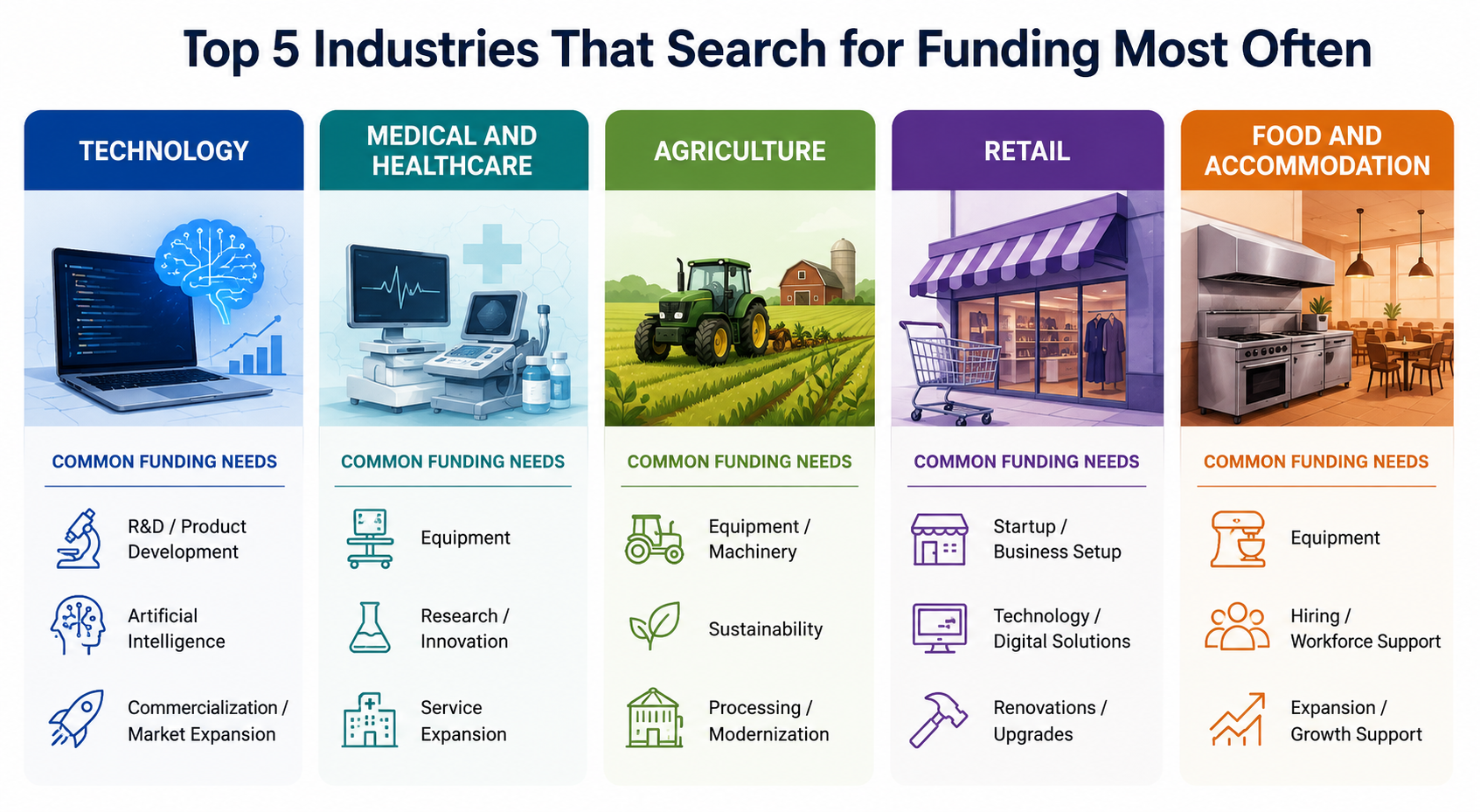
Funding exists across all industries, however the top 5 by far outperform in terms of max availability of funding
- Technology
- Medical and healthcare
- Agriculture
- Retail
- Food and accommodation
These industries represent a mix of innovation-driven sectors and traditional small-business categories.
Technology businesses frequently search for funding related to product development, artificial intelligence, software, commercialization and digital adoption. Medical and healthcare businesses often seek support for equipment, research, product development and service expansion.
Agriculture remains a major funding category because businesses require capital for equipment, sustainability, food production and modernization. Retail and food-and-accommodation businesses commonly search for startup funding, equipment, hiring, renovations, technology and expansion support.
The results also demonstrate that funding demand is not concentrated exclusively in advanced technology. Traditional sectors continue to represent a significant portion of the businesses looking for financial support.
How Much Funding Do Businesses Request?
The largest share of businesses are seeking relatively modest amounts of funding.
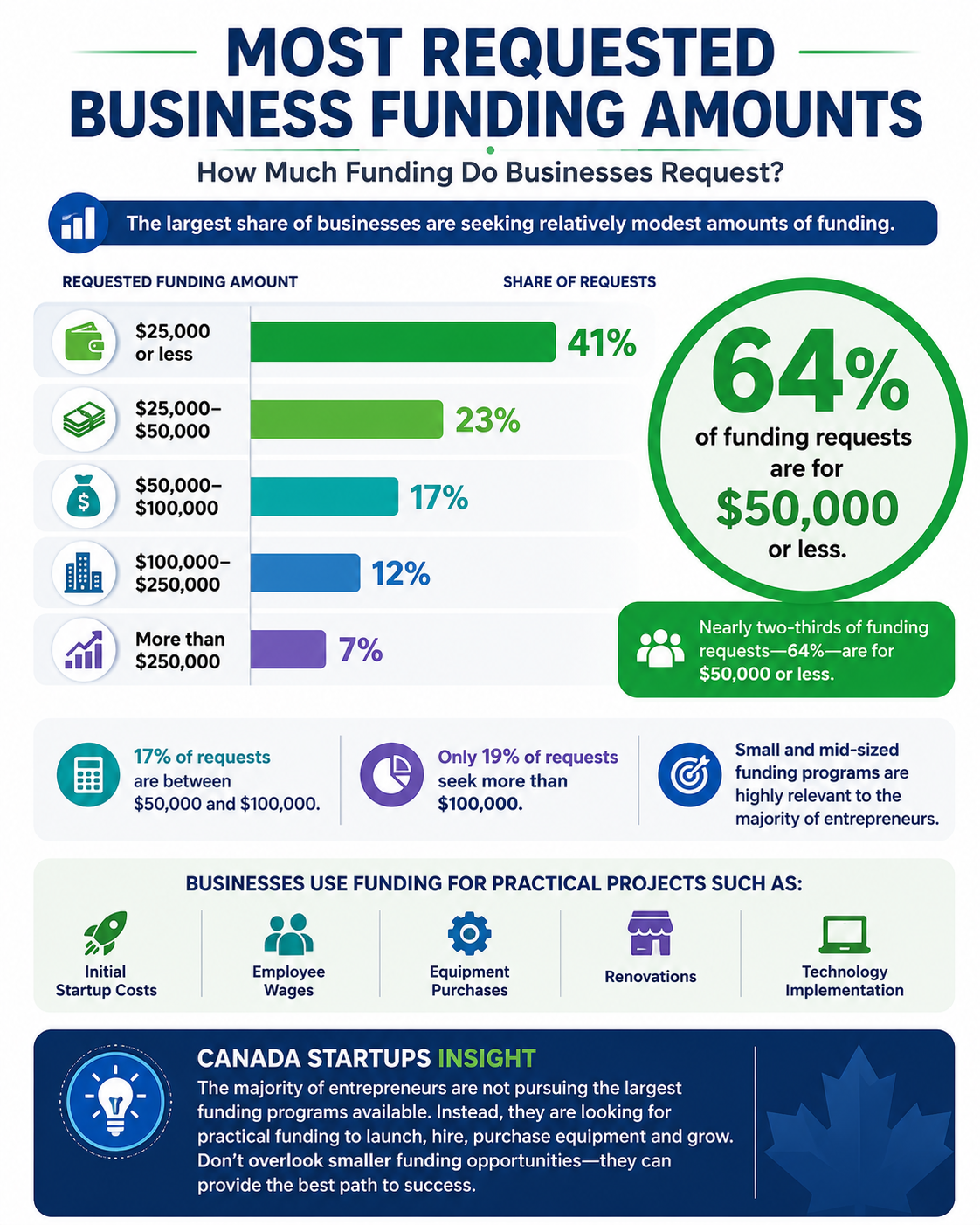
On average, 64% of all funding requests are seeking $50,000 or less
Nearly two-thirds of funding requests 64%, are for $50,000 or less. This suggests that many entrepreneurs are not looking for exceptionally large grants. Instead, they are trying to finance practical projects such as initial startup costs, employee wages, equipment purchases, renovations or technology implementation.
A further 17% request between $50,000 and $100,000, while only 19% seek more than $100,000.
This distribution reinforces an important point: small and mid-sized funding programs can be highly relevant to the majority of entrepreneurs. Businesses should not overlook grants or financing opportunities simply because the maximum award is lower than the largest programs available.
At What Stage Are Businesses Seeking Funding?
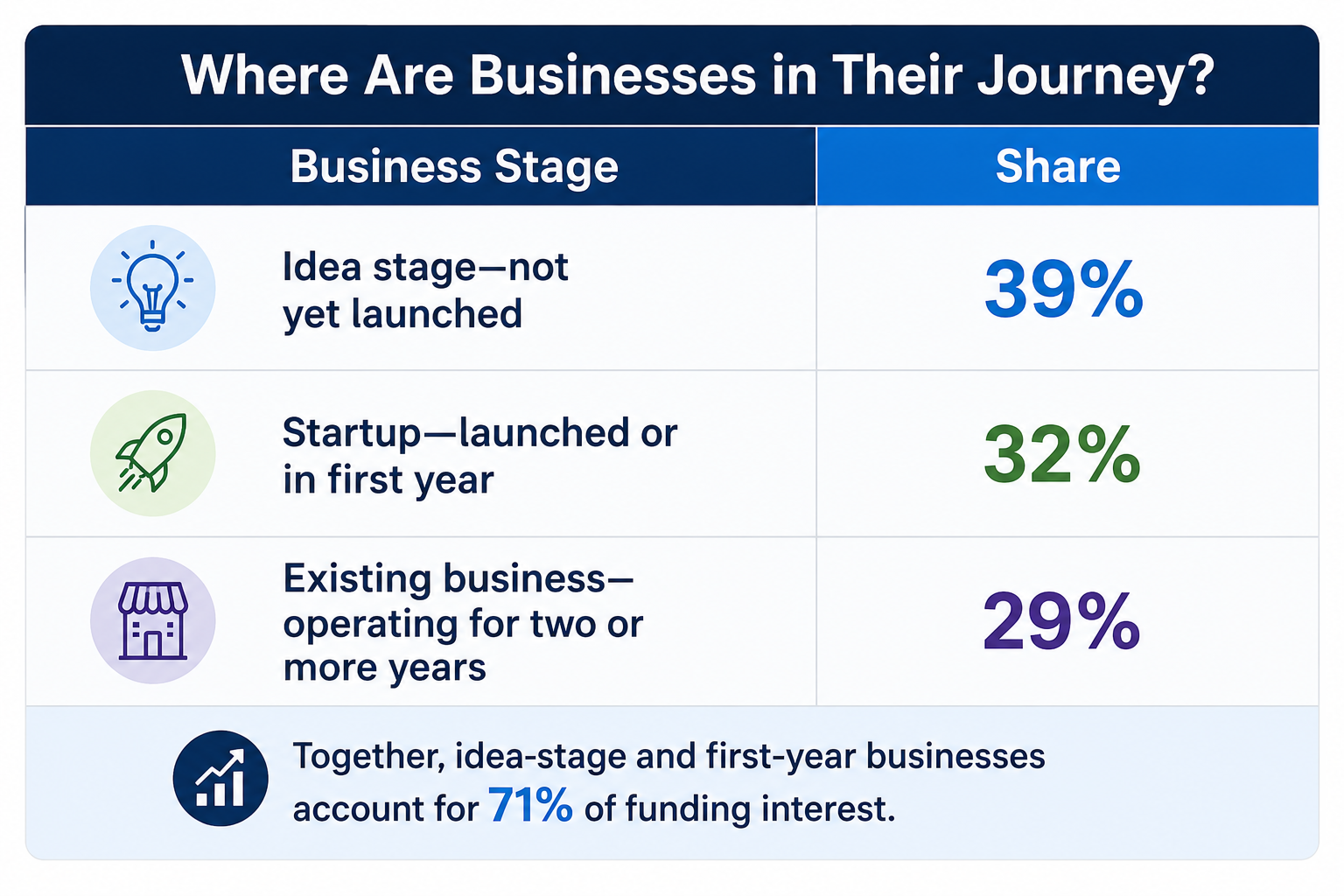
Funding is available across each stage of your business journey, from idea, startup to operating
Funding demand is relatively evenly distributed across the idea, startup and established-business stages, although early-stage businesses represent the majority.
This helps explain why startup funding, first-time business grants and grants to start a business appear among the most common funding searches. Many platform users are looking for financial support before generating significant revenue or establishing a long operating history.
However, early-stage businesses often face additional eligibility challenges. Many funding programs require business registration, owner investment, revenue history, confirmed project costs or the ability to contribute a percentage of the project budget.
Existing businesses typically have access to a broader funding pool because they can demonstrate operating history, financial performance, employees and project readiness.
Canada Startups Insight
A large portion of funding demand comes from entrepreneurs who are still preparing to launch. However, the number of programs available at the idea stage is generally more limited than the number available once a business is registered, operating and pursuing a clearly defined project.
What Projects Are Businesses Most Commonly Trying to Fund?
The three most common project types are:
- Wage support
- Equipment purchases
- Startup costs
These categories closely match the most common searches recorded across the platform.
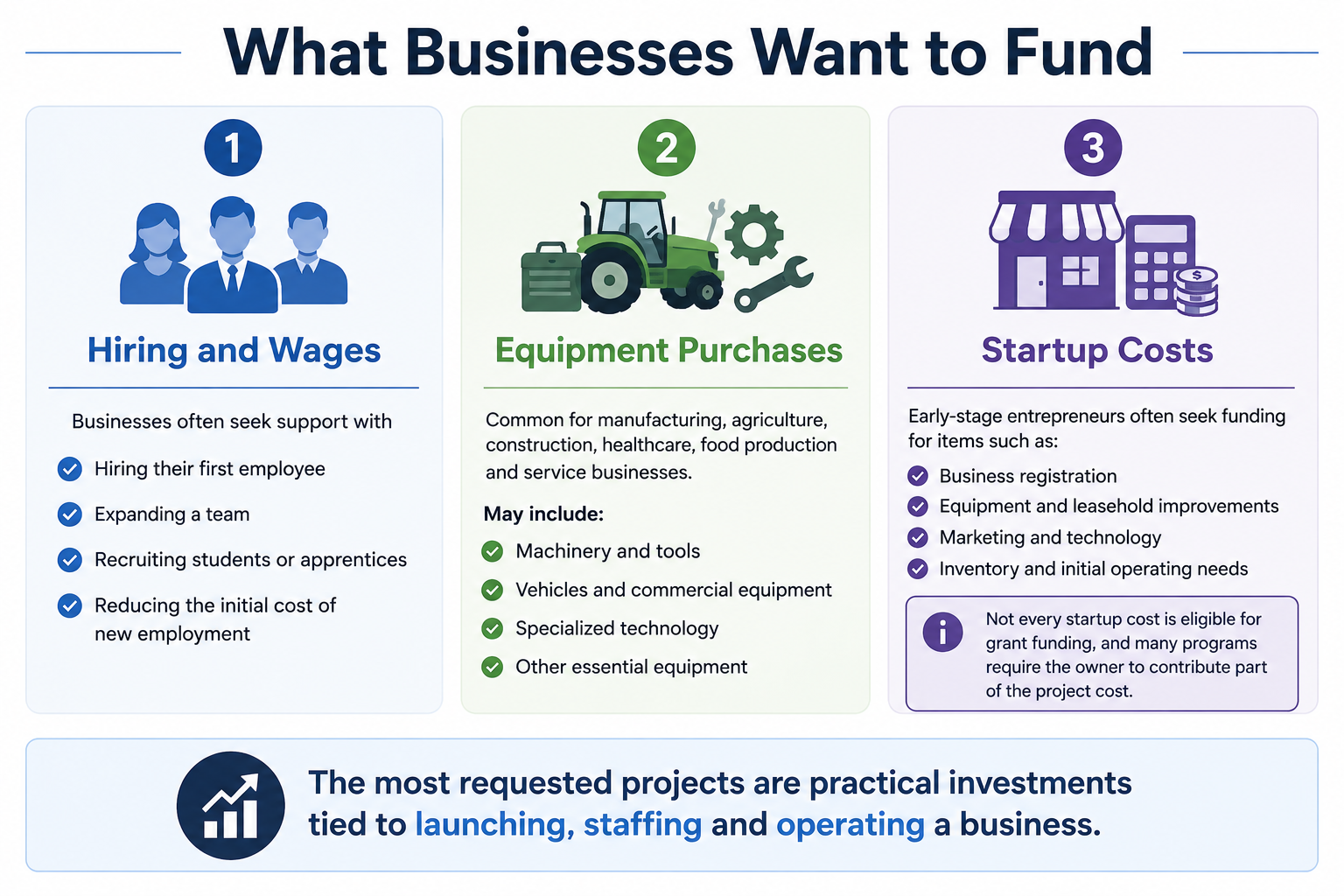
Startup costs is one of the top 3 fundable categories, which also includes a variety of costs/expenses
Wage support
Businesses frequently seek assistance with hiring their first employee, expanding a team, recruiting students or apprentices and reducing the initial cost of new employment.
Equipment purchases
Equipment funding is particularly relevant to manufacturing, agriculture, construction, healthcare, food production and service businesses. Requests may involve machinery, tools, vehicles, commercial equipment or specialized technology.
Startup costs
Early-stage entrepreneurs often seek funding for registration, equipment, leasehold improvements, marketing, inventory, technology and initial operating requirements. However, not every startup cost is eligible for grant funding, and many programs require the owner to contribute part of the project cost.
Why Are Funding Applications Denied?
Canada Startups’ observations indicate that many unsuccessful applications are not rejected because the business idea lacks value. They are rejected because the application does not meet the program’s requirements or the business is not sufficiently prepared.
The most common reasons include:
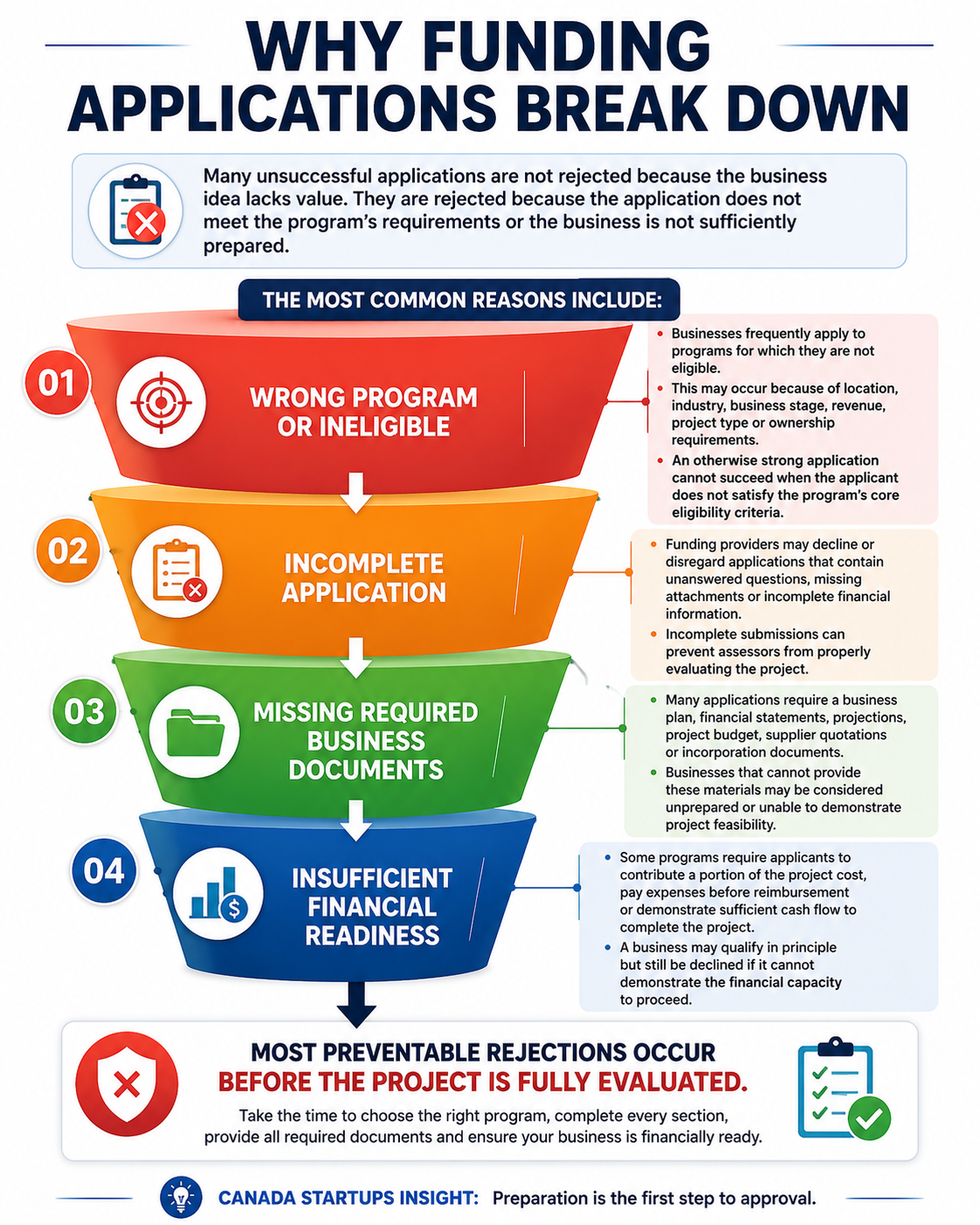
Each reason can be avoided.
Canada Startups Resource
Improve Your Funding Readiness
Many funding applications require business planning, financial projections and clearly defined project documentation before they can be properly evaluated.
Preparing these documents before applying often strengthens multiple funding applications, not just one.
Resources:
Applying to the wrong program
Businesses frequently apply to programs for which they are not eligible. This may occur because of location, industry, business stage, revenue, project type or ownership requirements.
An otherwise strong application cannot succeed when the applicant does not satisfy the program’s core eligibility criteria.
Submitting an incomplete application
Funding providers may decline or disregard applications that contain unanswered questions, missing attachments or incomplete financial information.
Incomplete submissions can prevent assessors from properly evaluating the project.
Missing required business documents
Many applications require a business plan, financial statements, projections, project budget, supplier quotations or incorporation documents.
Businesses that cannot provide these materials may be considered unprepared or unable to demonstrate project feasibility.
Being financially unprepared
Some programs require applicants to contribute a portion of the project cost, pay expenses before reimbursement or demonstrate sufficient cash flow to complete the project.
A business may qualify in principle but still be declined if it cannot demonstrate the financial capacity to proceed.
How Prepared Are Businesses When They Apply?
Canada Startups’ platform data shows a significant difference in business-plan readiness among applicants.
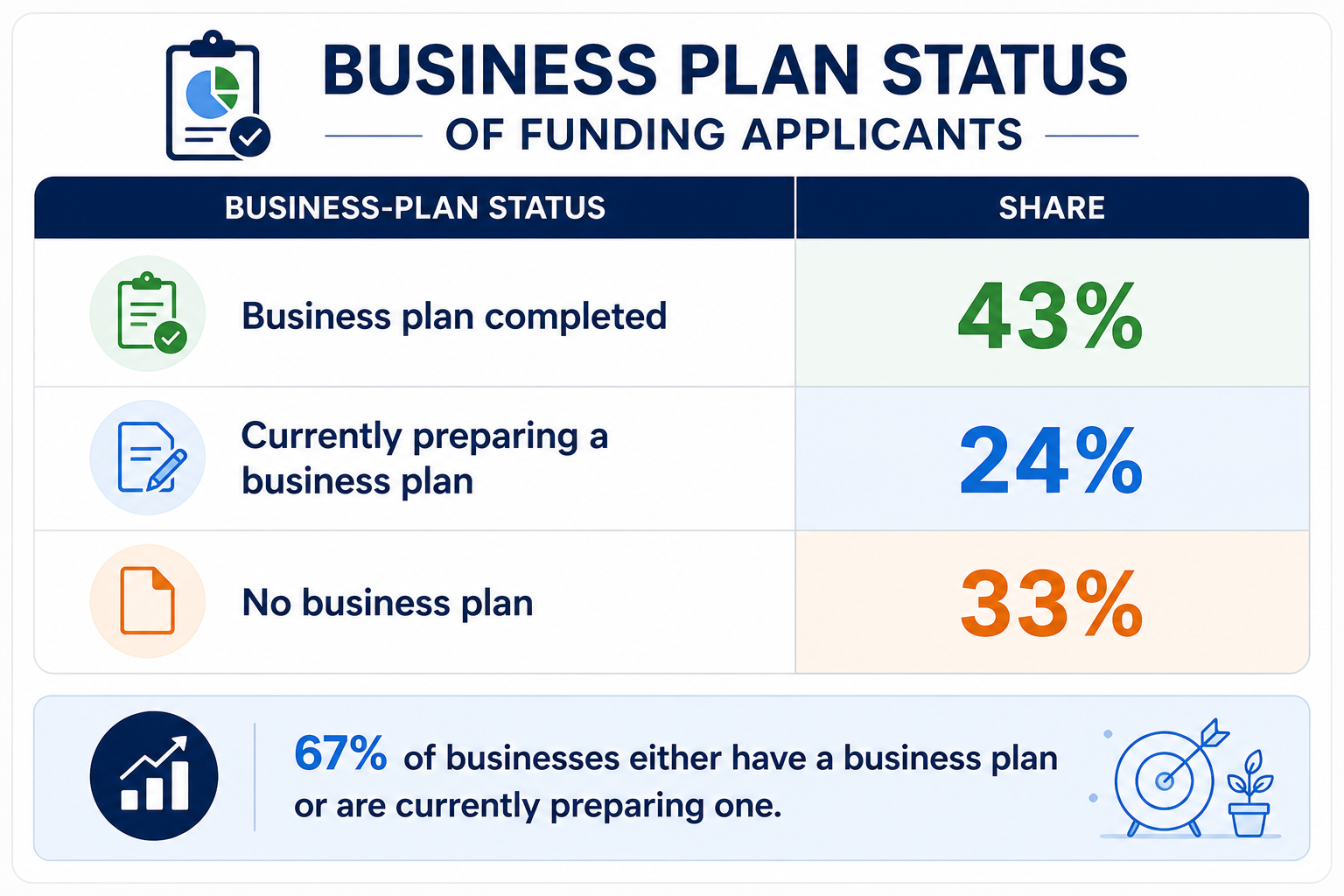
When applying to funding, only 33% don’t have a business plan ready, but 81% of those, get denied funding!
Less than half of applicants have a completed business plan when they begin the funding process. One-third have no business plan, while nearly one-quarter are still preparing one.
This is important because grant applications frequently request information that would normally be contained in a business plan, including:
- Business model
- Market analysis
- Project objectives
- Competitive position
- Management experience
- Revenue projections
- Funding requirements
- Use of funds
- Growth strategy
Even when a formal business plan is not mandatory, businesses without one may struggle to provide complete and consistent answers across the application.
Adding to this, according to Canada Startups’ internal observations, applicants without a business plan account for as much as 81% of denied applications within the reviewed activity.
This does not prove that the absence of a business plan alone caused every rejection. Businesses without plans may also be earlier-stage, financially unprepared or more likely to submit incomplete applications.
However, the pattern strongly suggests that funding readiness and application outcomes are connected.
A completed business plan helps applicants:
- Explain the business clearly
- Define the project
- Prepare realistic financial projections
- Demonstrate market demand
- Calculate the amount of funding required
- Show how funds will be used
- Maintain consistency across supporting documents

As per Canada Startups internal statistic.
What Does the Data Reveal Overall?
Several conclusions emerge from Canada Startups’ internal funding activity.
First, demand is concentrated around practical business needs. Entrepreneurs most often search for funding to hire employees, launch businesses and purchase equipment.
Second, most requested amounts are relatively modest. Nearly two-thirds of funding requests are for $50,000 or less.
Third, most funding interest comes from early-stage entrepreneurs. Seventy-one percent of users are either at the idea stage or within their first year of business.
Finally, funding preparedness remains a major challenge. A significant share of applicants begin the process without a completed business plan, financial documents or a fully defined project.
These findings suggest that the largest barrier to funding may not always be the lack of available programs. In many cases, the greater challenge is finding the right program and being sufficiently prepared to apply.
Canada Startups Takeaway
Canada’s funding ecosystem contains more than 1,500 funding opportunities, but access depends on more than simply locating a grant.
The strongest applicants tend to have three things in common:
- A clearly defined project
- Complete business and financial documentation
- A funding program that closely matches their eligibility and objectives
The data reinforces one of the central lessons of this guide: successful funding applications begin with preparation and alignment, not with the application form itself.
Canada Startups Member Funding Outcomes
From January through December 2025, more than 10,000 Canada Startups members used the platform’s funding tools, resources and expert support. Among members who completed the full funding process, including preparing the required business documents, conducting multiple funding searches, submitting applications, revising their plans when needed and working actively with funding experts- approximately 92% achieved a successful funding outcome.
For this analysis, a successful outcome means the member was able to identify suitable funding opportunities and obtain funding through one or more sources after completing the recommended funding-readiness and application process.
The results demonstrate that funding success is rarely based on submitting a single application. Members who achieved positive outcomes generally approached funding as an ongoing process that involved preparation, repeated searches, multiple applications and adjustments based on eligibility requirements or expert feedback.
What the Successful Members Did
Successful members typically:
- Completed their business plan and financial projections.
- Clearly defined the project and amount of funding required.
- Conducted multiple funding searches rather than relying on one program.
- Applied only to programs for which they met the eligibility requirements.
- Submitted all required documents and supporting information.
- Revised their plans or funding strategy when an application was unsuccessful.
- Continued applying to suitable opportunities over time.
- Worked with Canada Startups experts throughout the process.
Canada Startups Insight
The 92% outcome does not mean that every application submitted by these members was approved. Many members applied to several programs, encountered rejections or changed their funding strategy before obtaining support.
The finding instead demonstrates the value of completing the full funding process. Members who remained active, prepared the required documents, applied to multiple suitable programs and adjusted their approach were significantly more likely to achieve a positive outcome than those who relied on a single search or incomplete application.
Common Mistakes Businesses Make When Searching for Funding
Understanding Canada’s funding landscape is only the first step. Many businesses still overlook valuable funding opportunities because they limit where they search or assume that only one type of funding is available.
The following are some of the most common mistakes entrepreneurs make when searching for business funding and how these mistakes can reduce the number of opportunities available.
Searching Only Federal Government Funding
Many entrepreneurs begin their funding search by visiting federal government websites, believing that the largest or most valuable funding opportunities are offered nationally.
While federal programs play an important role, they represent only one part of Canada’s funding ecosystem. Provincial governments, municipalities, regional development agencies, nonprofit organizations and private businesses collectively administer hundreds of additional funding programs every year.
Limiting a search to federal programs alone can cause businesses to overlook opportunities that may be better suited to their location, industry or project.
Ignoring Provincial, Municipal and Regional Programs
Funding opportunities become increasingly specialized at the provincial and municipal levels.
Provincial governments often invest in industries that are important to their regional economy, while municipalities focus on projects that strengthen local communities, improve downtown areas, encourage tourism or support small business growth.
Regional development agencies also administer programs designed specifically for rural businesses, regional industries and economic diversification.
Businesses that expand their search beyond federal funding frequently discover programs that are less competitive and more closely aligned with their projects.
Overlooking Private and Nonprofit Funding
One of the biggest misconceptions among entrepreneurs is believing that only governments provide business funding.
Private corporations, charitable foundations, nonprofit organizations, industry associations and business competitions collectively provide millions of dollars in funding each year. Many of these opportunities receive less publicity than government programs, resulting in fewer applicants and, in some cases, less competition.
Expanding a funding search to include private organizations can significantly increase the number of opportunities available.
Searching Only for Business Grants
Grants are one of the most attractive forms of funding because they generally do not require repayment when program conditions are met. However, they represent only one category within Canada’s broader funding ecosystem.
Businesses that search exclusively for grants often overlook government-backed loans, tax credits, wage subsidies, equity investment, procurement opportunities and specialized financing programs that may be equally valuable depending on the project.
The strongest funding strategies consider every available funding type rather than focusing on grants alone.
Applying to Only One Funding Program
Many entrepreneurs identify a single grant, submit one application and wait months for a decision before searching again.
This approach significantly reduces the likelihood of securing funding.
Every funding provider has different objectives, eligibility requirements and evaluation criteria. A project that does not qualify for one program may be an excellent fit for several others.
Businesses that submit multiple well-targeted applications generally build stronger funding strategies than those relying on a single opportunity.
Ignoring Industry-Specific Funding
Many industries have funding opportunities that are rarely advertised as general business grants.
Manufacturing, agriculture, construction, healthcare, tourism, food processing, technology and dozens of other sectors often have specialized funding designed around the challenges and priorities of that particular industry.
Businesses searching only for “small business grants” may never discover these sector-specific opportunities.
Canada Startups Insight
One of the most successful funding strategies is also one of the simplest: search broadly, apply strategically.
Businesses that explore funding across multiple levels of government, private organizations, industry associations and different funding types often identify substantially more opportunities than those limiting themselves to one source or one program.
Funding success is rarely the result of finding one perfect grant, it is usually the result of building a well-rounded funding strategy.
Frequently Asked Questions About Canada’s Funding Landscape
Canada’s business funding ecosystem includes thousands of opportunities delivered by governments, agencies, nonprofit organizations and private funders. The following questions summarize some of the most common topics entrepreneurs ask when exploring Canada’s funding landscape.
How many business grants are available in Canada?
Canada currently offers an estimated 350+ business grant programs, with new opportunities opening and existing programs changing throughout the year. Grants represent only one part of Canada’s funding ecosystem, which also includes loans, tax credits, wage subsidies, equity investment and other financing options.
How much business funding exists in Canada?
Canada’s funding ecosystem includes more than 1,500 funding opportunities administered by over 300 organizations across the country. Collectively, these programs make billions of dollars available each year to support business growth, innovation, hiring, technology adoption and economic development.
Which province offers the most funding opportunities?
Ontario has the largest estimated number of business funding programs, followed by Quebec, Alberta and British Columbia. This reflects the size of their economies, business populations and the number of organizations delivering funding, not necessarily that funding is easier to obtain in those provinces.
Can startups access business funding?
Yes. Many funding programs are specifically designed for entrepreneurs at the idea stage or within their first year of operation. However, eligibility varies by program, and some opportunities require a registered business, owner investment or a clearly defined project before funding can be approved.
How often are new funding programs introduced?
New funding opportunities are introduced throughout the year as governments announce budgets, agencies launch initiatives and private organizations introduce new funding programs. Existing programs may also reopen annually or quarterly, while others remain available on a rolling basis.
Are business funding programs available year-round?
Some are, but many are not. Canada’s funding landscape includes open-intake, rolling, annual, quarterly and competitive funding programs. Because application periods vary, businesses should monitor funding regularly and keep their business documents up to date so they are ready when suitable opportunities become available.
Canada Startups Takeaway
Canada’s funding landscape is much larger than most entrepreneurs realize. Understanding where funding comes from, how programs are distributed and which opportunities best match your business can significantly improve your funding strategy. Businesses that search broadly, prepare thoroughly and monitor funding throughout the year are often in the strongest position to secure financial support.
Understanding the Different Types of Business Funding
Many entrepreneurs use the terms grant, loan and business funding interchangeably, but they are not the same. Each type of funding serves a different purpose, has different eligibility requirements and may be more appropriate depending on your business stage, project and financial needs.
Understanding the differences between each funding type allows businesses to build stronger financing strategies rather than relying on a single source of capital. Some funding provides non-repayable financial assistance, while other options offer financing, investment or incentives designed to support long-term business growth.
The following sections explain the most common types of business funding available in Canada, how they work and when they are typically used.
Business Grants
Business grants are non-repayable financial contributions provided to eligible businesses to support specific projects that align with the objectives of a funding organization. Unlike loans, grants generally do not need to be repaid, provided the recipient complies with the program’s terms, completes the approved project and meets all reporting requirements.
Most grants are not designed to finance the entire cost of a project. Instead, they typically cover a percentage of eligible expenses, requiring the business to contribute the remaining costs.
How They Work
Every grant program operates according to its own eligibility criteria, application process and funding rules, but the general process is similar:
- A funding organization announces a grant program.
- Businesses determine whether they meet the eligibility requirements.
- An application is submitted with supporting documentation.
- The project is evaluated against the program’s objectives.
- Approved applicants receive a funding agreement.
- The project is completed according to the agreed terms.
- Funding is provided either upfront, in installments or as reimbursement after eligible expenses have been incurred.
Many grants require businesses to maintain records, submit progress reports and demonstrate that funds were used for approved project costs.
Who Offers Business Grants?
Business grants are offered by a wide variety of organizations across Canada, including:
- Federal government departments
- Provincial and territorial governments
- Municipal governments
- Regional economic development agencies
- Crown corporations
- Industry associations
- Non-profit organizations
- Indigenous organizations
- Private corporations and foundations
Each organization supports projects that align with its own economic, social or industry-specific priorities.
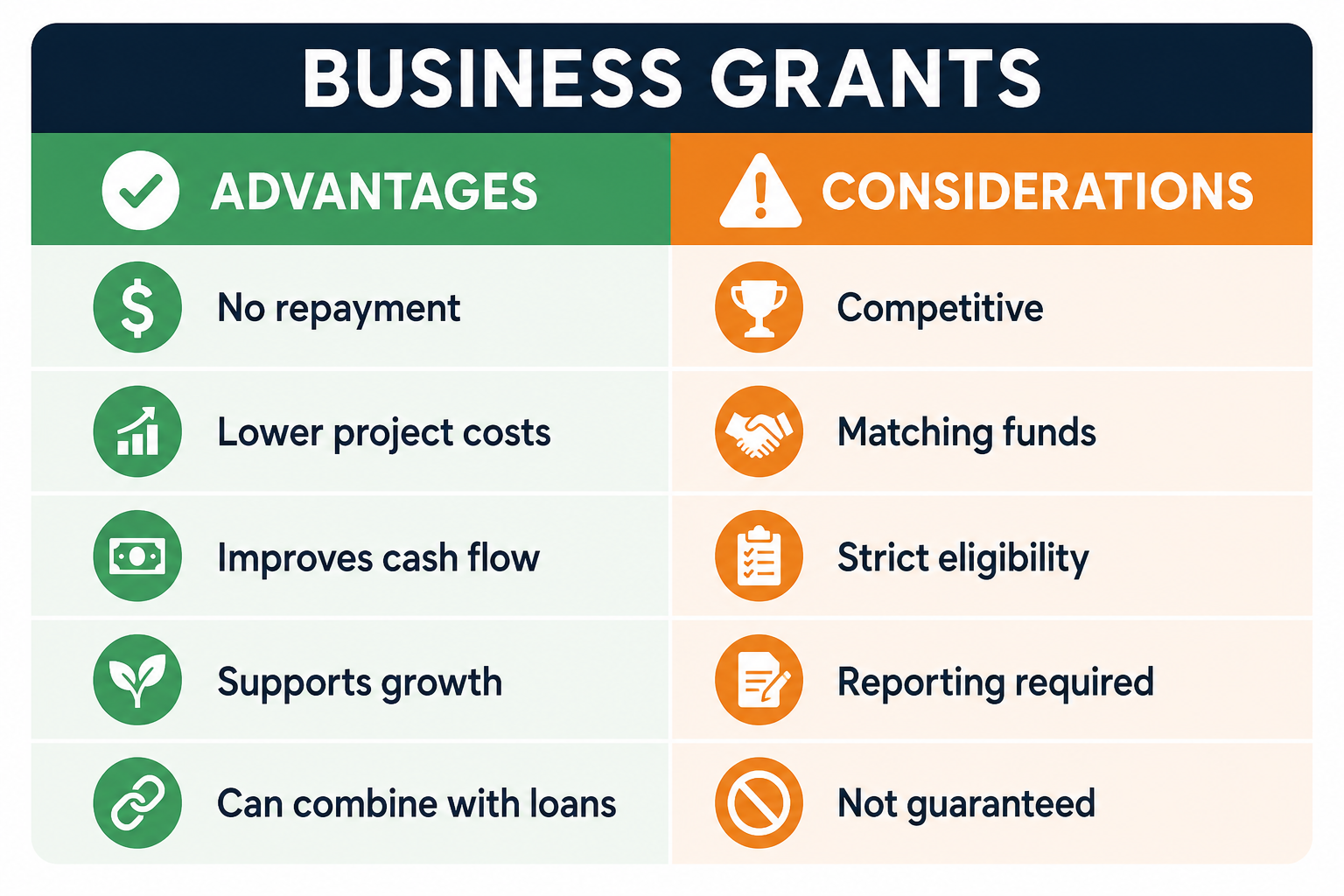
Grants, while they are non-repayable, they have various considaration points
Advantages of Grants
Business grants offer several important benefits:
- Non-repayable funding for eligible projects
- Reduce the financial risk of investing in business growth
- Help businesses undertake projects sooner
- Improve cash flow by lowering out-of-pocket costs
- Can often be combined with other forms of financing
- Support hiring, innovation, technology adoption, exports and expansion
Disadvantages of Grants
Grants also have limitations that businesses should understand:
- Highly competitive application process
- Strict eligibility requirements
- Funding is rarely guaranteed
- Many programs require matching contributions
- Eligible expenses are often limited
- Applications may require significant documentation
- Reporting and compliance obligations continue after approval
Receiving a grant is not automatic simply because a business qualifies. Most programs assess applications against available funding, program objectives and the strength of the proposed project.
Common Uses for Grants
Business grants commonly support projects such as:
- Hiring employees
- Wage subsidies
- Equipment purchases
- Technology adoption
- Digital transformation
- Research and development
- Product commercialization
- Export development
- Training and workforce development
- Sustainability initiatives
- Manufacturing improvements
- Artificial intelligence and automation projects
Most grant programs fund projects rather than general operating expenses.
Typical Funding Amounts
Grant values vary significantly depending on the program and project.
Typical funding ranges include:
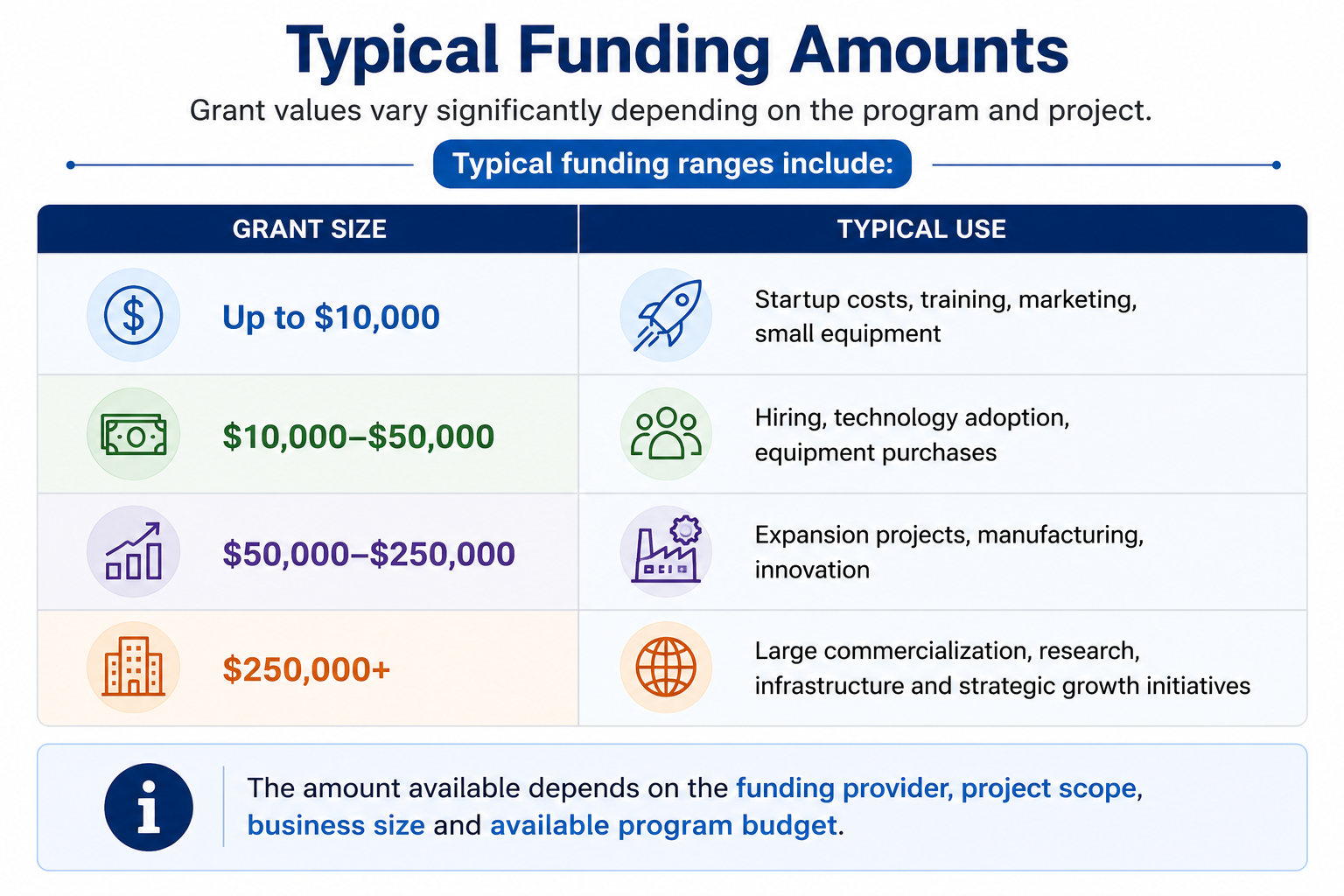
Funding amounts vary from business to business, but this is a typical range for requests
Example
A manufacturing company plans to purchase $150,000 of automated production equipment to improve productivity.
The business applies to an equipment modernization grant that covers 40% of eligible costs.
- Total project cost: $150,000
- Grant contribution (40%): $60,000
- Business contribution: $90,000
The company completes the project, submits proof of eligible expenses and receives the approved grant according to the program’s funding agreement.
Grants FAQ’s
Are business grants really free money?
No. Although grants generally do not need to be repaid, businesses must satisfy eligibility requirements, use the funds for approved purposes and comply with all program conditions.
Does every business qualify for grants?
No. Eligibility depends on factors such as industry, location, business stage, project type, ownership structure and the objectives of each funding program.
Do grants pay for the entire project?
Usually not. Many grant programs require businesses to contribute a portion of the project cost through matching funds or other financing.
How competitive are business grants?
Many grant programs receive more applications than they can fund. A strong application, complete documentation and a project that aligns closely with the program’s objectives can improve the chances of approval.
Can businesses receive more than one grant?
Yes. Many businesses use multiple grant programs over time or combine grants with loans, tax credits and other funding sources, provided the programs allow stacking and the business meets all eligibility requirements.
Business Loans
A business loan is borrowed capital that must be repaid over time, typically with interest. Unlike grants, loans provide businesses with immediate access to funding but require regular repayments according to the lender’s terms and conditions.
Business loans are commonly used to finance startup costs, expansion, equipment purchases, working capital, commercial property, inventory and other business investments. Because the funds are repaid, loan programs are generally available in larger amounts than grants and can support projects that require significant capital.
Government Loans
Government business loans are financing programs supported directly by governments or delivered through government-backed financial institutions. Their objective is to help businesses access capital that may not otherwise be available through traditional lenders.
Government loans often feature:
- Lower interest rates
- Longer repayment terms
- Flexible eligibility requirements
- Partial government guarantees
- Support for startups, innovation and business growth
Examples include loans administered through federal and provincial agencies, Crown corporations and government-backed lending programs.
Private Loans
Private business loans are offered by non-government lenders, including finance companies, online lenders, credit unions and alternative financing providers.
Private lenders often provide:
- Faster application processes
- Flexible lending products
- Short-term financing
- Equipment financing
- Working capital loans
- Lines of credit
While approval may be quicker, private loans frequently carry higher interest rates and shorter repayment periods than government-backed financing.
Bank Loans
Traditional banks remain one of the largest sources of business financing in Canada. Banks typically provide loans to businesses with established financial histories, predictable cash flow and strong credit profiles.
Common bank lending products include:
- Term loans
- Business lines of credit
- Commercial mortgages
- Equipment financing
- Operating loans
Banks generally require detailed financial information and may request collateral or personal guarantees before approving financing.
Advantages
Business loans offer several important benefits:
- Access to larger amounts of capital
- Immediate funding for business investments
- Flexible repayment terms
- Can finance a wide variety of projects
- Helps preserve business ownership compared with equity financing
- May improve business credit when managed responsibly
Disadvantages
Business loans also create financial obligations that businesses must consider.
Potential disadvantages include:
- Funds must be repaid
- Interest increases the total borrowing cost
- Regular repayments affect cash flow
- Approval may require strong financial statements
- Some loans require collateral or personal guarantees
- Missed payments can affect business and personal credit
Businesses should carefully evaluate whether projected revenue from the investment will comfortably cover future loan repayments.
Interest
Most business loans charge interest, which represents the cost of borrowing money. Interest rates vary depending on several factors, including:
- The lender
- Loan amount
- Repayment period
- Business credit history
- Financial performance
- Available security or collateral
- Current market interest rates
Government-backed loans often provide lower interest rates than many private lending options, while higher-risk borrowers may face higher borrowing costs.
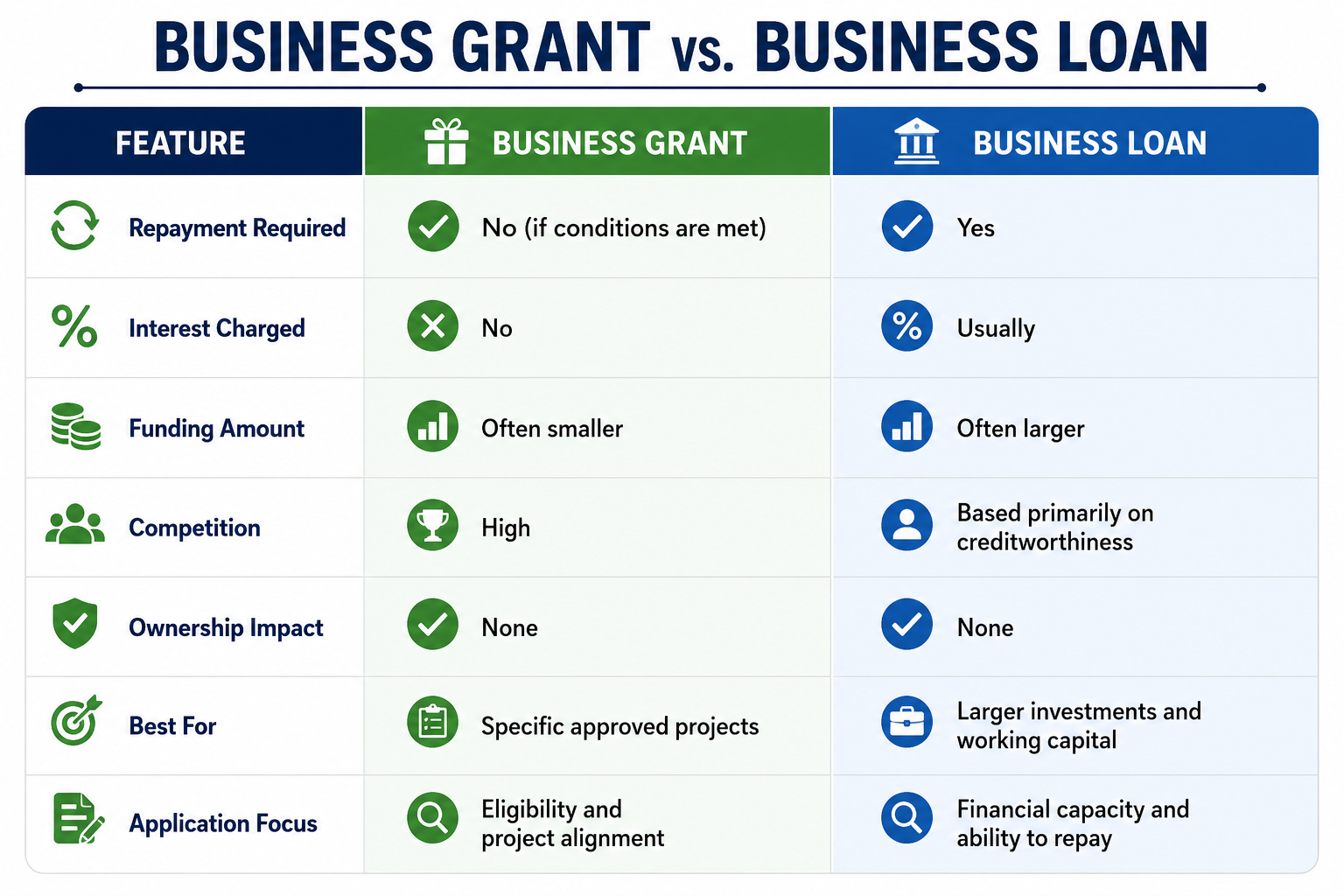
Comparing Grants vs Loans
Business Loan FAQ’s
Do business loans have to be repaid?
Yes. Business loans are borrowed funds and must be repaid according to the lender’s repayment schedule.
Are government loans easier to obtain?
Some government-backed loans are designed to improve access to financing for eligible businesses, but applicants must still meet the program’s requirements and demonstrate their ability to repay.
Can startups qualify for business loans?
Yes. Many startups obtain financing through government-backed lenders, banks, credit unions and alternative financing providers, although lending requirements vary.
What is collateral?
Collateral is an asset pledged as security for a loan. If the borrower cannot repay the loan, the lender may have the legal right to recover the outstanding balance using the pledged asset.
Can businesses combine loans with grants?
Yes. Many businesses use loans alongside grants, tax credits and other funding sources to finance larger projects, provided the individual programs permit combined funding.
Which Type of Funding Is Right for Your Business?
Finding funding is not simply about identifying every available program, it is about choosing the financing that best matches your business’s current stage, project and financial needs.
Many entrepreneurs begin by searching exclusively for grants. While grants can be an excellent source of funding, they are only one part of the broader funding landscape. In many situations, a loan, tax credit, investor or wage subsidy may be more appropriate.
The strongest funding strategies often combine multiple funding types to finance different parts of the same project.
Rather than asking “Where can I get money”, succesful busineses ask “Which type of funding best fits my project?”
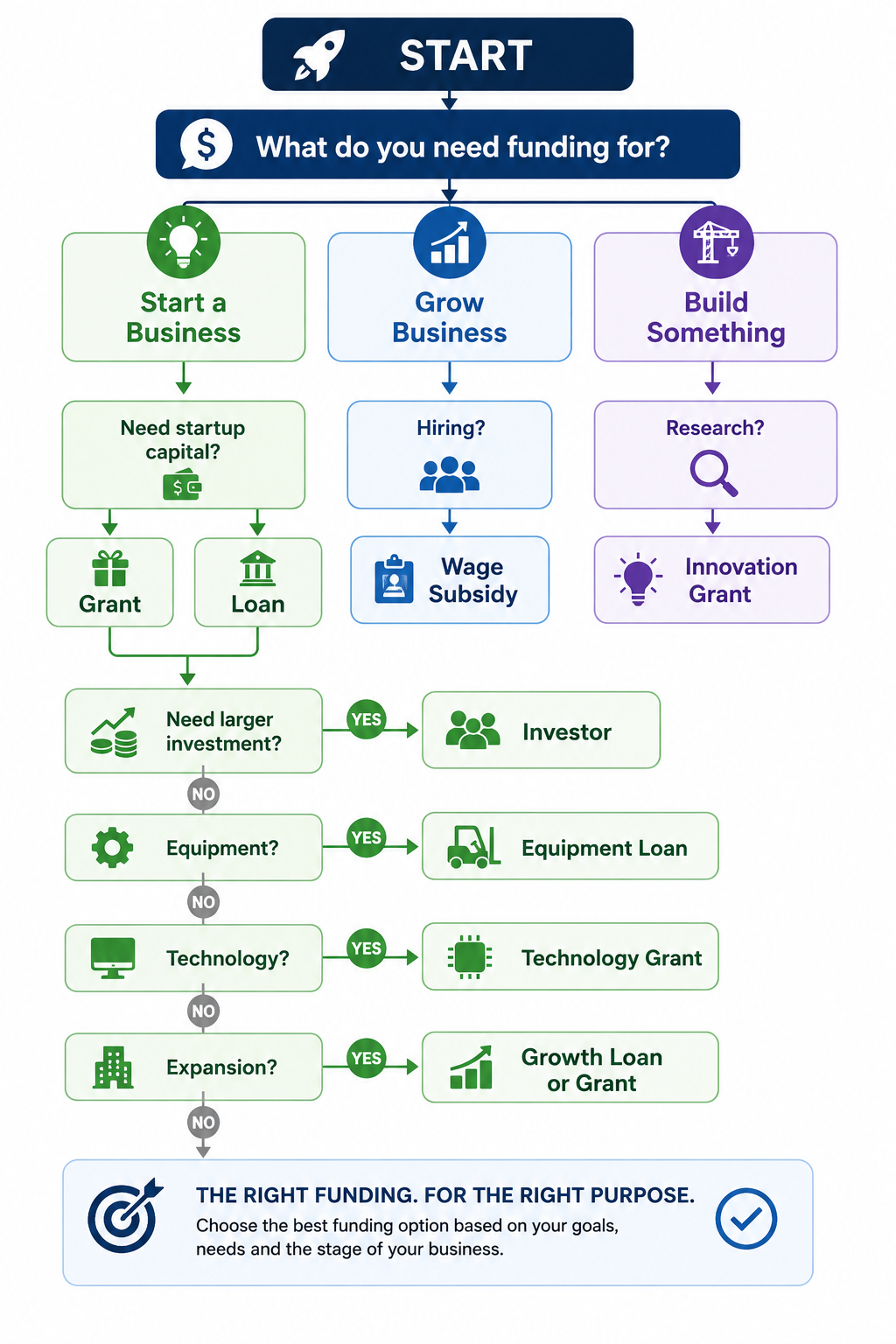
It’s not about finding funding, but about matching to the right options
Matching Funding to Your Business Stage
Different funding types become more relevant as your business grows.
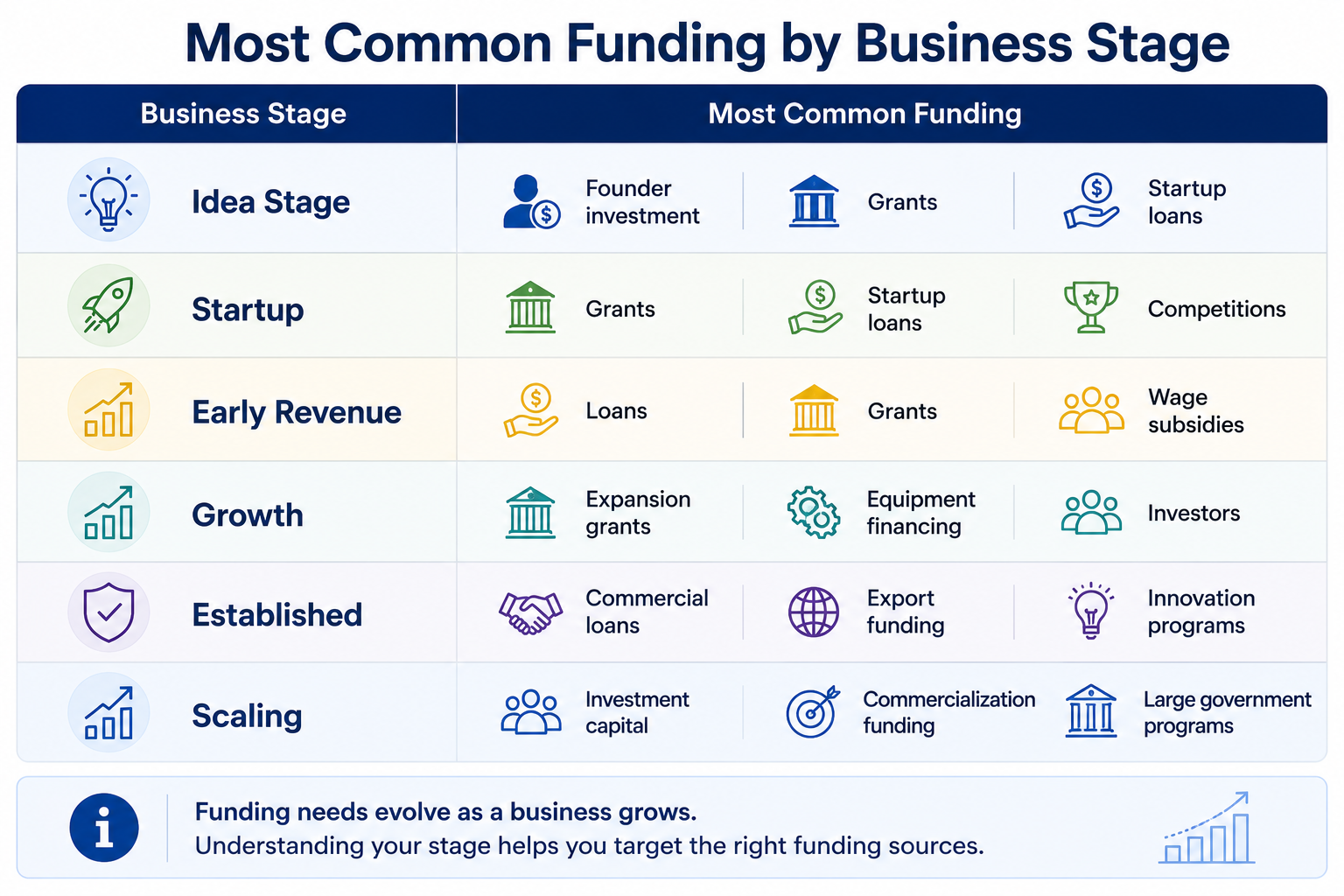
Matching to funding options based on your purpose is the key to success.
Businesses rarely rely on the same funding throughout their entire lifecycle.
Choosing the Right Funding
The following examples illustrate which funding type is often the best fit for different business needs.
Need money to launch a new business?
Consider:
- Startup grants
- Startup loans
- Founder investment
- Friends and family financing
- Business competitions
Hiring your first employee?
Consider:
- Wage subsidies
- Hiring grants
- Payroll incentives
Purchasing equipment?
Consider:
- Equipment grants
- Equipment financing
- Commercial loans
- Leasing
Developing a new product?
Consider:
- Research and development grants
- Innovation funding
- Investor financing
Buying a commercial building?
Consider:
- Commercial mortgages
- Bank financing
Grants rarely fund property purchases.
Improving cash flow?
Consider:
- Business line of credit
- Working capital loan
Loans are usually better suited than grants for ongoing operating expenses.
Expanding into international markets?
Consider:
- Export grants
- Export financing
- Trade development programs
Building new technology?
Consider:
- Innovation grants
- Research funding
- Venture capital
- Angel investors
Real-World Example
Imagine three entrepreneurs, each looking for funding.
Business A - New Café
Needs:
- Renovations
- Kitchen equipment
- Initial inventory
Best funding strategy:
- Startup loan
- Small equipment grant
- Founder investment
Business B - Software Company
Needs:
- AI development
- Product commercialization
- Hiring developers
Best funding strategy:
- Innovation grants
- Research funding
- Angel investment
- Wage subsidies
Canada Startups Insight
One of the biggest mistakes entrepreneurs make is searching only for grants.
Many of the most successful funding strategies combine several different funding types. For example, a business may use a grant to reduce equipment costs, a loan to finance the remaining balance, a wage subsidy to offset hiring expenses and a tax credit to recover eligible research costs.
By matching each project with the most appropriate source of funding, businesses can often access more capital while reducing financial risk.
Needs:
- New machinery
- Additional employees
- Export expansion
Best funding strategy:
- Equipment grant
- Commercial loan
- Hiring subsidy
- Export funding
Each business receives funding, but not from the same type of program.
Mini FAQ
Should every business apply for grants first?
Not necessarily. The best funding option depends on your project, financial position and stage of business. In many cases, loans or tax credits may provide faster or more suitable financing.
Can businesses receive more than one type of funding?
Yes. Many businesses combine grants, loans, tax credits, wage subsidies and private investment to finance different aspects of the same project.
Is one type of funding better than another?
No. Each funding type serves a different purpose. The most effective funding strategy is the one that aligns with your business goals, project requirements and ability to meet the associated obligations.
How do I know which funding is right for me?
Start by identifying what you need the funding for, such as hiring, equipment, technology, expansion or research. Once the project is clear, it becomes much easier to determine which funding types are most appropriate.
Helping Canadian Entrepreneurs Navigate Business Funding
Finding business funding can be challenging. Thousands of funding programs exist across Canada, each with its own eligibility requirements, deadlines and application process. Understanding which opportunities are relevant to a particular business often requires significant research and careful preparation.
For more than eight years, Canada Startups has helped entrepreneurs better understand Canada’s business funding landscape by providing educational resources, funding research and practical tools designed to simplify the funding process.
Throughout that time, the organization has continually researched funding programs, monitored changes to Canada’s business funding ecosystem and developed resources to help entrepreneurs prepare stronger funding applications.
A Continuously Updated Funding Database
Canada Startups maintains a funding database containing more than 1,500 funding opportunities, including business grants, government-backed loans, tax credits, wage subsidies, equity investment opportunities, competitions and private funding programs.
The database is updated daily to reflect newly announced funding opportunities, program changes, application deadlines and eligibility updates, helping entrepreneurs stay informed as Canada’s funding landscape continues to evolve.
Rather than focusing on a single funding source, the database covers opportunities available through federal, provincial and municipal governments, government-supported agencies, nonprofit organizations, private corporations and industry associations across Canada.
Tools Designed to Improve Funding Readiness
Securing funding often requires more than simply finding the right program. Many funding providers also require businesses to demonstrate planning, financial readiness and a clearly defined project.
To help entrepreneurs prepare, Canada Startups has developed practical business planning tools that support the funding application process, including:
- Business plan development
- Financial projection tools
- Pitch deck preparation
- Funding searches
- Funding application guidance
- Expert reviews and feedback
These resources are designed to help businesses prepare the documents and information most commonly requested by funding providers.
Ongoing Funding Research
Canada’s business funding landscape changes continuously as governments announce new budgets, agencies launch new initiatives and private organizations introduce additional funding opportunities.
Canada Startups conducts ongoing funding research to monitor these developments, update funding opportunities and identify emerging trends across industries, provinces and funding categories.
The research presented throughout this guide, including funding distribution, industry trends, funding priorities and platform insights - is based on Canada’s evolving funding landscape and years of funding analysis.
Supporting Entrepreneurs Across Canada
Canada Startups has worked with entrepreneurs from every province and territory, supporting businesses at the idea stage, startup stage and growth stage across a wide range of industries.
Whether a business is looking to hire employees, purchase equipment, adopt new technology, expand operations or commercialize a new product, understanding how Canada’s funding ecosystem operates is often the first step toward building a successful funding strategy.
Final Thoughts
Canada’s business funding landscape is one of the largest and most diverse in the world. Every year, governments, agencies, nonprofit organizations and private funders invest billions of dollars into projects that support entrepreneurship, innovation, job creation and long-term economic growth.
Understanding how this funding ecosystem works is often more valuable than simply finding a grant. Businesses that understand eligibility requirements, funding priorities, project planning and application preparation are generally in a much stronger position than those searching for funding only after a financial need arises.
Whether your business is still an idea, preparing to launch or planning its next stage of growth, building a clear funding strategy can significantly improve your ability to identify opportunities that align with your goals.
We hope this guide has helped you better understand Canada’s business funding landscape and has provided practical knowledge that supports your funding journey.
About Canada Startups
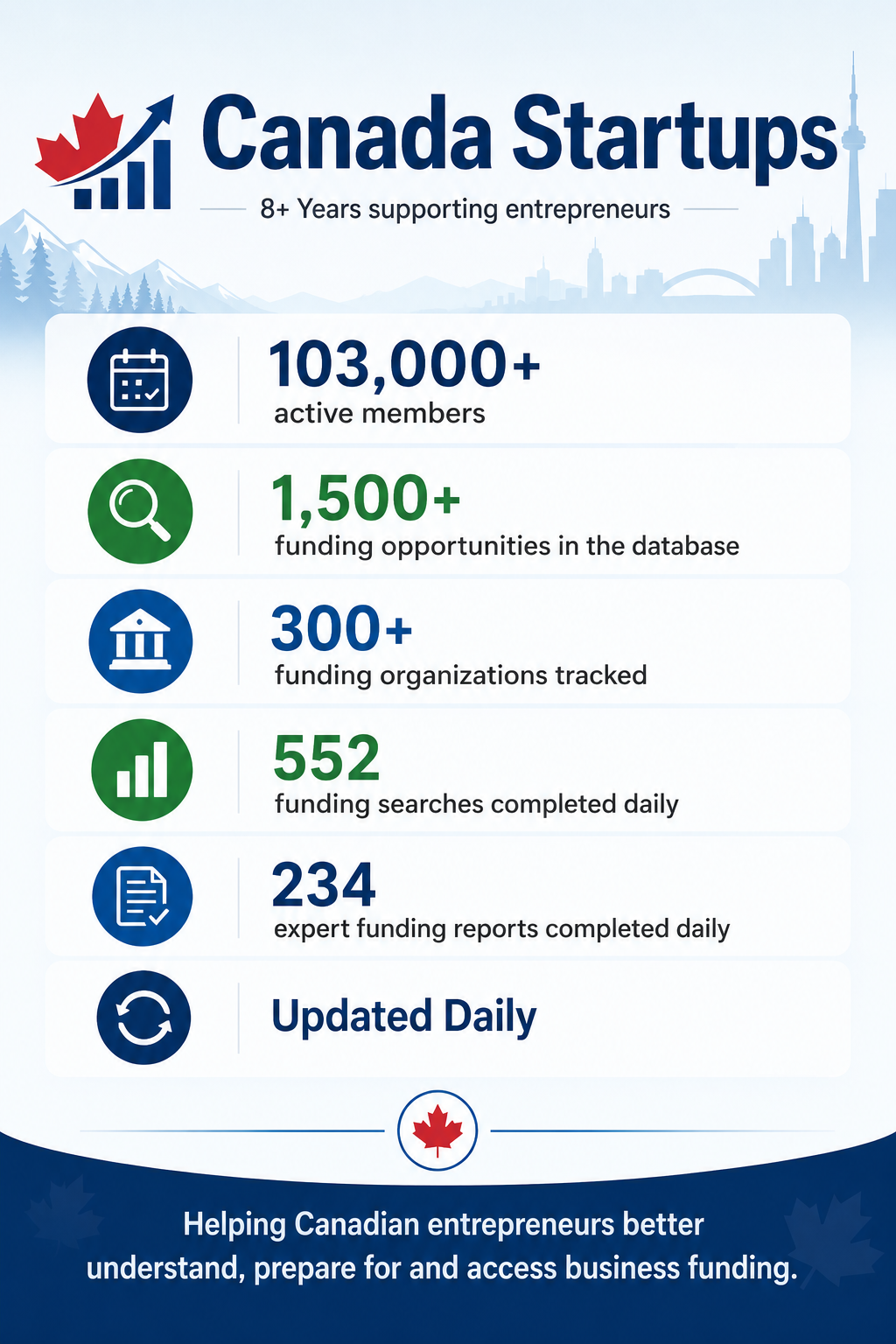
Canada Startups - Canadian proud!
For more than eight years, Canada Startups has researched Canada’s business funding ecosystem while developing tools, educational resources and funding support services for entrepreneurs across the country.
Today, the platform maintains a funding database containing more than 1,500 funding opportunities, tracks programs offered by 300+ funding organizations, conducts hundreds of funding searches each day and continually monitors changes across Canada’s funding landscape.
The research, statistics and insights presented throughout this guide combine publicly available funding information with observations gathered through years of working with Canadian entrepreneurs and maintaining one of Canada’s largest independent business funding databases.
As Canada’s funding landscape continues to evolve, this guide will continue to be updated to reflect new funding trends, changing priorities and emerging opportunities for Canadian businesses.
Our Commitment
Canada Startups believes that entrepreneurs make better funding decisions when they have access to clear, practical and unbiased information.
Our goal is to help Canadian businesses better understand how funding works, how funding programs are evaluated and how to prepare stronger applications, not simply where to find grants.
Whether a business ultimately works with Canada Startups or chooses another path, helping entrepreneurs better understand Canada’s funding ecosystem remains the purpose of this guide.
Guide Information
Guide: The Ultimate Guide to Small Business Funding in Canada (2026 Edition)
Published by: Canada Startups
Last Updated: July 2026
Reviewed: Funding Research Team
Funding Programs Reviewed: 1,500+
Organizations Tracked: 300+
Guide Updated: Ongoing
If you’re looking for additional funding research, business planning tools or funding application resources, Canada Startups continues to update its platform with new funding opportunities, educational content and practical resources for Canadian entrepreneurs.
This guide was developed using years of funding research, analysis of Canada’s business funding landscape and observations gathered through working with Canadian entrepreneurs. While funding programs, eligibility requirements and budgets change over time, the principles explained throughout this guide are intended to help businesses better understand how Canada’s funding ecosystem operates and how to build stronger funding strategies.