

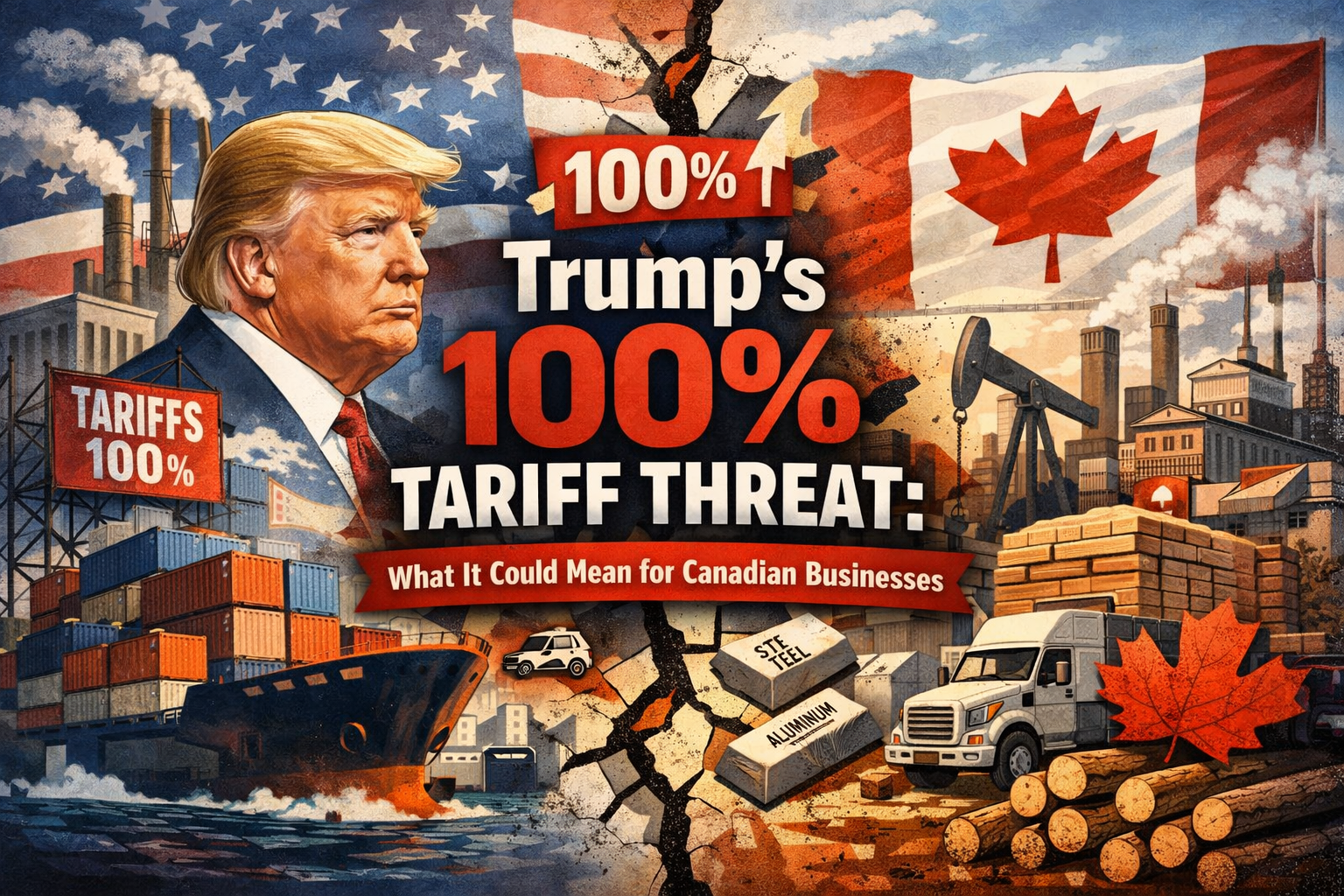

Former U.S. President Donald Trump has once again put trade tensions front and centre, this time by threatening a 100% tariff on Canadian goods and referring to Canada’s prime minister, Mark Carney, as a “governor.”
While the rhetoric is political, the economic implications are very real — especially for Canadian businesses that rely on the U.S. market.
This article breaks down what’s happening, why it matters, and how Canadian businesses should think about risk and opportunity going forward.
GROW YOUR BUSINESS WITH GRANTS & LOANS

Learn about the funding available for your small business. It just takes a second!

What Happened?
Trump publicly warned that the United States could impose a 100% tariff on Canadian exports if Canada moves forward with closer trade cooperation with China, particularly around:
- Electric vehicles
- Agriculture
- Industrial supply chains
A 100% tariff means U.S. buyers would effectively pay double for Canadian goods entering the U.S. market — a move that would immediately make many Canadian products uncompetitive.
Calling the Canadian prime minister a “governor” was a political jab, but the tariff threat itself signals a familiar pattern:
Trade policy being used as leverage.
Why This Matters to Canadian Businesses
Canada and the U.S. share one of the most integrated trade relationships in the world.
- Roughly 75% of Canadian exports go to the United States
- Even temporary trade disruptions can ripple through the economy quickly
Below is how this threat could affect key Canadian business sectors.
Sector-by-Sector Impact Breakdown
Manufacturing & Industrial Businesses
Risk level: HIGH
Canadian manufacturers — especially in auto parts, steel, aluminum, machinery, and fabricated goods — are deeply embedded in U.S. supply chains.
- A 100% tariff would make Canadian components far more expensive
- U.S. buyers could shift sourcing to domestic or alternative suppliers
- Canadian plants may face reduced orders, layoffs, or delayed expansion
Key takeaway: Businesses with a single-market export strategy are the most exposed.
Agriculture & Food Producers
Risk level: HIGH
Canadian farmers and food exporters operate on thin margins.
- Products like canola, beef, pork, grains, seafood, and processed foods are highly price-sensitive
- Tariffs reduce U.S. demand almost immediately
- Excess supply often pushes prices down domestically
Key takeaway: Tariffs don’t just hurt exports — they compress margins across the entire sector.
Small & Medium-Sized Enterprises (SMEs)
Risk level: MEDIUM to HIGH
Even if your business doesn’t export directly, you may still be affected.
- SMEs often supply parts, materials, or services to exporters
- Reduced export volume means fewer upstream orders
- Smaller firms have less financial buffer to absorb shocks
Key takeaway: Trade disruptions travel up the supply chain, not just at the border.
Logistics, Warehousing & Transportation
Risk level: MEDIUM
Cross-border trucking, freight, and logistics firms depend on consistent trade flows.
- Tariffs reduce shipment volume
- Contract renegotiations become common
- Uncertainty slows long-term investment
Key takeaway: Trade friction equals volume volatility.
Technology & Clean Energy Businesses
Risk level: MIXED
Some Canadian tech and clean-energy companies may face short-term risk, but also long-term opportunity.
- U.S. tariffs increase political pressure for Canada to diversify trade
- Government support for non-U.S. markets may expand
- Firms positioned for Europe or Asia could benefit
Key takeaway: Diversification rewards forward-thinking companies.
What This Means for Business Strategy in Canada
Whether or not this specific tariff threat materializes, the lesson is clear:
Over-reliance on a single export market is a business risk.
Canadian businesses should consider:
- Market diversification (EU, UK, Asia-Pacific)
- Domestic sales growth to balance export exposure
- Flexible supply chains that can adapt to policy shifts
- Scenario planning for tariffs, delays, or border friction
Trade policy is no longer just a government issue — it’s a core business planning variable.
What About Canadian Consumers?
Tariffs don’t stop at exporters.
- Higher costs can flow back into Canada
- Cross-border components raise production costs
- Consumers may face higher prices or fewer product options
In trade wars, nobody escapes untouched.
The Bigger Picture
This situation highlights a broader shift:
- Trade relationships are becoming more political
- Economic leverage is being used more aggressively
- Canadian businesses must plan for uncertainty, not stability
The smartest companies will treat this not as a crisis — but as a signal.
Bottom Line
- A 100% tariff would significantly disrupt Canadian exports
- Manufacturing, agriculture, and SMEs face the highest risk
- Diversification and flexibility are now competitive advantages
- Trade policy volatility is here to stay
Canadian businesses that adapt early will be far more resilient than those waiting for certainty that may never come.